AI cost-efficiency pressure on Anthropic
TECH

AI cost-efficiency pressure on Anthropic

26+
Signals

Strategic Overview

  • 01.
    Palantir CEO Alex Karp publicly attacked OpenAI's and Anthropic's token-based pricing in an early-July 2026 CNBC 'Squawk Box' interview, saying the model leaves enterprises with no value while handing their IP to AI labs.
  • 02.
    SpaceXAI released Grok 4.5 on July 8, 2026, pitched as an 'Opus-class' model priced at $2 per million input and $6 per million output tokens, dramatically undercutting Anthropic and OpenAI.
  • 03.
    Microsoft is reportedly shifting tens of thousands of Excel and Outlook prompts to its own MAI models to reduce - and ultimately eliminate - what it pays Anthropic.
  • 04.
    Meta warned staff that internal AI usage is on track to cost billions in 2026 and capped token spending after employees consumed 73.7 trillion tokens in roughly 30 days.

Deep Analysis

Karp's Real Attack Isn't Price - It's Ownership

The headline is that Palantir's Alex Karp called token pricing broken on live television, but the sharper claim underneath is about who ends up owning the value. Karp's argument is a three-way extraction: the AI labs charge you for every token, they learn from the proprietary data and workflows you feed them, and over time they commoditize the very competitive advantage you were trying to build [1]. In his framing, an enterprise pays to hand its 'alpha' to a vendor - 'I'm going to get no value and they're going to get my IP' [1].

That reframing is why he ties his critique to a build-your-own alternative: what enterprises want, he argues, is 'control over their compute, their models, their data stack and their alpha... they own the means of production' rather than transferring it to someone else [1]. It is a convenient pitch for a company that sells enterprise data platforms and has aligned with Nvidia on custom models, but it lands because it names an anxiety CFOs and CTOs already feel: consumption pricing turns your own usage growth into an open-ended liability, and the more valuable the workflow, the more you pay to keep renting it.
The Bills That Made This a Boardroom Problem

The Bills That Made This a Boardroom Problem
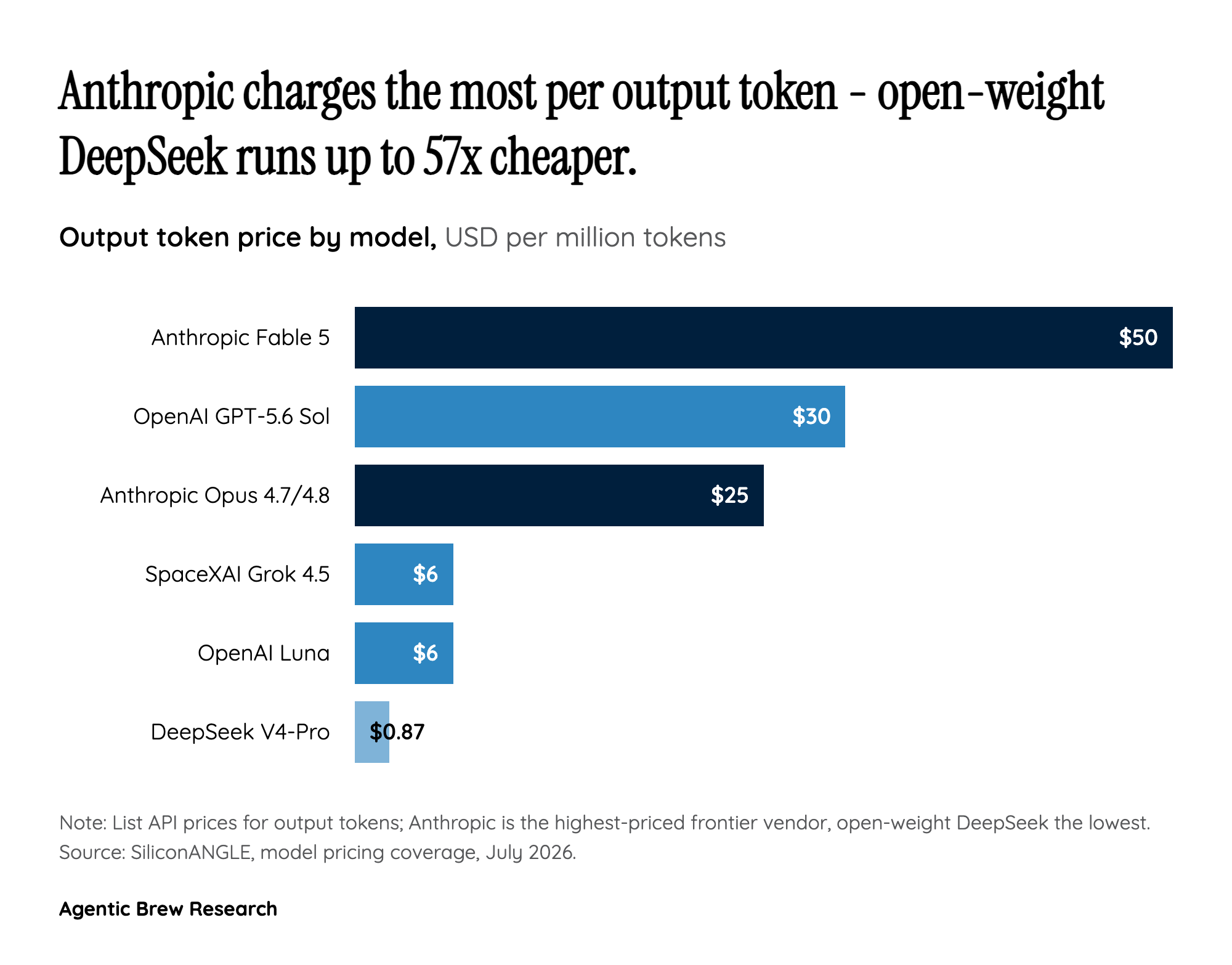
Output token price by model - Anthropic's Fable 5 and Opus are the priciest frontier options, while open-weight DeepSeek costs a fraction.

Cost efficiency became a buying criterion because the numbers got genuinely alarming. Meta warned employees that internal AI usage is tracking toward billions of dollars in 2026 and moved to cap spending after staff burned through 73.7 trillion tokens in roughly 30 days [2]. Uber reportedly exhausted its entire 2026 AI coding budget in four months and capped per-tool employee spend at $1,500 a month [2], and one enterprise client was cited as spending around $500 million in a single month after failing to set usage limits [3].

Against that backdrop the price gaps are stark. Anthropic's Opus 4.7/4.8 runs $5 per million input and $25 per million output, with Fable 5 at $10/$50, versus Grok 4.5 at $2/$6, OpenAI's cheap Luna tier at $1/$6, and DeepSeek V4-Pro near $0.435/$0.87 [4][5]. When Amazon CTO Werner Vogels says most workloads don't need 'the biggest, highest-end model' [3], he is describing the arithmetic every finance team is now running: for a large share of tasks, a model that is 'good enough' at a tenth of the cost wins.

The 5% Time-Bomb Under Frontier Valuations

The quieter risk is structural. Roughly 95% of enterprise AI usage still runs on the most expensive frontier models, with only about 5% routed to cheaper ones [6]- which means the premium-pricing revenue that underwrites frontier valuations depends on that split holding. Model routing, sending easy prompts to cheap models and reserving frontier models for hard ones, is the mechanism that erodes it, and it emerged this summer as a named structural problem for OpenAI and Anthropic [6].

Microsoft's move to shift tens of thousands of Excel and Outlook prompts to its in-house MAI models is exactly this playbook at scale, with the explicit goal to 'reduce and ultimately eliminate' its Anthropic cost [5]. If routing and in-house substitution climb from 5% toward the norm, the demand-at-premium-prices assumption baked into these companies' valuations weakens - not because the models got worse, but because buyers finally learned to stop paying frontier rates for commodity work.

The Contrarian Read: Karp Is Talking His Own Book

The community reaction captures a tension worth holding onto. On Reddit, the diagnosis - token pricing is expensive and its ROI is murky - drew broad agreement, but Karp's motives drew open skepticism, with the sharpest version being that a guy who benefits if open-weight models win is, unsurprisingly, predicting open-weight models will win. A recurring counterpoint defended Anthropic's economics specifically, arguing it clearly knows how to make money and can afford to keep shipping frontier models. That self-interest caveat is the load-bearing nuance: the trend is real, but its loudest messenger has a platform to sell.

There is also a durability argument the cost-panic narrative understates. Coverage of the cheap-AI threat notes that American labs still retain the regulated, high-trust workloads - banks, the power grid, defense, healthcare - that will not touch Chinese open-weight models on compliance and security grounds. And practitioners report the substitution isn't purely about price: enterprises dislike variable, unpredictable token bills and often prefer fixed-cost deals even when nominally more expensive, suggesting Anthropic's pressure is as much about pricing structure as pricing level.

Historical Context

2026-04-17
Commentary emerged that AI demand was inflated and that Anthropic was among the more realistic labs about token economics, presaging the efficiency turn.
2026-06-05
Model routing - sending easy tasks to cheaper models - emerged as a fix for overspending and a structural risk to premium-priced frontier labs.
2026-06-26
Enterprises visibly shifted from 'tokenmaxxing' to efficiency, forcing labs to cut costs and boost throughput.
2026-07-08
Grok 4.5 launched, dramatically undercutting Anthropic and OpenAI on price and intensifying the pricing war.

Power Map

Key Players
Subject

AI cost-efficiency pressure on Anthropic

AN

Anthropic

The most exposed frontier vendor: its Opus 4.7/4.8 ($5/$25 per million) and Fable 5 ($10/$50) pricing make it the most expensive option and the primary substitution target for cost-conscious enterprises.

AL

Alex Karp (Palantir CEO)

Chief public critic of token pricing; reframes the debate around data ownership and aligns Palantir with Nvidia on custom, enterprise-owned models as the alternative to token-metered labs.

SP

SpaceXAI / Elon Musk

Cost disruptor whose Grok 4.5 claims Opus-class performance with twice the token efficiency at a fraction of Anthropic's price, intensifying the pricing war.

MI

Microsoft (Mustafa Suleyman)

Enterprise buyer defecting; routing Copilot and Office prompts to in-house MAI models to cut Anthropic costs, a signal that even close partners are seeking alternatives.

DE

DeepSeek / Chinese open-weight labs

Cheap open-weight substitute pulling enterprise traffic (e.g., Lindy moved fully to DeepSeek), with V4-Pro priced near $0.435/$0.87 per million tokens.

Fact Check

6 cited
  1. [1] Palantir's Karp bashes OpenAI and Anthropic over tokens
  2. [2] Meta caps internal AI token spending as costs approach billions
  3. [3] Amazon CTO: companies shifting toward cheaper open-source AI models
  4. [4] SpaceXAI's Grok 4.5 dramatically undercuts Anthropic, OpenAI on price
  5. [5] Microsoft reportedly ditching OpenAI's, Anthropic's models to cut costs
  6. [6] Model routing is a problem for OpenAI and Anthropic

Source Articles

Top 3

THE SIGNAL.

Analysts

"Token pricing has been oversold to enterprises who get no value while surrendering their IP; companies should own their compute, models, and data rather than transfer them to AI labs."

Alex Karp
CEO, Palantir

"Grok 4.5 is 'an Opus-class model, but faster, more token-efficient and lower cost' - and that combination is what makes it competitive."

Elon Musk
Founder, SpaceXAI

"Cost must be a first-class architectural decision; most workloads do not need the biggest model. 'Do you really need to have the biggest, highest-end model to solve this? The answer is no, you don't.'"

Werner Vogels
CTO, Amazon

"'Anthropic is extremely expensive and I think many people are urgently looking for alternatives' - the rationale for routing work to Microsoft's own models."

Mustafa Suleyman
CEO, Microsoft AI

"'All motion is not progress and token usage alone is not a measure of impact' - employees should not run AI tools for their own sake."

Andrew Bosworth
CTO, Meta
The Crowd

"Palantir CEO Alex Karp on what customers actually want, the real business of frontier labs, and the importance of open source models: “What the technical customers want is control over their compute, their models, their data stack, and their alpha. They want to know they own the"

@@PalantirTech5700

"So basically Alex Karp’s argument is that frontier AI labs profit three times: (1) they charge you for tokens, (2) they get access to your IP and business know-how, and (3) they eventually commoditize your competitive advantage. Instead, he says enterprises should pay Palantir to"

@@ruima3626

"Palantir CEO Alex Karp says enterprises want to "own the means of production" instead of "transferring their alpha" to OpenAI or Anthropic: "Why are [LLMs] charging for tokens if it's so valuable?" "If it was so valuable—let's say I can make you a billion dollars tomorrow."

@@jawwwn_1589

""Something has gone completely wrong": Palantir CEO Alex Karp rants on live television about his problems with the AI business model: "Why are they charging for tokens if it's so valuable?""

@u/ControlCAD2800
Broadcast
Palantir CEO Alex Karp says 'something has gone completely wrong' with how AI is sold

Palantir CEO Alex Karp says 'something has gone completely wrong' with how AI is sold

How Cheap AI Could Derail OpenAI And Anthropic's IPOs

How Cheap AI Could Derail OpenAI And Anthropic's IPOs

Palantir CEO Bashes OpenAI and Anthropic AI Over Token Cost - AI Bubble is Bad Business

Palantir CEO Bashes OpenAI and Anthropic AI Over Token Cost - AI Bubble is Bad Business