TSMC B US Semiconductor Investment and AI Chip Profit Surge
TECH

TSMC B US Semiconductor Investment and AI Chip Profit Surge

34+
Signals

Strategic Overview

  • 01.
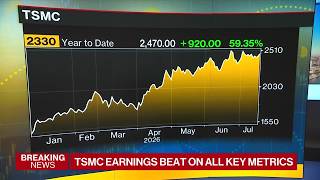
    TSMC reported Q2 2026 net profit of NT$706.56 billion (~$22 billion USD), up 77.4% year-over-year - a record for the fifth consecutive quarter, beating analyst forecasts of NT$632.6 billion.
  • 02.
    High-Performance Computing (the AI chip category) generated 66% of Q2 2026 wafer revenue, growing 20% sequentially in a single quarter, making AI the undisputed engine of TSMC's record results.
  • 03.
    TSMC announced an additional $100 billion US investment on July 16, 2026, bringing its total US commitment to $265 billion and planning at least four more advanced fabs in Arizona - but CEO CC Wei gave no timeline, tying the pace to market situation and customer demand.
  • 04.
    TSMC raised its 2026 capex guidance to $60-64 billion (up from $52-56 billion) and its full-year revenue growth forecast to slightly above 40% in USD terms, with Q3 2026 revenue guided at $44.6-$45.8 billion versus $33.1 billion in Q3 2025.

Deep Analysis

The AI Profit Engine

The 77% profit surge is not a rounding error or accounting trick - it is the direct output of AI infrastructure spending hitting TSMC's order books at scale. High-Performance Computing, the category that encompasses AI chips for Nvidia, AMD, and the hyperscalers, accounted for 66% of TSMC's Q2 2026 wafer revenue and grew 20% in a single quarter [1]. That sequential jump is the number that matters: it means AI chip demand is not just large, it is accelerating within an already record quarter.

The margin story is equally striking. TSMC posted a gross margin of 67.7% and an operating margin of 60.3%, both beating its own guidance range [1]. Advanced nodes - 7nm and below - represented 77% of wafer revenue, with 5nm alone at 33% and the newly ramping 2nm already contributing 3% [1]. The 2nm ramp is significant because it marks the first time TSMC has commercialized its most advanced process node within a cycle still dominated by the previous generation. One notable footnote: a NT$63.2 billion (~$1.97 billion) one-time gain from the sale of Vanguard International Semiconductor shares boosted the net profit figure, so the headline 77% overstates the purely operational gain somewhat - though even stripping that out, the underlying business performance was exceptional [1].

$265 Billion in Headlines, Four Fabs Without a Timeline

The $265 billion figure deserves scrutiny. It is the sum of three separate announcement events: an initial $65 billion commitment, a $100 billion pledge in March 2025, and now another $100 billion in July 2026 [2]. Each announcement followed a White House event with President Trump and Commerce Secretary Lutnick. Each lacked a binding construction schedule. When asked directly about timelines for the four new fabs, CEO CC Wei said the pace depends on market situation and customer demand and that TSMC would try to speed it up as fast as possible [3]. That is not a construction plan - it is an aspiration.

Industry analysts and tech media have called the July 2026 announcement primarily political: claiming a headline for something that may or may not happen on a timescale that has not been announced [3]. The practical reality is that TSMC's Arizona campus currently operates at 10,000 wafers per month with one fab producing at 4nm [2]. The 12-facility vision projected for the full $265 billion deployment is a best-case multi-decade buildout, not a committed delivery schedule. TSMC's most advanced processes - the cutting edge that makes it irreplaceable - also remain anchored in Taiwan by design, meaning even a fully built Arizona campus will lag Taiwan's technology frontier by several generations.

TSMC's Geopolitical Hedge

TSMC is running a dual-track geopolitical strategy that is more sophisticated than either the US government's triumphalist framing or Taiwan's reassurances suggest. On the US side: $6.6 billion in CHIPS Act subsidies, a formal US-Taiwan Trade and Investment deal signed in January 2026 providing diplomatic cover, and the Trump administration's tariff pressure all make US expansion financially and politically necessary to preserve market access [4][5]. Taiwan's government, meanwhile, has publicly endorsed the Arizona investment as a product of bilateral partnership - framing it as strategic cooperation rather than a drain on Taiwan's technological crown jewels.

The hedge works because TSMC deliberately keeps each geography at different technology levels. Arizona gets advanced nodes - eventually 2nm - but Taiwan retains the frontier. This means TSMC remains indispensable to Taiwan's security equation while satisfying enough US domestic production requirements to avoid punitive trade policy. The partnership with Amkor Technology for advanced packaging in Arizona adds another layer: it signals TSMC is building a genuine US supply chain segment, not just wafer fabrication [5]. Taiwan President Lai Ching-te's endorsement signals Taipei calculated that the US investment strengthens rather than undermines the alliance - the chips flowing to American customers deepen interdependence on both sides.

The Capex Cliff and the Bull-Bear Divide

TSMC raised its 2026 capex guidance from $52-56 billion to $60-64 billion - a $8 billion increase in a single quarter [6]. That is the largest absolute capex raise in the company's history. The bull case is straightforward: if AI chip demand stays at its current trajectory, today's $64 billion in factories becomes tomorrow's $90 billion in annual revenue. The Q3 2026 revenue guide of $44.6-$45.8 billion versus $33.1 billion in Q3 2025 supports that math [7].

The bear case is subtler and worth taking seriously. Sophisticated semiconductor investors flagged the depreciation cliff: massive capex spending from 2024-2026 will begin flowing through the income statement as depreciation charges starting around 2027-2028, compressing margins even if revenue stays strong. CEO Wei himself acknowledged that aggregating all customer demand forecasts would overstate actual market demand [7]. Apple's diversification to Intel and Samsung creates another demand-side risk for Arizona utilization specifically. And the pattern of stock drops on record earnings reflects a market that has already priced in perfection and is now discounting execution risk on the $265 billion commitment. The $1.97 trillion market cap - nearly double Samsung's - embeds an assumption that AI demand remains at current velocity through the end of the decade.

Historical Context

2020-05-01
TSMC announced its first US fabrication plant in Arizona with an initial $12 billion investment commitment, beginning its US domestic expansion.
2022-12-01
TSMC announced a second Arizona fab and expanded total US investment to approximately $40 billion - at the time the largest foreign direct investment in Arizona history.
2024-04-01
TSMC added a third Arizona fab, expanded US investment to $65 billion, and received $6.6 billion in CHIPS Act government funding from the Department of Commerce.
2025-01-01
TSMC's Arizona Fab 21 began N4 (4nm) volume production with more than 3,000 employees on site, marking the first meaningful output from the Arizona investment.
2025-03-01
TSMC announced a second $100 billion US investment tranche (bringing the total to $165 billion) alongside President Trump and Commerce Secretary Lutnick.
2026-01-01
A historic US-Taiwan Trade and Investment deal was signed, providing the formal diplomatic and trade framework that enabled TSMC's subsequent $100 billion expansion announcement.
2026-07-16
TSMC simultaneously announced a third $100 billion US investment tranche (total $265 billion, targeting 12 Arizona facilities) and Q2 2026 earnings showing 77.4% profit growth to a record $22 billion, driven by AI chip demand.

Power Map

Key Players
Subject

TSMC B US Semiconductor Investment and AI Chip Profit Surge

TS

TSMC (Taiwan Semiconductor Manufacturing Company)

World's largest chipmaker and primary investor; pledging $265 billion in total US expansion while simultaneously maintaining Taiwan as the home of its most advanced processes; manufacturer of 2nm and below chips for Apple, Nvidia, AMD, and major cloud providers.

TR

Trump Administration / US Department of Commerce

Government partner securing and publicly announcing the TSMC investment; provided $6.6 billion in CHIPS Act subsidies; framing the $265 billion commitment as a landmark manufacturing and jobs achievement under Commerce Secretary Howard Lutnick.

CL

Cloud Service Providers and AI Hyperscalers

TSMC's primary demand drivers providing very strong signals and positive outlooks that justify the multi-year investment; the category drove 66% of Q2 2026 revenue and 20% sequential growth, making them the core reason TSMC's profits are at record highs.

AP

Apple

Key TSMC customer with Arizona fabs already producing A16 processors; however, Apple is actively diversifying chip supply to Intel and Samsung, creating a real utilization risk for TSMC's expanded Arizona capacity.

TA

Taiwan Government

Geopolitical endorser of the Arizona expansion; Taiwan President Lai Ching-te supported TSMC's US investment as a product of the US-Taiwan industrial partnership formalized in January 2026, framing it as bilateral rather than a strategic concession.

AM

Amkor Technology

Advanced packaging partner collaborating with TSMC in Arizona; combining front-end fabrication with advanced packaging and test services to build a US-based end-to-end semiconductor supply chain.

Fact Check

7 cited
  1. [1] TSMC Q2 Profit 77% Record High - TradingKey
  2. [2] TSMC Arizona Fab - Project Profile, Cost, Expansion, Latest Update - BlackRidge Research
  3. [3] TSMC says it may build 12 Arizona chip plants in total - but be skeptical - 9to5Mac
  4. [4] Trump Administration Secures Additional $100 Billion in US Semiconductor Investment - NIST
  5. [5] TSMC $100B US Investment Confirmed - CryptoBriefing
  6. [6] TSMC Pledges Another $100 Billion to Expand US Chipmaking Capacity - BNN Bloomberg
  7. [7] TSMC to Invest Another $100 Billion in the US - Yahoo Finance

Source Articles

Top 5

THE SIGNAL.

Analysts

"Strongly bullish on AI demand through 2029-2030, describing cloud service providers as giving very strong signals and positive outlooks. Committed to speeding up Arizona construction while acknowledging the pace depends on market conditions. Notably warned that aggregating all customer forecasts would overstate actual demand."

C.C. Wei
Chairman and CEO, TSMC

"Views TSMC's expanded US investment as essential to support its long-term growth trajectory and meet accelerating AI chip demand, describing it as necessary to keep up with demand."

William Li
Senior Analyst, Counterpoint Research

"Frames the $265 billion total commitment as validation of the Trump administration's manufacturing-first industrial policy, calling it a major job-creation milestone driven by presidential leadership."

Howard Lutnick
US Commerce Secretary

"Characterize the July 2026 announcement as primarily political - a headline without a delivery schedule. Note that TSMC's most advanced processes remain restricted to Taiwan, the investment is conditional on market conditions, and the $265 billion total may never materialize on any concrete timeline."

Industry Skeptics / 9to5Mac Analysis
Tech media and independent analysts
The Crowd

"Taiwan Semiconductor Manufacturing Co. (#TSMC), the world's largest contract chipmaker, announced an additional $100 billion investment in Arizona and raised its capital expenditure guidance, underscoring its confidence that artificial intelligence-driven demand will remain"

@@ETMarkets4

"Taiwan Semiconductor Manufacturing Co (TSMC) will invest an additional US$100 billion in Arizona after reporting record second quarter earnings that comfortably beat market expectations, underscoring continued strong demand for artificial intelligence chips."

@@BusinessTodayM11

"TSMC, the world's main producer of advanced AI chips and a major supplier to Nvidia, pledged today to invest a further $100 billion in the US state of Arizona and said it was still seeing robust AI-driven demand for chips."

@@RTEbusiness0

"Taiwan computer chipmaker TSMC pledges another $100 billion to expand US chipmaking capacity"

@u/Presently_Naked878
Broadcast
TSMC's New Arizona Fab! Apple Will Finally Make Advanced Chips In The U.S.

TSMC's New Arizona Fab! Apple Will Finally Make Advanced Chips In The U.S.

TSMC: The Hidden Giant of the Global Microchip Industry | Chip War | China vs USA | FD Finance

TSMC: The Hidden Giant of the Global Microchip Industry | Chip War | China vs USA | FD Finance

TSMC Beats Estimates Amid Sustained AI Demand

TSMC Beats Estimates Amid Sustained AI Demand