South Korea AI/chip mega-investment
TECH

South Korea AI/chip mega-investment

24+
Signals

Strategic Overview

  • 01.
    South Korea is steering at least 1,350 trillion won (about $880 billion) from Samsung Electronics and SK Hynix into chips and AI data centers, with combined long-term plans potentially reaching 2,000 trillion won (about $1.3 trillion) over the next decade.
  • 02.
    Samsung and SK Hynix will build four new chipmaking plants (two each) in the southwest at a combined cost of about 800 trillion won ($518 billion), centered on HBM and DRAM for AI hardware.
  • 03.
    The plan, unveiled at the Blue House on June 29, 2026 as the 'National Briefing on Three Mega Projects for the Republic of Korea Great Leap,' targets a doubling of DRAM production within five years and 18.4 GW of AI data-center capacity by 2035.
  • 04.
    Despite the confident headline numbers, the KOSPI fell over 2% intraday with Samsung down about 5% and SK Hynix about 3%, while U.S. chip stocks gained.

Deep Analysis

Korea Is Buying the Layer Every AI Model Depends On

The most striking thing about this plan is what it does not include: a homegrown frontier model to rival GPT or Gemini. Instead, South Korea is doubling down on the part of the AI stack it already dominates - memory. The headline commitment is at least 1,350 trillion won, about $880 billion, from Samsung and SK Hynix, with combined long-term plans that could reach roughly $1.3 trillion over a decade [1]. Insiders summarized the logic bluntly as 'country strategy, not company strategy.'

The reason memory matters so much is technical. Modern AI accelerators are bottlenecked less by raw compute than by how fast they can feed data to the processor, and that job falls to high-bandwidth memory (HBM) - stacks of DRAM chips wired directly alongside the GPU. Samsung and SK Hynix together supply most of the world's HBM, with SK Hynix the leading supplier to the dominant accelerator makers. Bloomberg framed this commanding HBM position as the core reason scaling capacity sits at the center of the global push for more powerful AI [2]. By financing four new fabs at about $518 billion [3]and aiming to double DRAM output within five years, Korea is effectively trying to own a chokepoint rather than compete in the crowded, capital-bleeding race to build the models themselves.
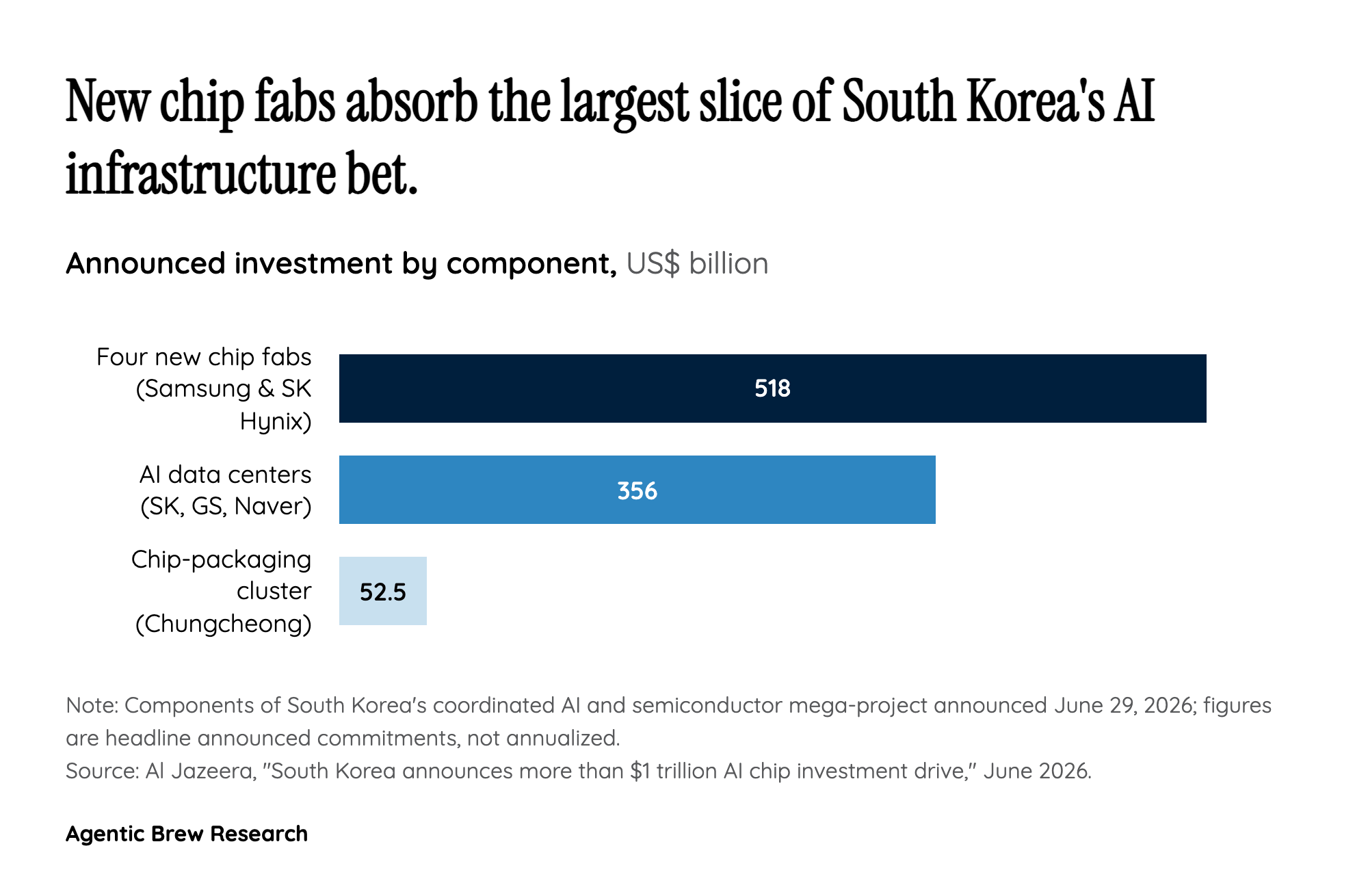

Follow the Money: Inside the $880B-to-$1.3T Stack

Follow the Money: Inside the $880B-to-$1.3T Stack
New chip fabs absorb the largest slice of South Korea's AI infrastructure bet (US$ billion).

Strip away the round numbers and the plan is a layered set of commitments. At the corporate level, Samsung Group pledged about 2,655 trillion won in domestic investment and SK Hynix roughly 1,100 trillion won [4]. The flagship manufacturing piece is four chipmaking plants in the southwest at about 800 trillion won, or $518 billion [3]. On top of that sits a 550 trillion won ($356 billion) AI data-center buildout from SK Group, GS Group, and Naver, targeting 18.4 GW of capacity by 2035, plus an 81 trillion won ($52.5 billion) chip-packaging cluster in the Chungcheong region [3].

JPMorgan put the most aggressive frame on it, calling the initiative the start of a 'Mega Investment Era' and tallying total long-term spending at about 4,755 trillion won - roughly $3.1 trillion - with 60 to 70% of it flowing into front-end wafer equipment [5]. The bank's most consequential observation is about speed: adding roughly a million additional units of DRAM capacity will happen multiple times faster than in any prior cycle [5]. That pace is the whole bet - and also the whole risk.

Why the Market Punished Confidence

Here is the paradox that dominated community reaction: a government and its two champions announced the largest industrial investment in the country's history, and the stocks fell. The KOSPI dropped over 2% intraday, Samsung slid about 5% and SK Hynix about 3%, even as U.S. chip and memory names rose on the same news [6]. Part of the pressure was mechanical - an estimated $30 billion of passive selling tied to U.S. pension rebalancing hit at the same time [6].

But the deeper reason is how investors read capital expenditure. On Reddit, the most-upvoted explanation cut through the noise: the expected spending was already priced in, and 'even more' spending reads bearish in the short term because heavy capex depresses near-term earnings through depreciation and raises the risk of debt or dilution. The benefit shows up years later, when the fabs actually produce. So the market's logic was not 'this is a bad plan' but 'this is a long-dated plan, and we pay for it now.' That gap between national-strategy timelines and quarterly-earnings timelines is the tension the whole story turns on.

Bubble or Backlog: The Contrarian Read

Not everyone thinks doubling memory capacity into a roaring AI cycle is wise. The skeptical case, voiced most sharply by author and analyst Michael Fritzell, is that the Korea and Taiwan memory rally has entered dangerous bubble territory built on unsustainable profit estimates - the classic setup for a chip-cycle top. The memory-glut worry is concrete: if demand softens just as a wave of new capacity comes online, prices crater, exactly the cyclicality that has burned memory investors before.

The other side of the debate is just as grounded. The most-upvoted counterargument in the community is that supply simply cannot meet AI demand 'well into 2030,' and that fabs take two to four years to build - so today's spending is a backlog response, not speculative overbuilding. A separate expert thread, framed by AI strategist Sung Soo Eric Kim, reframes the whole rivalry as cooperation: Korea's memory strength and Taiwan's foundry lead are complementary chokepoints, with HBM shortages and the 2nm process as the binding constraints rather than a winner-take-all fight. The honest read is that the plan is a directional bet on demand durability - JPMorgan's pulled-forward fab timelines, from the 2040s to the mid-2030s [5], only pay off if the AI buildout keeps absorbing memory faster than Korea can pour it.

Historical Context

2026-06-28
Bloomberg first reported that Samsung and SK would spend roughly $880 billion over ten years to drive Korea's AI lead, ahead of the formal announcement.
2026-06-29
President Lee unveiled the 'Three Mega Projects for the Republic of Korea Great Leap' national briefing, attended by Samsung's Lee Jae-yong and SK's Chey Tae-won.

Power Map

Key Players
Subject

South Korea AI/chip mega-investment

SA

Samsung Electronics / Samsung Group

Anchor chipmaker; Chairman Lee Jae-yong committed Samsung Group to about 2,655 trillion won in domestic investment, including roughly 800 trillion won ($518B) for new fab sites and 300 trillion won for southwestern fabs. Its scale sets the pace for the entire national plan.

SK

SK Hynix / SK Group

Co-anchor and world HBM leader; Chairman Chey Tae-won pledged 1,100 trillion won to expand semiconductor supply, with SK Group also a major AI data-center investor. As the leading HBM supplier to AI accelerator makers, its capacity decisions ripple through the global AI hardware chain.

PR

President Lee Jae Myung

Head of state driving the plan as a national survival strategy; presided over the Blue House briefing and framed speed in securing AI infrastructure as the only way to compete in the AI race.

NA

Naver, GS Group and SK Group

Data-center investors contributing to a 550 trillion won ($356 billion) AI data-center buildout, supplying the domestic compute capacity the chip plan is meant to feed.

Fact Check

6 cited
  1. [1] Samsung, SK Hynix to Invest $880B in Chips and Data Centers
  2. [2] Samsung, SK Reportedly to Invest $1.3 Trillion Over 10 Years
  3. [3] South Korea announces more than $1 trillion AI chip investment drive
  4. [4] Samsung Announced 2,655 Trillion Won Investment Plan, Largest Investment in South Korea AI Semiconductor Strategy History
  5. [5] Entering The 'Mega Investment Era': JPM Breaks Down South Korea's Plan To Double Memory Chip Capacity
  6. [6] Samsung, SK Hynix, Micron, Apple: Market Reaction to South Korea's Chip Mega-Investment

Source Articles

Top 5

THE SIGNAL.

Analysts

"Characterized the initiative as the start of a 'Mega Investment Era,' with memory capacity doubling within five years and the advanced Yongin fab ramp pulled forward by 7 to 12 years."

Jay Kwon
Analyst, JPMorgan

"The pace of adding roughly 1 million additional units of DRAM capacity will be multiple times faster than in the past, with total long-term investment of about 4,755 trillion won (US$3.1 trillion) skewed 60-70% toward front-end wafer equipment."

JPMorgan
Investment bank, research team
The Crowd

"Samsung and SK Hynix will build two chip plants each in a $518 billion plan aimed at cementing South Korea's status as a global AI powerhouse. Follow our live blog for the latest ⤵️"

@@business206

"South Korean firms including Samsung and SK Hynix will spend at least 1,350 trillion won ($880 billion) on chips and data centers as the country seeks to maintain its edge in the AI era: Here is your Evening Briefing."

@@business158

"JUST IN: 🇰🇷 South Korea unveils $518 billion plan to expand AI memory chip production, with Samsung and SK Hynix set to build four new fabrication plants. The investment aims to strengthen the country's leadership in AI chips, boost memory production, and create a second major"

@@CryptoTweets129

"Samsung, SK Hynix shares fall as investors brace for reported $1.3 trillion spending plans"

@u/joe4942546
Broadcast
Can Samsung Overtake TSMC? Taiwan vs. South Korea AI Chip Rivalry Explained | CONNECTED Chip Island

Can Samsung Overtake TSMC? Taiwan vs. South Korea AI Chip Rivalry Explained | CONNECTED Chip Island

The AI Chip Bubble: Why South Korea & Taiwan Are In the Danger Zone

The AI Chip Bubble: Why South Korea & Taiwan Are In the Danger Zone

South Korea's chip workers enjoy hot demand - in jobs and marriage

South Korea's chip workers enjoy hot demand - in jobs and marriage