Alibaba $10.2B Share Sale to Fund AI Expansion
TECH

Alibaba $10.2B Share Sale to Fund AI Expansion

31+
Signals

Strategic Overview

  • 01.
    Alibaba raised HK$80 billion (US$10.2 billion) by placing 710 million new ordinary shares at HK$112.70 each, an 8.4% discount to the prior close, to fund its AI expansion.
  • 02.
    The placement is the largest primary follow-on offering ever undertaken by a Hong Kong-listed company, and the world's third-largest primary follow-on share sale of 2026, trailing only offerings from Alphabet and Intel.
  • 03.
    Alibaba said 100% of the net proceeds will go toward full-stack AI capabilities, including chips, computing infrastructure, and the development and deployment of AI models such as its Qwen family.
  • 04.
    The dilutive announcement, Alibaba's first share placement since its 2019 Hong Kong listing, sent its stock down as much as 10.5% intraday - closing roughly 8.5% lower, its worst one-day drop since early 2025 and about 37% below its October 2025 all-time high.

Deep Analysis

From Buybacks to a Record Dilution: Why Alibaba Chose Equity Over Debt

Just months after running share buybacks, Alibaba reversed course and priced its first share placement since its 2019 Hong Kong listing [1]- raising HK$80 billion (US$10.2 billion) by selling 710 million new shares at an 8.4% discount, the largest primary follow-on offering in Hong Kong's history [2]. The dilution wasn't optional theater: capital spending jumped 75% to RMB67.68 billion in the same quarter that net income collapsed 76% to RMB10.54 billion [3], and free cash flow swung to roughly a RMB45 billion outflow [4]. That combination - a company returning cash to shareholders one year and asking them to absorb dilution the next - is what drew scrutiny from Alibaba investors online, who debated why the company didn't instead tap comparatively cheap onshore Chinese debt rather than sell equity at a steep discount.

The Oversubscription Signal: What $28 Billion in Orders Actually Means

Despite the sharp price plunge, the deal was covered nearly three times over: institutional investors placed roughly $28 billion in orders against the $10.2 billion offering, with about 40% of the allocation going to sovereign wealth funds and long-only investors under lockup [5]. Existing shareholders absorbed about 3.6% dilution to their enlarged share count [5]and sold into the discounted price, driving the headline drop, but the buyers on the other side of that trade were making a very different bet than the sellers. That split - retail-adjacent selling pressure against a deeply oversubscribed institutional order book - is what shareholder forums pointed to when arguing the 8.4% discount was a floor, not a fair-value signal: if the offer had actually been priced to clear the market, it wouldn't have needed three times the demand to do so.

Burry vs the Market: A Bearish Bet Against Alibaba's AI Paradigm

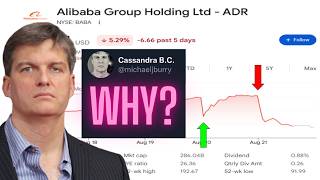
The loudest skeptic is Michael Burry, the investor known for shorting the 2008 housing bubble, who exited his Alibaba stake for JD.com and said flatly that repeated equity issuance is now the company's operating pattern rather than a one-off: "I will not flip any of that back to #Alibaba, as issuing shares is now its new paradigm." [6]He's said he wouldn't consider buying back in until the stock falls roughly another 50% [6], and financial media noted his rotation into JD.com followed directly on the placement announcement [7]. Yang Tingwu of Tongheng Investment raised a related but distinct objection - not about capital structure but about competence - arguing that "Alibaba's DNA is in e-commerce, not advanced tech. No matter how much it invests in AI hardware, it will likely be outmaneuvered by competitors in tech innovation." [8]Both critiques cut against the same $28 billion of institutional demand described above, meaning Alibaba's lockup-bound buyers are, in effect, betting against Burry's paradigm and Yang's DNA argument in the same trade.

The Global AI Capex Arms Race Alibaba Can't Afford to Skip

Alibaba's move can't be read in isolation. In February 2025 the company had already committed RMB380 billion (about $53 billion) to AI and cloud infrastructure over three years, a sum it billed as exceeding its total AI/cloud spend of the prior decade - and one that still trailed Microsoft's roughly $80 billion in AI capex for the year and Meta's roughly $65 billion for 2025 [9]. The bet is that Alibaba Cloud's 45% year-over-year revenue growth, to RMB48.44 billion (about $7.1 billion) [3], is the early return on that spending rather than just its cost. Whether that's enough to answer skeptics like Yang Tingwu, who doubts Alibaba's e-commerce-rooted DNA can match dedicated tech rivals, depends on whether Cloud's growth curve keeps outpacing the capex it's consuming.

Historical Context

2019
Alibaba completed its secondary listing on the Hong Kong Stock Exchange; the August 2026 placement is its first share issuance since that listing.
2025-02-24
Alibaba announced plans to invest at least RMB380 billion (~$53 billion) in AI and cloud infrastructure over three years, exceeding its total AI/cloud spend of the prior decade.
2026-08-20
Alibaba reported quarterly earnings showing a 75% year-over-year drop in net profit alongside 45% cloud revenue growth, as AI capex weighed heavily on results.
2026-08-23
Alibaba announced the HK$80 billion ($10.2 billion) share placement, its first since the 2019 Hong Kong listing, to fund full-stack AI capabilities.

Power Map

Key Players
Subject

Alibaba $10.2B Share Sale to Fund AI Expansion

AL

Alibaba Group Holding

Issuer of the share placement; directing 100% of proceeds toward full-stack AI capabilities (chips, infrastructure, Qwen models) amid surging AI capex and a 75% year-over-year net profit decline.

MI

Michael Burry (Scion Asset Management)

Prominent investor who exited his Alibaba position for JD.com and publicly criticized the share sale as evidence of a 'new paradigm' of dilutive equity issuance, saying the stock would need to fall by half before he'd reconsider buying.

SO

Sovereign wealth funds and long-only institutional investors

Provided roughly 40% of the placement allocation and drove the ~$28 billion oversubscription, signaling institutional confidence in Alibaba's AI investment thesis despite the discount and dilution.

EX

Existing Alibaba shareholders

Bear roughly 3.6% dilution of the enlarged share count from the new issuance, and sold shares toward the discounted placement price, driving the stock decline.

YA

Yang Tingwu, vice general manager, Tongheng Investment

Skeptical analyst voice questioning whether Alibaba's AI hardware investment can overcome its e-commerce-rooted DNA to compete with dedicated tech innovators.

Fact Check

9 cited
  1. [1] Alibaba Shares Plunge Nearly 10% After Record HK$80 Billion AI Share Sale
  2. [2] Alibaba Plans Record $10.2 Billion Hong Kong Share Sale to Fund AI
  3. [3] Alibaba Shares Fall Despite 45% Cloud Growth as AI Spending Weighs
  4. [4] Down 40%, Alibaba Faces AI Spending Pressure as Michael Burry Steps Back
  5. [5] Alibaba's $10.2 Billion Share Sale Puts AI Plans to the Test
  6. [6] Michael Burry Says Alibaba's $10 Billion Share Sale Marks a 'New Paradigm'
  7. [7] Michael Burry Trades Alibaba for JD.com After $10 Billion Raise Sends Stock Falling
  8. [8] Alibaba Shares Slide After $10.2 Billion AI Share Sale Offered at Sharp Discount
  9. [9] Alibaba to Spend $53 Billion on AI Infrastructure in Big Pivot

Source Articles

Top 5

THE SIGNAL.

Analysts

Criticized Alibaba's repeated reliance on share issuance to fund AI spending, calling it a new, unwelcome operating pattern, and said the stock needs to fall roughly 50% further before he'd consider re-investing.

Michael Burry
Investor, Scion Asset Management

Argued Alibaba's core competency is e-commerce, not advanced technology, and that heavy AI hardware investment is unlikely to let it outcompete dedicated tech rivals.

Yang Tingwu
Vice general manager, Tongheng Investment
The Crowd

Alibaba shares plunged as much as 10% in Hong Kong on Monday after the Chinese tech giant priced an 80 billion Hong Kong dollar ($10.20 billion) placement of newly issued shares to non-U.S. investors. The company said it plans to use all of the net proceeds to invest in its [AI infrastructure]

@@CNBC114

Alibaba launches $10B Hong Kong share placement to fund AI spending

@@nypost19

Alibaba announced a HKD80 billion (USD10.2 billion) share placement in a Hong Kong stock exchange filing yesterday, aiming to strengthen AI infrastructure construction. The Chinese tech giant plans to sell 710 million ordinary shares at HKD112.90 (USD14.41) each by Aug. 26.

@@yicaichina18

Alibaba shares fall 5% as AI spending drives 75% drop in net income

@u/ControlCAD591
Broadcast
Alibaba's $10B Share Sale Draws Investor Scrutiny | The China Show | 8/24/2026

Alibaba's $10B Share Sale Draws Investor Scrutiny | The China Show | 8/24/2026

AI in Focus Amid Alibaba's Record Share Sale and Nvidia's Price Hike | The Asia Trade 8/24/2026

AI in Focus Amid Alibaba's Record Share Sale and Nvidia's Price Hike | The Asia Trade 8/24/2026

Alibaba Stock TANKED After This NEWS! Sell BABA Now?

Alibaba Stock TANKED After This NEWS! Sell BABA Now?

Alibaba $10.2B Share Sale to Fund AI Expansion — AI News | Agentic Brew