Samsung's xMAE and HiMAE on-device health AI models
TECH

Samsung's xMAE and HiMAE on-device health AI models

23+
Signals

Strategic Overview

  • 01.
    Samsung Research America's Digital Health Team unveiled two health foundation models, xMAE and HiMAE, that analyze wearable biosignal data in real time.
  • 02.
    xMAE reconstructs ECG-equivalent cardiac insight from continuously available PPG signals, removing the need for users to manually trigger a separate ECG measurement.
  • 03.
    HiMAE analyzes wearable time-series data across multiple time scales and processes raw health signals in under one millisecond on a smartwatch-class CPU, entirely on-device.
  • 04.
    Both models cleared peer review at top AI conferences - xMAE at ICML and HiMAE at ICLR 2026 - and underpin Samsung's Connected Care vision, announced at Galaxy Unpacked July 2026.

Deep Analysis

Inside xMAE: Reconstructing ECG-Grade Insight From Everyday PPG

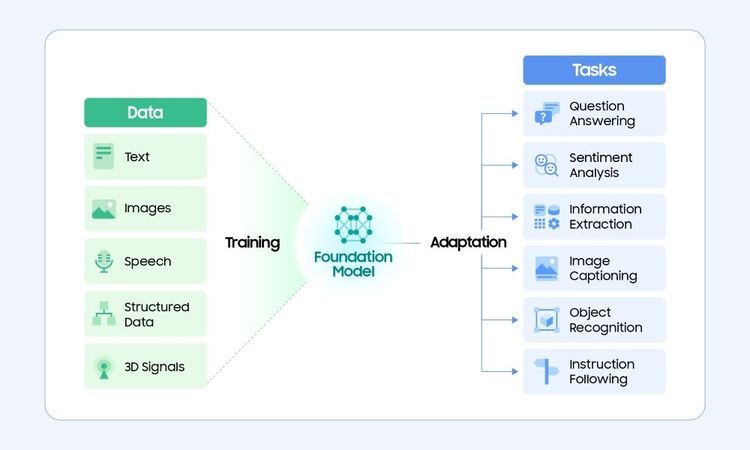
xMAE - short for Physiology-Aware Masked Cross-Modal Reconstruction for Biosignal Representation Learning - is built on a straightforward physiological insight: ECG and PPG signals originate from the same cardiac activity but arrive with a slight time offset, much like thunder is heard after lightning is seen [1]. By learning that temporal relationship during pretraining, the model can infer ECG-equivalent cardiac insight continuously from PPG alone, without asking the wearer to trigger a separate ECG reading [1]. Samsung pretrained xMAE on roughly 9,400 hours of paired ECG and PPG data, and the resulting model beat unimodal biosignal models and existing multimodal approaches in 15 of 19 evaluation tasks, including cardiovascular disease prediction, abnormal test-result detection, and sleep-stage classification [2]. The learned features also showed early signs of transferring across different sensor devices, body locations, and data-gathering environments - a signal that the approach could generalize beyond a single Galaxy wearable [2].

HiMAE's Multi-Timescale Learning and Sub-Millisecond On-Device Inference

HiMAE (Hierarchical Masked Autoencoder) starts from a different hypothesis: that "temporal resolution is a fundamental axis of representation learning," with different health outcomes best captured at different time scales [3]- a few seconds of data can reveal something about a single heartbeat, while hours of data expose patterns in sleep or activity. Samsung says HiMAE processes those multi-timescale biosignals in under one millisecond on a smartwatch-class CPU, with no cloud round-trip required [4]. The company frames this as the first demonstration of an on-device health foundation model - a meaningful claim given that most foundation-model-scale inference still depends on server infrastructure [5].

From arXiv Preprint to Galaxy Unpacked: The Research Pipeline Behind Connected Care

The product unveiling wasn't the starting point - the research was. The academic paper behind HiMAE, co-authored by 15 researchers from Samsung Research America's Digital Health Team and UCLA's Department of Computational Medicine, was posted to arXiv on October 28, 2025, roughly nine months before Samsung's public announcement [3]. Both models subsequently cleared peer review at top-tier AI venues - xMAE at ICML, HiMAE at ICLR 2026 - which lends the work independent academic scrutiny rather than pure marketing framing [2]. Samsung then positioned both models as supporting infrastructure for its "Connected Care" vision, unveiled at Galaxy Unpacked in London in July 2026, aiming to shift health care "from reactive treatment toward preventive, personalized and connected experiences" [6].

What On-Device Health AI Unlocks - and What's Still Unproven

The near-term payoff is passive, continuous cardiac monitoring: xMAE's ECG reconstruction means a wearer gets cardiac-monitoring-grade insight without ever actively triggering a measurement [1]. HiMAE's sub-millisecond, fully on-device processing is framed by Samsung as removing cloud dependency for health inference entirely, which the reporting treats as a privacy and latency win - though that framing comes from Samsung's own materials and hasn't been independently verified [5]. On X, the one detailed technical thread found on the topic treated the sub-millisecond, no-cloud-round-trip design as the standout detail, explicitly linking it to reduced exposure of raw health data - suggesting early technical audiences are reading this as a privacy story as much as a performance one. What's still unresolved from the public record is how these lab benchmarks translate into real Galaxy Watch battery life, on-wrist accuracy versus clinical-grade ECG, and whether the cross-device generalization holds up outside Samsung's own test data [2].

Historical Context

2025-10-28
The HiMAE research preprint was posted to arXiv (2510.25785), predating the public product announcement and formal ICLR 2026 acceptance by roughly nine months.
2026-07
Samsung announced its Connected Care vision for digital health at Galaxy Unpacked July 2026 in London, the broader initiative that xMAE and HiMAE support.

Power Map

Key Players
Subject

Samsung's xMAE and HiMAE on-device health AI models

SA

Samsung Research America (SRA) - Digital Health Team

Developed both xMAE and HiMAE foundation models as part of Samsung's broader push into predictive, on-device digital health, positioned to feed Samsung's Connected Care vision for Galaxy wearables.

SH

Sharanya Arcot Desai

Head of Digital Health Algorithms at Samsung Research America; co-leads the research and is a co-author on the HiMAE arXiv preprint.

SU

Subbu (Subramaniam) Venkatraman

Head of the Digital Health Research Lab at Samsung Research America; co-leads the research and is a co-author on the HiMAE arXiv preprint.

UC

UCLA Department of Computational Medicine

Co-authoring academic institution on the HiMAE research, contributing to the peer-reviewed foundation supporting the on-device model's design.

Fact Check

6 cited
  1. [1] From Biosignals to Health Insights: Samsung Research's Work on Health Foundation Models
  2. [2] Samsung Health AI Models Analyse Wearable Biosignal Data
  3. [3] HiMAE: Hierarchical Masked Autoencoders Discover Resolution-Specific Structure in Wearable Time Series
  4. [4] Samsung's On-Device Health AI Runs in Under 1 Millisecond
  5. [5] Samsung Unveils Health AI Models That Read Your Body 24/7
  6. [6] Galaxy Unpacked July 2026: Samsung and Partners Envision a Connected Care Future, From First Signal to Lasting Change

Source Articles

Top 4

THE SIGNAL.

Analysts

Frames the research as foundational to delivering efficient, precise, continuous health insight through a single foundation model.

Sharanya Desai
Head of Digital Health Algorithms, Samsung Research America

Emphasizes that the core research contribution is proving foundation models can capture both the relationships between different biosignals and their temporal structure.

Subbu Venkatraman
Head of the Digital Health Research Lab, Samsung Research America
The Crowd

Wearables have become very good at collecting health data. Samsung Research is working on that problem with two health foundation models, xMAE and HiMAE, designed to learn from signals such as ECG, heart rate and activity data. xMAE looks at the relationship between different...

@@_PradeepGoel49

HiMAE takes a different approach, looking at health signals across different time scales. A few seconds of data can tell us something about a heartbeat, while hours of data can reveal patterns around sleep or activity. That distinction is important because our health doesn't...

@@_PradeepGoel24

Samsung says HiMAE can run in less than a millisecond on a smartwatch-class CPU, opening up the possibility of doing this analysis directly on the device rather than sending raw health data to the cloud. That last part is particularly important. As AI moves closer to personal...

@@_PradeepGoel19
Broadcast
Samsung's xMAE and HiMAE on-device health AI models — AI News | Agentic Brew