OpenAI shuts down Atlas AI browser, folds features into ChatGPT
TECH

OpenAI shuts down Atlas AI browser, folds features into ChatGPT

22+
Signals

Strategic Overview

  • 01.
    OpenAI is sunsetting ChatGPT Atlas, its standalone AI-powered browser, less than a year after launching it in October 2025, with a deprecation date of August 9, 2026.
  • 02.
    Atlas's capabilities are being folded into a redesigned ChatGPT desktop app that bundles ChatGPT, the Codex coding tool, and Atlas into one build with tabs, a password manager, and autofill.
  • 03.
    The new desktop app gains a built-in browser that can visit sites, log into accounts, and download files, plus a separate cloud browser on OpenAI's servers where agents complete tasks remotely, and an updated ChatGPT Chrome extension.
  • 04.
    Atlas users must manually save their bookmarks, browsing history, and open tabs before shutdown because that data will not transfer automatically to the new experience.

The Browser Was a Feature All Along

OpenAI is not walking away from AI browsing - it is dismantling the wrapper and keeping every part inside. Atlas's core capabilities are being redistributed across three surfaces at once. The redesigned ChatGPT desktop app gets a built-in browser that can visit sites, log into accounts, and download files, plus a separate cloud browser that runs on OpenAI's own servers so agents can complete tasks remotely [1]. An updated ChatGPT Chrome extension reads the page you are viewing and can summarize it, answer questions, control tabs, use local files, and kick off longer tasks - with OpenAI saying it plans to bring the extension to more browsers [2]. A new desktop Computer Use feature lets ChatGPT work in the background, clicking, typing, moving files, and operating across apps and browsers [2].

The strategic logic, as TechCrunch reads it, is that the browser is a feature, not the destination [3]. Atlas asked people to switch browsers and most did not want to, so OpenAI is meeting users inside Chrome and inside the desktop app they already have open [3]. The net effect is that the agentic layer that made Atlas interesting is now aimed to be everywhere, and the standalone icon is the only thing actually dying.


Surface Half-Life: Why the App Dies and the Plumbing Survives

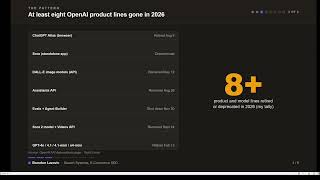
This is the second time OpenAI has killed a standalone surface while quietly keeping the underlying capability. The same side-quests directive that ended Atlas already shut down Sora [4], and Atlas itself lands less than a year after its October launch [5]. Developer commentators tracking AI search have started calling this a surface half-life: in a consolidation, the single-purpose apps and standalone browsers get cut first while the plumbing they proved out gets absorbed into the flagship product. The cited historical rhyme is ChatGPT plugins, which launched in 2023 and were folded into GPTs the following year - the interface disappeared, the capability did not.

For anyone building on top of OpenAI, the read is uncomfortable but clarifying: a splashy standalone launch is not a commitment to a standalone product. The capability is the durable asset; the shell around it is disposable. Atlas was, in effect, a public beta for agentic browsing whose learnings are being ported into Codex's browser and the ChatGPT app rather than defended as its own franchise.

Why Now: The Side-Quests Purge and the Anthropic Wake-Up Call

The timing is not about Atlas failing in isolation - it is about OpenAI deciding it had too many bets open at once. Fidji Simo, OpenAI's CEO of Applications, told staff that fragmentation had been slowing the company down and making it harder to hit its quality bar, and directed teams to cut side quests [4]. That directive is the connective tissue between the Sora and Atlas shutdowns, and the refocus points squarely at productivity: ChatGPT and Codex, where OpenAI most needs to compete [5]. Internally, Anthropic's rising popularity was framed as a wake-up call, with Codex flagged as the front where losing ground would hurt most [3].

The consolidation also carries a hard financial subtext. The same directive that killed Atlas ended Sora, which reportedly burned a million dollars a day while losing half its users [2]. Read together, the moves look less like an editorial pivot and more like an operator trimming expensive experiments to concentrate capital and engineering on the products that defend the core business.

The Traction Problem Nobody at OpenAI Said Out Loud

OpenAI's framing is all focus and iteration, but the community read is blunter: almost nobody was using Atlas. On Reddit, the dominant reaction was that most people did not even know the browser existed, with threads turning into a running tally of unaware users and complaints that it burned through ChatGPT usage limits fast enough to be nearly useless. Two structural failures came up repeatedly - the Mac-only launch that walled off most potential users, and a buggy agent mode that undercut the one feature meant to differentiate it. The recurring counterargument, that this should have shipped as a Chrome extension like Claude's rather than a whole browser, is precisely the shape the product is now taking.

Developer YouTube supplied the sharper structural framing - the surface half-life pattern and the plugins parallel - while broader roundup coverage slotted the shutdown into OpenAI's wider consolidation story. The tension is clean: OpenAI presents a company sharpening its focus, while the people who actually tried Atlas describe a distribution and quality miss that the redistribution strategy conveniently corrects. Both can be true, and that is what makes the move more interesting than a simple failure.

Historical Context

2025-10-21
OpenAI launched ChatGPT Atlas, a Chromium-based, macOS-first browser with ChatGPT at its core, an Ask ChatGPT sidebar, history-based personalization, and an Agent Mode, pitched as a challenge to Chrome and Perplexity's Comet.
2025-10
Alphabet shares fell nearly 3% as investors reacted to Atlas as new browser competition, with Perplexity's Comet going free worldwide and Google rolling out Chrome with Gemini.
2026-07-09
OpenAI announced it would sunset Atlas on August 9, 2026, folding features into the ChatGPT desktop app and a Chrome extension, following the earlier Sora shutdown under Simo's side-quests directive.

Power Map

Key Players
Subject

OpenAI shuts down Atlas AI browser, folds features into ChatGPT

OP

OpenAI

The company shutting down Atlas and consolidating its features into the ChatGPT desktop app and a Chrome extension, part of a broader push to refocus on core productivity products.

JA

James Sun

OpenAI's leader of browsing efforts, who framed the retirement as a move to integrate Atlas's core capabilities into the redesigned ChatGPT desktop app and thanked users who took a leap of faith on a new browser.

FI

Fidji Simo

OpenAI's CEO of Applications, who directed the team to cut back on side quests to reduce fragmentation - a directive that also drove the Sora shutdown.

AN

Anthropic

The rival cited internally as a wake-up call; OpenAI is refocusing on productivity products like ChatGPT and Codex partly to catch it.

GO

Google Chrome / Alphabet

The dominant browser incumbent with over 3 billion users that Atlas originally aimed to challenge; OpenAI now ships ChatGPT as a Chrome extension rather than a rival browser.

Fact Check

5 cited
  1. [1] OpenAI's ChatGPT Atlas Browser Shutting Down
  2. [2] OpenAI kills its Atlas browser after just eight months and folds everything into ChatGPT
  3. [3] OpenAI is shutting down its ChatGPT Atlas browser for a superapp
  4. [4] OpenAI Shutting Down Atlas Browser
  5. [5] OpenAI is shutting down Atlas, but its AI browser ambitions are still growing

Source Articles

Top 3

THE SIGNAL.

Analysts

"Reads the shutdown as OpenAI concluding that the browser is a feature, not the destination, so it is folding agent capabilities into where people already work, including Chrome, rather than exiting AI browsing."

TechCrunch
Technology news publication

"Said Atlas is being retired because its core capabilities were integrated into the redesigned ChatGPT desktop app, and credited early Atlas users who took a leap of faith on a new browser."

James Sun
Leader of browsing efforts, OpenAI

"Warned staff that Anthropic's popularity should be a wake-up call and that fragmentation across too many efforts had been slowing the company down and making it harder to hit its quality bar."

Fidji Simo
CEO of Applications, OpenAI (internal message, as reported)
The Crowd

"Lastly, with all these updates, we are going to be sunsetting Atlas. All these capabilities were built on what we learned from Atlas users who took a leap of faith on a new browser. You taught us how agents can help make browsing and doing work on the open web better, and we"

@@JamesZmSun132

"OpenAI is discontinuing ChatGPT Atlas, its standalone desktop browser https://t.co/yz9BeXOrjW by @apollozac"

@@9to5mac1185

"🦔OpenAI is shutting down Atlas, its standalone AI browser, less than a year after launch. The company announced the deprecation alongside ChatGPT Work, a desktop superapp that folds browser capabilities into the main ChatGPT app. Atlas joins Sora and the shelved adult mode as https://t.co/EvJQuOLSpU"

@@HedgieMarkets128

"The ChatGPT browser is already dead / Less than a year after launch, Atlas is being shut down."

@u/MarvelsGrantMan1363300
Broadcast
OpenAI's New SuperApp Could Break The Industry

OpenAI's New SuperApp Could Break The Industry

Weekly AI News: GPT-5.6 Launch, Atlas Browser Shuts Down & The Open-Source Threat! (July 11, 2026)

Weekly AI News: GPT-5.6 Launch, Atlas Browser Shuts Down & The Open-Source Threat! (July 11, 2026)

OpenAI Killed Atlas The Pattern That Matters for AI Search

OpenAI Killed Atlas The Pattern That Matters for AI Search