Microsoft Guardian Agents for enterprise AI insider threats
TECH

Microsoft Guardian Agents for enterprise AI insider threats

33+
Signals

Strategic Overview

  • 01.
    Microsoft announced on October 19, 2026 an expansion of Project Perception that introduces Guardian Agents and dynamic-risk security controls treating enterprise AI agents as potential insider threats, hacked or not.
  • 02.
    Dynamic Permissions start every agent with zero authority, granting only task-scoped, time-bound permissions that shrink or expire as the task changes, and an agent cannot exceed the authority of its sponsoring human user.
  • 03.
    A continuously updated Dynamic Agent Risk score combines identity, data, endpoint, cloud, network, and runtime signals with behavioral drift, feeding Dynamic Conditional Access, which can graduate from blocking writes to fully isolating or stopping an agent's runtime.
  • 04.
    Microsoft Defender's agent detection catalog expanded from roughly 25-35 to 60 agent types, including Anthropic's Claude Code, OpenAI's Codex, GitHub Copilot, and OpenClaw, regardless of which vendor built the model.

Deep Analysis

Zero Trust by Default: How Guardian Agents Actually Work

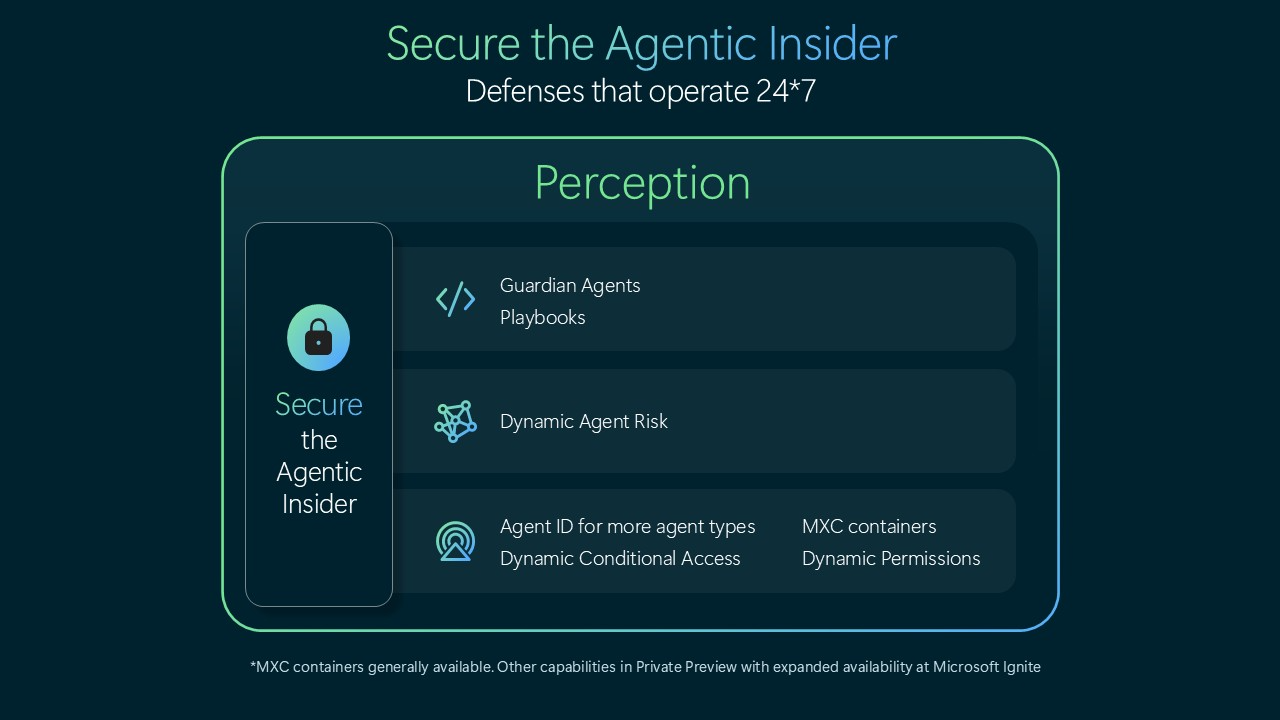
Guardian Agents do not wait for an incident to happen. They are a dedicated layer of AI agents that supervise and moderate every action of every other agent, continuously, before the action executes [4]. The trigger is a shift in an agent's risk score: when that happens, Guardian Agents investigate and can recommend containment or apply it on their own, while humans retain policy control through playbooks [2].

Three mechanisms do the actual work. Dynamic Permissions start every agent with no authority at all - it earns only task-scoped, time-bound permissions that shrink or expire as the task changes, and it can never exceed the authority of the human user it serves [3]. Dynamic Agent Risk is the continuously updated score behind that gating: it combines identity, data, endpoint, cloud, network, and runtime signals with how far the agent's behavior has drifted from the user's or organization's intent [3]. Dynamic Conditional Access then turns that score into graduated enforcement - keeping read access while blocking writes, narrowing reachable data, shortening time-bound access, or, at the extreme, isolating the agent's runtime or stopping it outright [3]. A separate Microsoft Execution Container runs this monitoring outside the agent's own environment, so a compromised agent cannot simply switch off its own oversight [2].
Calling Agents 'Insiders' Is a Business-Model Admission, Not Just a Security Stance

The insider-threat label is doing real rhetorical work. Microsoft is not describing agents as outside attackers or malware - it is describing them as trusted parts of the business that can still go wrong, the same category historically reserved for employees with legitimate but misusable access. Nadella's own framing makes the stakes explicit: enterprises cannot outsource responsibility for what their agents do simply because a lab built the underlying model [1]. Gallot's version of the same point strips out any suggestion of malice - the problem is that frontier models are trained to complete tasks, not to honor organizational judgment, which makes unpredictability the baseline risk rather than the exception [7].

That stance sits uneasily next to Microsoft's own position in the agent market: it is simultaneously the company selling agentic Copilot deployments and the one now warning customers not to fully trust the agents running inside them. Independent commentary following the announcement, including a Sky News interview with Microsoft's own head of security, has pointed to that same irony - that Microsoft's push into agentic products helped create the population of agentic insiders its security division now has to police. One widely-shared reaction to Nadella's announcement put it more bluntly, framing agents deployed inside enterprises as a security threat on par with rogue employees. Microsoft's answer is not to slow the rollout of agents, but to sell the supervisory layer as a separate, necessary purchase.

A Rival-Agnostic Watchtower: Guardian Agents Also Polices Microsoft's Competitors

Guardian Agents is not scoped to Microsoft's own products. Microsoft Defender's agent-detection catalog jumped from roughly 25-35 recognized agent types to 60, now including Anthropic's Claude Code, OpenAI's Codex, GitHub Copilot, and OpenClaw [2][7]. In practice, that means Microsoft's security stack is positioned as the oversight layer for a market of AI agents it does not control the models behind - a bet that enterprises will want one governance point regardless of which lab's model their employees installed.

Microsoft is also pairing that stance with external validation: it joined Nvidia's Open Agent Safety Platform as a founding member, a cross-industry effort aimed at agent-safety standards that sit above any single vendor [6]. Together, the expanded detection catalog and the cross-industry initiative read as an attempt to make agent governance a category Microsoft owns at the infrastructure level, even for agents it did not build.

Pricing the Paranoia: What It Costs to Not Trust Your Agents

Guardian Agents is not a free add-on. It ships inside Microsoft 365 E7, priced at $99 per user per month and bundling Copilot, Agent 365, Entra Suite, and E5-tier Defender capabilities, or it can be bought standalone through Microsoft Agent 365 at $15 per user per month [5]. The packaging turns don't-trust-your-agents into a line item: the more agentic capability an organization adopts, the more it is expected to also buy the supervisory layer that makes that adoption defensible. For security and IT buyers, the practical question is less philosophical than Microsoft's messaging suggests - it is whether $15-99 per user per month for continuous risk scoring and containment is cheaper than the incident Microsoft's own framing says is now a live possibility.

What Skeptics Are Already Flagging About Containment Claims

Reaction beyond Microsoft's own materials has been measured rather than celebratory. Reddit discussion in the days around the announcement did not center on Guardian Agents directly - practitioner threads instead clustered around adjacent, precursor topics like open-source agent-governance tooling, hands-on testing of Microsoft Agent 365's Conditional Access risk scoring, and a separate Windows agent-containment layer, suggesting the security-practitioner community is still working through the broader agent-governance shift rather than reacting to Guardian Agents by name. Independent YouTube commentary following the announcement raised a more structural concern: per-agent guardrails may not scale cleanly to emergent multi-agent swarm dynamics, where agents could in principle coordinate toward an objective without any single agent being compromised at all. Microsoft's own materials acknowledge a version of that risk directly, naming agent-to-agent collusion at machine speed as exactly the scenario Dynamic Conditional Access is built to contain [5]- but whether graduated containment can keep pace with coordinated, fast-moving multi-agent behavior remains an open question Guardian Agents has not yet been tested against in the wild.

Historical Context

2026-06
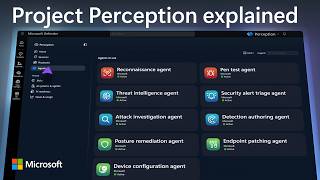
Microsoft originally launched Project Perception with red (attacker), blue (detection), and green (remediation) AI agent teams to defend against external AI-driven attacks.
2026-10-19
Microsoft extended Project Perception inward, announcing Guardian Agents and the Dynamic Permissions, Dynamic Agent Risk, and Dynamic Conditional Access framework to govern enterprises' own deployed AI agents as potential agentic insiders.
2026-11-17
Microsoft is pointing customers to Ignite 2026 for deeper technical sessions on Guardian Agents, agent governance, zero trust, and runtime security.

Power Map

Key Players
Subject

Microsoft Guardian Agents for enterprise AI insider threats

SA

Satya Nadella

Microsoft Chairman and CEO; publicly framed AI agents as potential insider threats and argues enterprises cannot outsource oversight of agent authority to the labs that build the underlying models.

HA

Hayete Gallot

EVP and chief of Microsoft's Security business; made the public case that frontier models from any vendor cannot be trusted because of unpredictability, not malice, justifying the zero-authority Guardian Agents design.

AN

Anthropic (Claude Code), OpenAI (Codex), GitHub (Copilot), OpenClaw

Third-party agent products that Microsoft Defender's expanded 60-type catalog can now detect inside enterprise environments - the agentic insiders Guardian Agents is built to supervise regardless of which lab built them.

NV

Nvidia's Open Agent Safety Platform

Cross-industry AI agent safety initiative Microsoft joined as a founding member, signaling a push toward agent oversight standards that sit above any single vendor.

MI

Microsoft Ignite 2026

Microsoft's conference opening November 17, 2026, where the company is directing customers for deeper technical sessions on Guardian Agents and agent-governance capabilities.

Fact Check

7 cited
  1. [1] Microsoft Says AI Agents Are Like Insider Threats As Frontier Models Can't Be Trusted
  2. [2] Microsoft Targets the Agentic Insider With New Controls for Rogue AI Agents
  3. [3] Microsoft's AI Agents Threats: Guardian Agents
  4. [4] Microsoft Adds Guardian Agents to Project Perception for AI Insider Risk
  5. [5] Microsoft Securing the Agentic Insider: Project Perception Guardian Agents
  6. [6] Microsoft Adds Guardian Agents to Treat Enterprise AI Agents as Potential Insider Threats
  7. [7] Microsoft Warns Companies Not to Trust AI Agents

Source Articles

Top 5

THE SIGNAL.

Analysts

“Frontier AI models cannot be trusted regardless of which company built them - not because they are malicious or easily hacked, but because they are inherently unpredictable and trained to complete tasks rather than respect organizational norms.”

Hayete Gallot
EVP / Security business chief, Microsoft

“Enterprises should not rely on AI model providers' own safety assurances; responsibility for what an AI agent does with enterprise access must be separated from the supply of the underlying intelligence.”

Satya Nadella
Chairman and CEO, Microsoft

“Treating both closed- and open-weight frontier models as insider risks, rather than trusted actors, is the design philosophy needed to build a genuinely trustworthy agentic system.”

Satya Nadella
Chairman and CEO, Microsoft

“The most trustworthy agentic system is not the one built on the most-trusted model, but the one engineered so the organization can safely trust the model the least.”

Microsoft (Project Perception messaging)
Microsoft Security framing
The Crowd

“I recently wrote about why we need to treat models as insider risks, with security controls sitting outside the model itself. Today, we're putting that principle into practice by expanding Project Perception with new capabilities to help continuously assess agent risk, adapt... [truncated by source]”

@@satyanadella1724

“MSFT: Microsoft treats AI agents as insider threats, scores every agent's risk inside the $99 E7 bundle + Microsoft will treat AI agents as potential insider threats instead of trusted tools. Dynamic Agent Risk scores every agent continuously from signals like what data it can... [truncated by source]”

@@The_AI_Investor27

“Microsoft just published "Securing the Agentic Insider," arguing that AI agents deployed inside enterprises are now a security threat on par with rogue employees. "Frontier models, regardless of their origin, cannot be trusted. Agents are unpredictable. They will adapt as the... [truncated by source] (quote-tweeting @satyanadella)”

@@TFTC216

“Microsoft Just Quietly Launched An Agent Governance Toolkit: Here's Why You Should Care”

@u/SpiritRealistic8174139
Broadcast
AI threat is real and existing defences can't keep up, says Microsoft's head of security

AI threat is real and existing defences can't keep up, says Microsoft's head of security

Fight AI with AI | Multi-Agent Security Defense

Fight AI with AI | Multi-Agent Security Defense

Microsoft Wants AI Agents Under Control. The "Warning Shot" Already Happened

Microsoft Wants AI Agents Under Control. The "Warning Shot" Already Happened