AWS raises GPU compute prices 20%
TECH

AWS raises GPU compute prices 20%

26+
Signals

Strategic Overview

  • 01.
    Amazon Web Services is raising prices on its EC2 Capacity Blocks for ML reservations - the product enterprises use to lock in scarce Nvidia GPU instances for a future, time-bound window - by about 20%, effective July 1, 2026. All other EC2 prices stay unchanged.
  • 02.
    The increase hits the P6-B300, P6-B200, P5, P5e, P5en, and P4de instance families - the Blackwell and Hopper-class machines used for large-scale model training. New per-accelerator hourly rates include P6-B300 at $14.04, P6-B200 at $12.355, and P5 at $5.191 in US regions.
  • 03.
    This is the third consecutive 2026 increase on AWS GPU Capacity Blocks, following a quiet ~15% hike in January. AWS attributes the move to periodic supply-and-demand updates, citing rising compute costs amid surging AI infrastructure demand.

Deep Analysis

The reversal: AWS stops cutting and starts charging
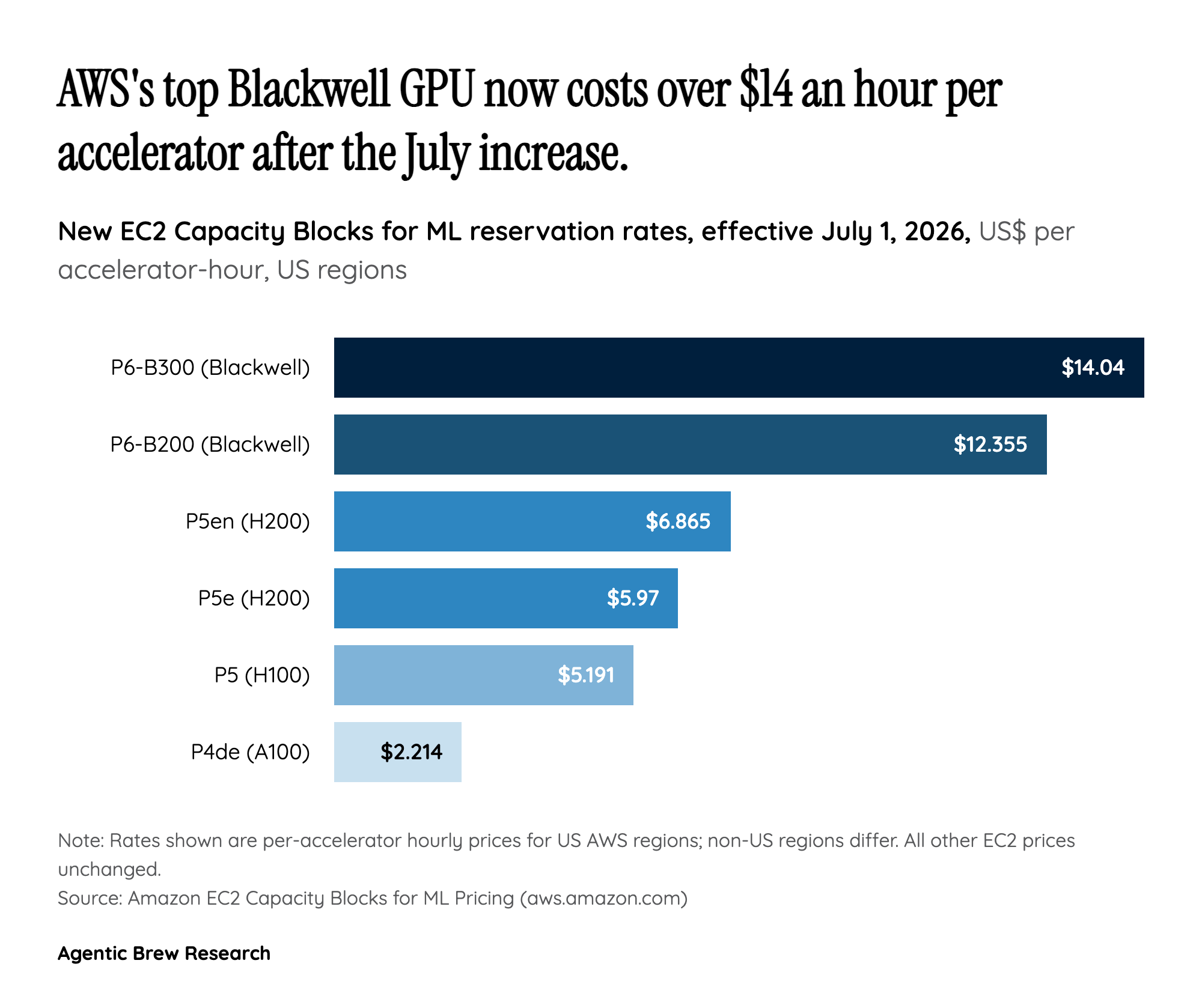
The reversal: AWS stops cutting and starts charging
New EC2 Capacity Blocks per-accelerator reservation rates effective July 1, 2026, after the increase.

For most of its history, AWS was a metronome of price cuts - and Capacity Blocks for ML were no exception, with three reductions across 2024 and 2025 [4]. 2026 broke the pattern. A quiet ~15% increase landed in January, reported by both The Register and DatacenterDynamics on the H200 instances [6][7], and now a third consecutive hike of about 20% takes effect July 1 [2]. When the largest cloud provider raises rather than cuts prices on its scarcest product, it is a market signal: demand growth has outpaced capacity expansion, and the era of compute getting reliably cheaper has, at least for frontier GPUs, paused [8]. The cumulative effect is steep - across chip configurations, AWS GPU reservation pricing has climbed roughly 20% to 50% over the course of 2026 from the stacked increases [8]. This is not a discount cycle blip; it is a structural reset in how guaranteed AI compute is priced.


The mechanism: dynamic scarcity pricing, and who actually pays

Capacity Blocks for ML is a reserved-capacity product: enterprises secure scarce GPU instances for a future, time-bound window - typically large model-training runs - and the reservation fee is charged up front at scheduling time [4]. Because AWS updates these rates periodically based on supply and demand [1], the pricing behaves less like a fixed catalog and more like a market for guaranteed inventory. Pareekh Jain, CEO of EIIRTrend, frames it bluntly: with H100 and H200 demand outstripping supply, AWS is 'effectively applying a scarcity premium to guaranteed inventory' [3]. Who pays? The increase flows directly into training economics - runs consuming millions of GPU hours can absorb hundreds of thousands of dollars in additional expense [9]. Even buyers who think they are insulated are not: Enterprise Discount Program customers negotiate a percentage off public pricing, so a public-price hike lifts their absolute rate even when the discount percentage holds steady [9].

The contrarian read: alternatives exist, but data gravity keeps everyone put

The community response to AWS GPU price hikes has been broadly skeptical, and the obvious retort is 'just leave.' On X, the loudest counter-narrative reframes the increase as a buy-signal for AMD's MI300X at roughly $1.50 to $2.00 per hour against an H200 effective rate near $4.975 per GPU hour. On Reddit, a meme thread spilled into a serious cloud-versus-on-prem debate, with users pegging an on-prem 8xH100 break-even at around 240 days of continuous use - the kind of math that makes owning hardware look rational. Google Cloud's TPU instances offer another off-ramp [5]. Yet migration stays limited in the near term. Rivals like Azure and GCP face the same Nvidia supply constraints [5], and data gravity plus entrenched infrastructure means the hikes bite new workloads harder than existing commitments [3]. The leverage to negotiate is real; the practical ability to actually move at scale is not.

The money picture: a 20% hike against a $200 billion bet

The price move does not happen in a vacuum - it sits on top of an AWS that is growing and spending at once. AWS Q1 2026 revenue grew 28% year over year to $37.6 billion, its fastest growth in more than three years [2]. At the same time, Amazon earmarked roughly $200 billion in 2026 capex for AI infrastructure [2], and is set to take delivery of 1 million Nvidia GPU chips by the end of 2027 [5]. The increase partly reflects genuine input cost - the higher price of Nvidia Blackwell B200 and B300 silicon and a global energy crunch squeezing data centers [10]. Markets read the move as strength rather than strain: Amazon stock climbed as AWS implemented the third consecutive increase [11], suggesting investors view scarcity pricing on AI compute as a durable margin lever, not a warning sign.

Historical Context

2024-2025
Across 2024 and 2025, AWS reduced Capacity Block pricing three times - once in 2024, twice in 2025 - consistent with its long history as a serial price-cutter.
2026-01-05
On January 5, 2026, AWS quietly raised EC2 Capacity Block H200 prices about 15%: p5e.48xlarge rose from $34.61 to $39.80 per hour and p5en.48xlarge from $36.18 to $41.61 per hour in most regions.
2026-03
In March 2026, Reuters reported Amazon is expected to receive 1 million Nvidia GPU chips by the end of 2027 through a cloud supply agreement, underscoring persistent high-end GPU scarcity.
2026-06-26
On June 26, 2026, AWS disclosed the third consecutive 2026 GPU Capacity Block increase of about 20%, effective July 1.

Power Map

Key Players
Subject

AWS raises GPU compute prices 20%

AM

Amazon Web Services (AWS)

Amazon Web Services is the cloud provider raising the rates. It sets Capacity Block prices dynamically based on supply and demand, effectively applying a scarcity premium on guaranteed GPU inventory.

NV

Nvidia

Nvidia is the GPU supplier whose H100, H200, and Blackwell chips back the affected instances. Constrained supply underpins the price action, with Amazon set to receive 1 million Nvidia chips by the end of 2027.

AI

AI startups

AI startups are the most exposed customer segment. They feel the increase most acutely as the initial six-figure cloud-credit packages from the 2023-2025 boom expire, turning subsidized experimentation into real monthly bills.

MI

Microsoft Azure and Google Cloud (GCP)

Microsoft Azure and Google Cloud are competitors who could court ML workloads displaced by the AWS hikes, though they face the same GPU constraints. GCP's TPU instances are positioned as an alternative path.

EN

Enterprises on Enterprise Discount Programs (EDP)

Enterprises on Enterprise Discount Programs are negotiated-contract customers whose percentage discounts apply to public pricing. A public-price hike raises their absolute rate even when the discount percentage holds, so the increase reaches even committed buyers.

Fact Check

11 cited
  1. [1] Amazon EC2 Capacity Blocks for ML Pricing
  2. [2] AWS Raises GPU Capacity Block Prices 20% for AI Workloads
  3. [3] AWS hikes prices for EC2 Capacity Blocks amid soaring GPU demand
  4. [4] AWS is raising prices on EC2 Capacity Blocks
  5. [5] AWS raising GPU instance prices 20% on July 1
  6. [6] AWS quietly raises GPU prices 15%
  7. [7] AWS quietly increases prices for H200 EC2 instances by 15%
  8. [8] What AWS's GPU pricing shift reveals about cloud cost risk
  9. [9] AWS hikes EC2 GPU prices: enterprise strategy implications for AI workloads
  10. [10] AWS GPU price increase 2026
  11. [11] Amazon (AMZN) stock climbs as AWS implements third consecutive GPU price increase

Source Articles

Top 3

THE SIGNAL.

Analysts

"Frames the increase as a scarcity premium on guaranteed GPU inventory as H100 and H200 demand outstrips supply."

Pareekh Jain
CEO, EIIRTrend

"Contrasts AWS's dynamic, segmented Capacity Block model with competitors' steadier guarantee-based pricing."

Sanchit Vir Gogia
Analyst, Greyhound Research
The Crowd

"Amazon $AMZN AWS has raised pricing for EC2 Capacity Blocks for ML by about 15%, with H200-based p5e.48xlarge moving from $34.61 to $39.80 per hour in most regions and p5en.48xlarge from $36.18 to $41.61, while US West (N. California) p5e went from $43.26 to $49.75 - The Register https://t.co/CWPhWdmnL1"

@@wallstengine418

"$AMD MI300X vs $NVDA H200 rent The affected instance is the p5e.48xlarge (8x NVIDIA H200 GPUs), now priced at $39.80 per hour (in most regions, up from $34.61). This works out to roughly $4.975 per H200 GPU per hour. While MI300X is $1.50-$2.00/ hour. nearly 200% more https://t.co/OfLfHeaUW2"

@@MikeLongTerm66

"AWS raises GPU prices 15% on a Saturday, hopes you weren't paying attention https://t.co/IljqBzDE3D"

@@TheRegister13

"awsRaisedGpuPricesFifteenPercent"

@u/TxTechnician1200
Broadcast
AWS Raises GPU Prices! Hourly Rates for Nvidia Clusters Heading Higher on July 1

AWS Raises GPU Prices! Hourly Rates for Nvidia Clusters Heading Higher on July 1

337: AWS Discovers Prices Can Go Both Ways, Raises GPU Costs 15 Percent

337: AWS Discovers Prices Can Go Both Ways, Raises GPU Costs 15 Percent

How AWS Raises Prices

How AWS Raises Prices