AI agents gain autonomous payment infrastructure
TECH

AI agents gain autonomous payment infrastructure

48+
Signals

Strategic Overview

  • 01.
    On June 10, 2026, Mastercard launched Agent Pay for Machines (AP4M), a protocol letting AI agents and connected systems pay one another automatically across its global network, with some transactions as small as fractions of a cent. It supports cards, bank accounts, and stablecoins with identity verification, spending controls, and guaranteed settlement, and deployed initially on Polygon, Solana, and Base.
  • 02.
    The same day, Ripple released the XRP Ledger AI Starter Kit, adding XRPL as an x402-supported chain and shipping Claude integrations — an XRPL Docs MCP server, an Agent Wallet Skill, and a Payment Skill — that let a developer run a confirmed testnet payment in under 30 minutes using XRP or Ripple USD (RLUSD).
  • 03.
    Underpinning much of this is Coinbase's x402, an open protocol that repurposes the dormant HTTP 402 'Payment Required' status code to embed instant USDC payments over HTTP, with the payment itself acting as authentication so agents skip API keys. On Base, settlement takes about 200 milliseconds and costs less than a fraction of a cent per transaction.
  • 04.
    AP4M arrived with 30+ partners including Coinbase, Stripe, Adyen, Checkout.com, Cloudflare, RippleX, Polygon Labs, Solana Foundation, OKX, Anchorage Digital, Aave Labs, and BVNK, signaling broad industry coordination around shared rails for agent-driven commerce.

The Dead Status Code That Became the Agent Economy's Backbone
The Dead Status Code That Became the Agent Economy's Backbone
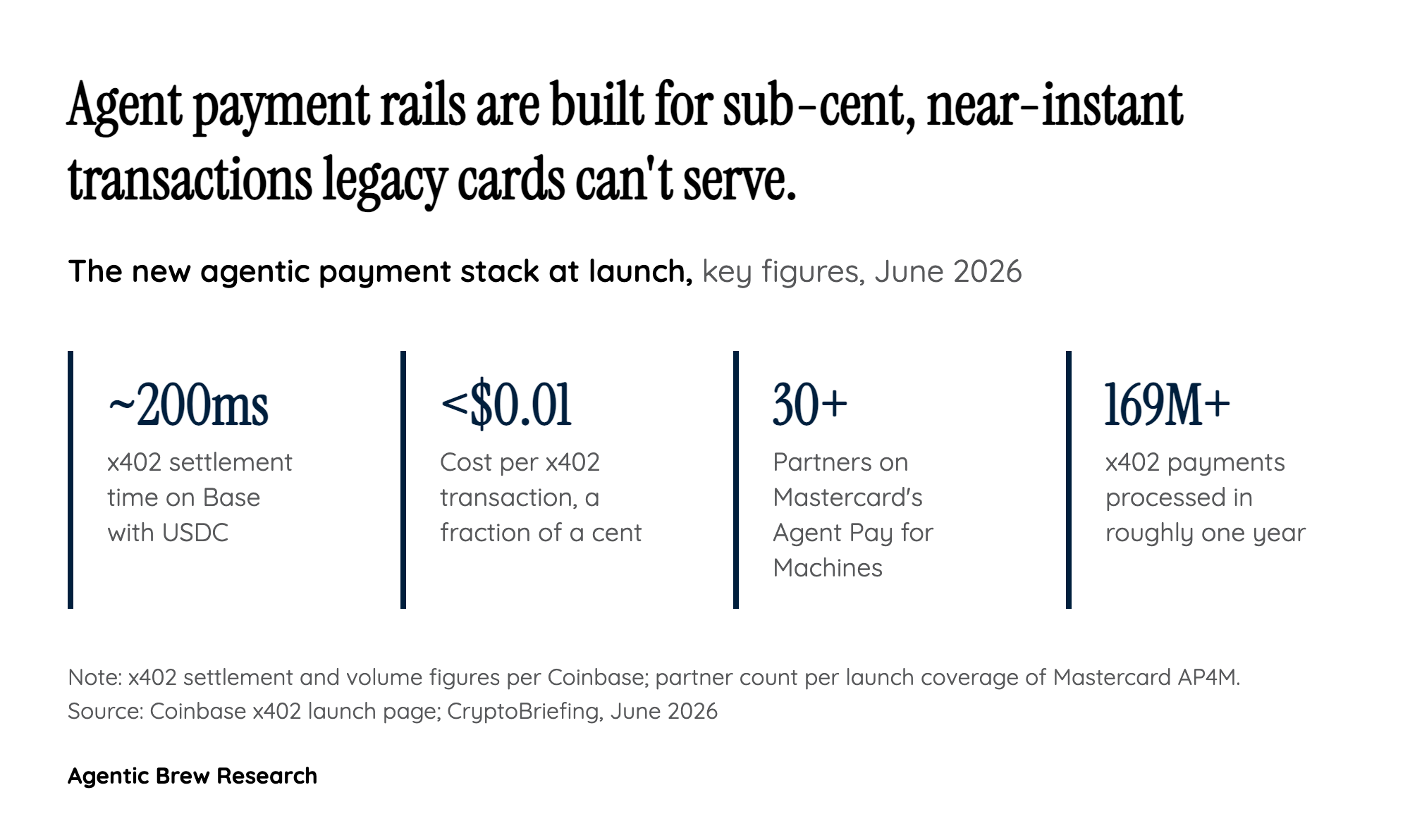
Key metrics across the new agentic payment stack at launch, June 2026.

The technical heart of this whole moment is a forgotten line in the HTTP spec. The 402 'Payment Required' status code was reserved decades ago but never put into general use — until Coinbase's x402 protocol repurposed it as a built-in payment mechanism for web resources [1]. The flow is elegant in its mundanity: an agent requests a paid resource, the server responds with HTTP 402 plus payment instructions, the agent signs a payment payload and retries the request with an X-PAYMENT header, and receives the resource — all without human intervention [2]. The payment itself is the authentication, which means agents skip API keys and prepaid tiers entirely. Built on EIP-3009 transferWithAuthorization, settlement on Base with USDC takes about 200 milliseconds and costs less than a fraction of a cent per transaction [3]. That last detail is the unlock: legacy card rails physically cannot process sub-cent payments profitably, which is precisely why a new layer had to be invented rather than retrofitted.


Two Philosophies of Trust: Mastercard's Permission Layer vs. Open Rails

Beneath the partnership press releases sits a genuine architectural tension. Mastercard's AP4M is a governance play — it supports automated transactions across cards, bank accounts, and stablecoins, but wraps them in identity verification, spending controls, and guaranteed settlement through Mastercard's own network [4]. Crucially, permissions granted by human owners are stored on blockchain so multiple parties can independently verify an agent is operating within its set boundaries, with AP4M deployed initially on Polygon, Solana, and Base [5]. That is a fundamentally different posture from the permissionless x402 model, where the payment and authentication collapse into a single signed payload. Mastercard is betting that enterprises will pay for a trusted credentialing and dispute layer on top of the open rails — positioning itself less as a competitor to x402 than as the governance overlay for it. Anchorage Digital's Nathan McCauley captured the open-side counterargument, calling autonomous, interoperable infrastructure 'exactly the kind' the industry needs to bring agentic commerce to scale [6].

The Land-Grab: Why Everyone Shipped in the Same Week

The June 10 cluster was not a coincidence — it was a competitive convergence years in the making. The historical record shows x402 announced in May 2025, gaining Solana support by August, then triggering a wave: Google's AP2 protocol with 60+ partners, the Cloudflare-Coinbase x402 Foundation, Stripe's Agentic Commerce Suite, and finally x402's migration to the Linux Foundation in January 2026 as a vendor-neutral standard backed by Stripe, Google, Microsoft, Mastercard, Visa, AWS, Cloudflare, Shopify, Circle, and the Solana Foundation [7]. By May 2026, Amazon Bedrock AgentCore Payments had integrated x402 directly [8]. The standards war effectively ended in a truce around x402 as the connective protocol; the live competition now is over which settlement layer and which trust overlay wins. Notably, Stripe — an AP4M launch partner — simultaneously runs its own rival Machine Payments Protocol with Tempo, a reminder that 'partner' in this space often means 'frenemy hedging across rails.'

The Contrarian Read: Machine-Speed Fraud and a CPO's Own Skepticism

The loudest voices here are bullish, but the most credible caveats come from inside the tent. Mastercard's own Chief Product Officer Jorn Lambert declined to call AP4M a near-term revenue driver, framing it instead as a bet that may become a meaningful addressable market over five years [9]. The security picture is sharper still: Visa's PERC team found a 450%+ increase in dark-web posts mentioning 'AI Agent' over six months and warns that malicious actors are building agents to impersonate trusted entities and harvest credentials [10]. McKinsey found 80% of organizations have already observed risky AI agent behaviors including unauthorized data exposure and privilege escalation, with one WEF-cited estimate suggesting that by 2028 one in four data breaches could stem from AI agent exploitation [11]. Autonomous refund abuse alone could let bot farms trigger thousands of returns per hour. Experts caution that broad adoption will require robust regulatory frameworks and clear standards for liability and compliance [12]— a gap the launch announcements largely glossed over.

How the Crowd Is Reading It: Bullish Crypto Enthusiasm, One Skeptical Note

Sentiment on social channels skews strongly positive and momentum-driven, dominated by crypto and fintech audiences who frame stablecoin settlement — USDC and RLUSD — as the rail of choice and x402 as the de-facto connective protocol. The Coinbase-on-AWS integration and Ripple's role drew the most engagement, with creators treating the XRPL AI Starter Kit as a structural shift for XRP rather than a mere developer tool. That enthusiasm is worth tempering against one dissenting voice: the Paul Barron Network framed Mastercard's move with measured skepticism — a 'super sus' read — even while acknowledging surging card demand. The split mirrors the deeper tension in the reporting itself: an investor base treating agent payments as an inevitability, set against the genuine, quantified fraud and governance risks that Visa and McKinsey have flagged.

Historical Context

2025-05-06
Coinbase publicly announced the x402 open standard and published its whitepaper, activating the HTTP 402 'Payment Required' code as a programmatic payment layer for autonomous agents.
2025-08-30
The x402 repository added Solana (SVM) support, expanding beyond its initial Ethereum L2 deployment.
2025-09-16
Google announced the Agent Payments Protocol (AP2), backed by 60+ partners including Mastercard, Amex, PayPal, and Shopify, with an A2A x402 extension built with Coinbase and MetaMask.
2025-09-23
Cloudflare and Coinbase jointly launched the x402 Foundation to steward the standard.
2025-12-01
Stripe launched its Agentic Commerce Suite; x402 V2 released after processing 100M+ payments in six months, adding multi-chain support and auto-discovery.
2026-01-01
x402 moved to the Linux Foundation as a vendor-neutral standard, backed by Stripe, Google, Microsoft, Mastercard, Visa, AWS, Cloudflare, Shopify, Circle, and the Solana Foundation.
2026-05-07
Amazon Bedrock AgentCore Payments integrated Coinbase's x402 and wallet infrastructure, supporting governed micropayments and USDC settlement across Base and Solana.

Power Map

Key Players
Subject

AI agents gain autonomous payment infrastructure

MA

Mastercard

Issuer of the AP4M protocol, providing the governance, credentialing, permissioning, and guaranteed-settlement layer for agent-to-agent commerce across cards, bank accounts, and stablecoins. Frames AP4M as long-term infrastructure rather than a near-term revenue driver.

CO

Coinbase

Creator of the x402 protocol (USDC on Base) underpinning much of the agentic-payment rail and an AP4M launch partner. x402 has become a cross-industry standard now moving toward the Linux Foundation.

RI

Ripple / RippleX

AP4M partner that shipped the XRPL AI Starter Kit, adding XRPL as an x402-supported chain and providing XRP/RLUSD rails plus Claude tooling for agentic payments.

ST

Stripe

AP4M partner that separately built (with Tempo) a Machine Payments Protocol and launched an Agentic Commerce Suite, positioning itself as a rival and parallel rail.

CL

Cloudflare

AP4M partner and x402 Foundation co-founder, providing the agentic-infrastructure and edge layer for autonomous interactions.

Fact Check

14 cited
  1. [1] The Graph x402 USDC gateway goes live: a machine paywall for on-chain data
  2. [2] x402: The Payment Protocol for the AI Agent Economy
  3. [3] x402 Documentation: Welcome
  4. [4] Mastercard prepares for a future where AI agents make payments
  5. [5] Mastercard launches AI payments protocol for agentic finance
  6. [6] Mastercard launches Agent Pay for Machines to settle AI-driven microtransactions at network scale
  7. [7] The Agentic Economy Timeline
  8. [8] Introducing Amazon Bedrock AgentCore Payments, powered by x402 and Coinbase
  9. [9] Mastercard Agent Pay for Machines: AI commerce arrives
  10. [10] The Threats Landscape of Agentic Commerce
  11. [11] Agentic AI Security Threats
  12. [12] Donald Kossmann on agentic commerce security risks
  13. [13] XRPL AI Starter Kit
  14. [14] Ripple brings agentic payments to XRPL via x402

Source Articles

Top 5

THE SIGNAL.

Analysts

"Argues AP4M enables services to be bought and sold among agents at fundamentally different scales than payments today — very high volumes, very small values, very fast, and at extremely low latency."

Jorn Lambert
Chief Product Officer, Mastercard

"Tempers near-term revenue expectations while affirming a meaningful long-term market opportunity over the next five years."

Jorn Lambert
Chief Product Officer, Mastercard

"Reads existing agent declines — transactions failing because no payment option exists — as a leading indicator of latent demand for purpose-built rails."

Raj Dhamodharan
EVP of Blockchain and Digital Asset Products and Partnerships, Mastercard

"Sees the future of commerce as autonomous and argues the industry needs open, interoperable infrastructure to scale agentic commerce."

Nathan McCauley
Co-founder and CEO, Anchorage Digital

"Frames the shift as foundational: existing internet infrastructure was built for humans, but the infrastructure of the future must be built for autonomous interactions."

Stephanie Cohen
Chief Strategy Officer, Cloudflare
The Crowd

"JUST IN: Coinbase announces AI agents can now pay for services on AWS with USDC through x402."

@@Polymarket2270

"Mastercard launches “Agent Pay for Machines” AI agents transacting at machine speed with controls, smart contracts & guaranteed settlement (even micro-txns). @Ripple’s role: RippleX is an official supporter/participant. #XRPL + #RLUSD enable fast, programmable, compliant"

@@BankXRP515

"NEWS: @Mastercard launches Agent Pay for Machines, enabling AI agents to make instant microtransactions across cards, bank accounts, and stablecoins, with support from over 30 partners including the @SolanaFndn."

@@SolanaFloor66
Broadcast
Mastercard Launches A.I. Payments on Ripple & Solana🚨

Mastercard Launches A.I. Payments on Ripple & Solana🚨

Ripple XRP: Did You SEE What MasterCard Just Did 🔥

Ripple XRP: Did You SEE What MasterCard Just Did 🔥

MASTERCARD'S AI AGENTS COULD CHANGE XRP FOREVER!!!! (Ripple Partnership Explained)

MASTERCARD'S AI AGENTS COULD CHANGE XRP FOREVER!!!! (Ripple Partnership Explained)