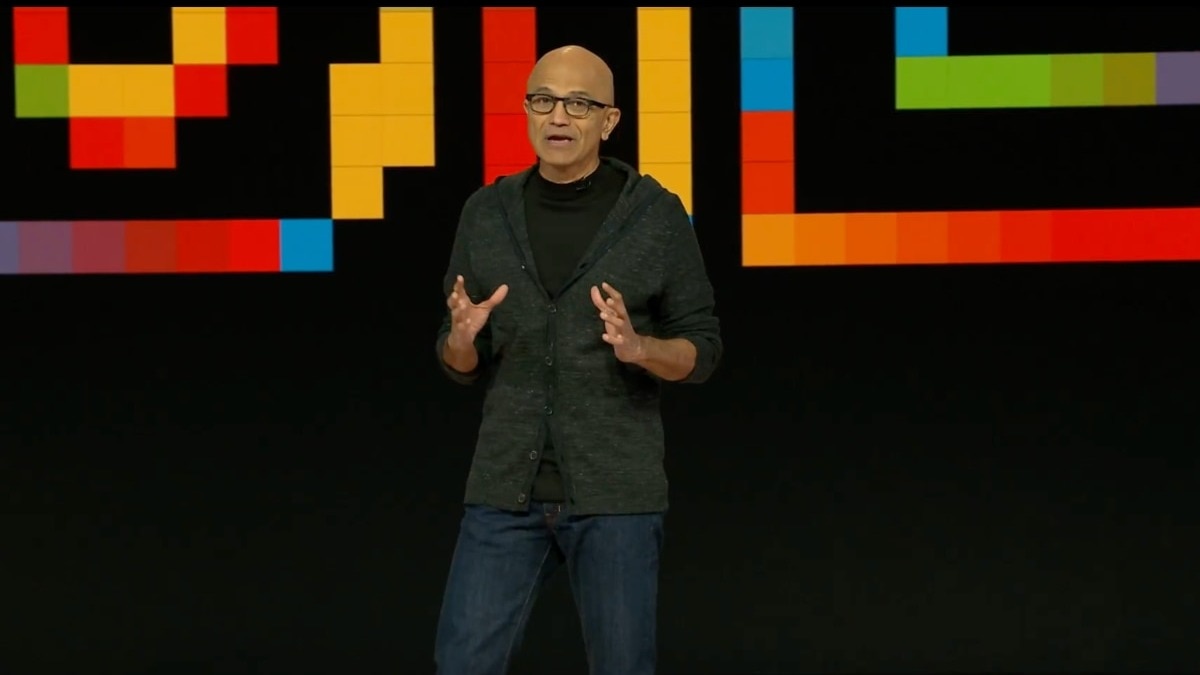
Nadella's AI learning loops and token capital
TECH

Nadella's AI learning loops and token capital

25+
Signals

Strategic Overview

  • 01.
    Satya Nadella introduced 'token capital' — the AI capability a company builds and owns — as a new form of corporate value sitting alongside human capital.
  • 02.
    His central claim is that the winners in enterprise AI will be the firms with the best human-AI learning loops, not the firms using the best models.
  • 03.
    Nadella warns that if companies let their expertise flow into a handful of frontier models, value concentrates with those labs and industries get hollowed out.
  • 04.
    Critics counter that the framework rationalizes job elimination, pointing to Microsoft's 15,000-plus layoffs in 2025 alongside record profits.

The New Balance Sheet of the Firm

For a century, a company's balance sheet listed people, processes, software, brand, and IP. Nadella's argument is that the modern firm now carries a second kind of asset that doesn't appear on any ledger: token capital. Where human capital is the judgment, relationships, and pattern recognition of employees, token capital is the accumulated, machine-operable cognition a company builds and owns [1]. Every workflow becomes a training surface, every expert correction becomes reusable signal, and over time that loop turns scattered human judgment into institutional intelligence that is queryable and portable across models.

The mechanism that makes this strategic rather than buzzwordy is swappability. Nadella's framing holds that a company should be able to switch out a 'generalist' model without losing the 'company veteran' expertise embedded in its learning system [2]. The business-strategy publication FourWeekMBA maps this to what it calls 'Harness Theory' — the real moat is not the foundation model underneath but the orchestration layer above it: the agents, schedules, feedback, and memory that compound with use [2]. In that reading, the model is a commodity input; the loop is the durable asset. This is the load-bearing idea of the whole thesis, and it is why the original post detailing it became the single most-engaged item in the surrounding discussion.
Why a Company That Sells Tokens Wants You to Hoard Your Own

The thesis is striking partly because of who is making it. Microsoft profits when enterprises consume AI, yet Nadella is telling those same enterprises to keep their expertise out of the model layer. The resolution is that his warning targets a specific failure mode: a world where all company knowledge flows upward into a few foundation models, turning those labs into economic landlords that absorb everyone's expertise and capture the value created by every firm's learning process [3]. Microsoft's answer is to let every company build its own AI capital on top of frontier models — while Microsoft owns the infrastructure where that happens.

That is the elegant, self-serving core of the doctrine. Microsoft does not need to own the single best frontier model forever; it needs to own the enterprise control plane — identity, security, data, compliance, agents, and model routing. If the model becomes swappable, the platform underneath the firm's loop becomes the durable franchise. FourWeekMBA's Harness Theory makes the same structural point from the outside: value migrates from the model layer to the orchestration layer [2]. Read this way, 'own your loop' is both genuine strategic advice for enterprises and a precise description of where Microsoft wants to stand in the value chain.

The Layoff in the Room

Nadella insists human capital becomes more valuable, not less, because without human direction AI just runs in circles [1]. The hard part of his argument is reconciling that optimism with the numbers: Microsoft cut more than 15,000 jobs in 2025 even as it reported record profits [6]. To critics, the 'learning loop' reads less like a promise of amplification and more like a roadmap in which every workflow a human encodes is a job that can later be eliminated.

The community reaction sharpened this tension rather than resolving it. On Reddit, the dominant response to the thesis was open cynicism, framing the loop as a mechanism for workers to train their own replacements for free while the value accrues to whoever sells the tokens. Even the internal version of the idea drew skepticism: Nadella has acknowledged trying to rein in 'tokenmaxxing' — the overuse of expensive frontier models — and to right-size model use to the value of the task [5]. But practitioners read the move cynically, warning that measuring people by token consumption is a textbook Goodhart's-law trap, since once usage becomes the metric, usage gets gamed rather than value created. The unresolved question underneath all of it is distributional: the thesis is clearer about who captures the value of the loop than about who shares in it.

When the Model Can Be Switched Off

The deepest argument for owning your loop is not competitive but defensive. Nadella's claim is that an organization's resilience will come from the learning system it owns rather than from dependence on any one model [1]. If frontier-model access can be restricted, repriced, or otherwise pulled out from under a business, then a firm that has parked its entire intelligence layer inside a single external model is exposed in a way that doesn't show up until the moment access changes.

This is where Nadella's thesis intersects with a broader unease about the structure of the AI economy. Fortune's reporting on the 'loopification' of AI describes hyperscalers, model labs, and infrastructure companies forming closed-loop partnerships that function as a mutual-assurance pact — an arrangement that concentrates power and can hide the real demand signals underneath [4]. One analyst quoted in that coverage called the circular vendor-customer arrangements 'very murky' [4]. Against that backdrop, 'own your loop' is partly a sovereignty test: portability, private evaluations, and internal memory are what let a firm survive a change in the model it rents. The model can change; the cognition loop has to outlast it.

Historical Context

2025-11-20
Fortune publishes 'The loopification of AI is making me dizzy,' raising alarm over circular AI vendor-customer partnerships.
2026-06
Reporting surfaces Nadella urging Microsoft staff to stop overusing expensive frontier models for routine work.
2026-06-14
Wide coverage of Nadella's human-capital-plus-token-capital learning-loop thesis frames AI value as ecosystems over frontier models.

Power Map

Key Players
Subject

Nadella's AI learning loops and token capital

SA

Satya Nadella / Microsoft

Originator of the token-capital thesis. The 'own your loop, models are swappable' message aligns with Microsoft's interest in owning the enterprise control plane rather than any single frontier model.

FR

Frontier model labs (OpenAI, Anthropic)

The 'few models that capture all the value' Nadella warns against, even as Microsoft partners with them. Their concentration of power is the exact risk the thesis is designed to counter.

EN

Enterprises across sectors

The intended audience. Urged to convert their workflows, decisions, and corrections into a proprietary learning loop so they accrue AI value instead of leaking it upward.

KN

Knowledge workers and Microsoft employees

Caught between Nadella's 'human capital becomes more valuable' framing and ongoing AI-era layoffs, making them the test case for whether the loop amplifies workers or replaces them.

Fact Check

6 cited
  1. [1] Satya Nadella on AI economy: Microsoft chief says ecosystems matter more than models
  2. [2] Nadella's Harness Theory: Human Capital and Token Capital
  3. [3] Microsoft's Satya Nadella Issues Warning On AI Frontier Models
  4. [4] The loopification of AI is making me dizzy
  5. [5] Satya Nadella is trying to rein in Microsoft's tokenmaxxers
  6. [6] Microsoft CEO Nadella Defends 15K Layoffs Amid AI Investments and Profits

Source Articles

Top 5

THE SIGNAL.

Analysts

"Critiques the circular 'loopification' of AI partnerships as a mutual-assurance pact that concentrates power and obscures real demand signals."

Sharon Goldman
AI Reporter, Fortune

"Calls the circular vendor-customer arrangements 'very murky,' questioning whether Nvidia is effectively subsidizing demand for its own chips."

Jay Goldberg
Analyst, Seaport

"Maps the thesis to 'Harness Theory' — the orchestration loop of agents, feedback, and memory is the real moat, not the underlying foundation model."

FourWeekMBA
Business strategy publication

"Reports that Nadella is trying to rein in 'tokenmaxxing' at Microsoft, advising staff to match model power to problem difficulty rather than defaulting to frontier models."

Rya Jetha
Reporter, Business Insider
The Crowd

"https://t.co/vLmiBKTtX3"

@@satyanadella18367

"Microsoft CEO Satya Nadella says AI tokenmaxxing is costly: "I'm a tokenmaxxer too, it's addictive." | The executive wants staffers to rethink how they use frontier AI models to solve problems."

@u/ControlCAD181

"Microsoft CEO Satya Nadella says AI tokenmaxxing is costly: "I'm a tokenmaxxer too, it's addictive.""

@u/WindowsCentral30

"Microsoft CEO Satya Nadella says the future is humans and AI working together in a continuous learning loop."

@u/Ok_Plenty600
Broadcast
Satya Nadella: AI Is the Future of the Firm

Satya Nadella: AI Is the Future of the Firm

Satya Nadella on AI: @NoPriorsPodcast x Latent Space Crossover Special at Microsoft Build 2026

Satya Nadella on AI: @NoPriorsPodcast x Latent Space Crossover Special at Microsoft Build 2026

Build 2026 Podcast: Satya Nadella, Sarah Guo and Elad Gil from No Priors, and Swyx from Latent Space

Build 2026 Podcast: Satya Nadella, Sarah Guo and Elad Gil from No Priors, and Swyx from Latent Space