Meta Brain2Qwerty v2 non-invasive brain-to-text decoding
TECH

Meta Brain2Qwerty v2 non-invasive brain-to-text decoding

23+
Signals

Strategic Overview

  • 01.
    Meta introduced Brain2Qwerty v2, an end-to-end deep learning model that decodes natural typed sentences from non-invasive magnetoencephalography (MEG) brain recordings with no surgery or implants, and supports real-time sentence decoding.
  • 02.
    The system was trained on roughly 22,000 sentences from nine volunteers, each recorded for 10 hours wearing a helmet-like MEG scanner while actively typing - about ten times more training data than v1.
  • 03.
    Unlike v1, v2 reads continuous raw brain activity without requiring keystroke timing, decoding at the character, word, and sentence levels and using fine-tuned large language models to infer intent from noisy signals.

Under the hood: raw MEG in, sentences out - and why it is imagined typing, not mind-reading

The pipeline is deliberately simple to describe and hard to pull off. A volunteer sits inside a helmet-like MEG scanner, which reads the faint magnetic fields thrown off by neural activity, and tries to type sentences. Instead of the hand-crafted pipelines v1 leaned on to detect discrete neural events, v2 feeds the continuous raw brain signal straight into an end-to-end deep learning model and lets it reconstruct the intended text [2]. A crucial second stage layers fine-tuned large language models on top, so the system can lean on semantic context to clean up noisy guesses - the same trick that lets your phone keyboard turn garbled taps into a coherent word [1]. The most important caveat surfaced not in the press release but in community discussion: this decodes imagined keystrokes, not free-floating thoughts. The tell is in the errors, which track the physical layout of a keyboard rather than meaning - the model will misread 'girl' as 'firl' because F sits next to G, the kind of slip you would never make if you were reading intent rather than motor planning. That nuance matters: Brain2Qwerty is a typing decoder, and the brain it listens to is the one rehearsing finger movements.

By the numbers: an 8 percent to 61 percent leap, and what it actually buys

By the numbers: an 8 percent to 61 percent leap, and what it actually buys
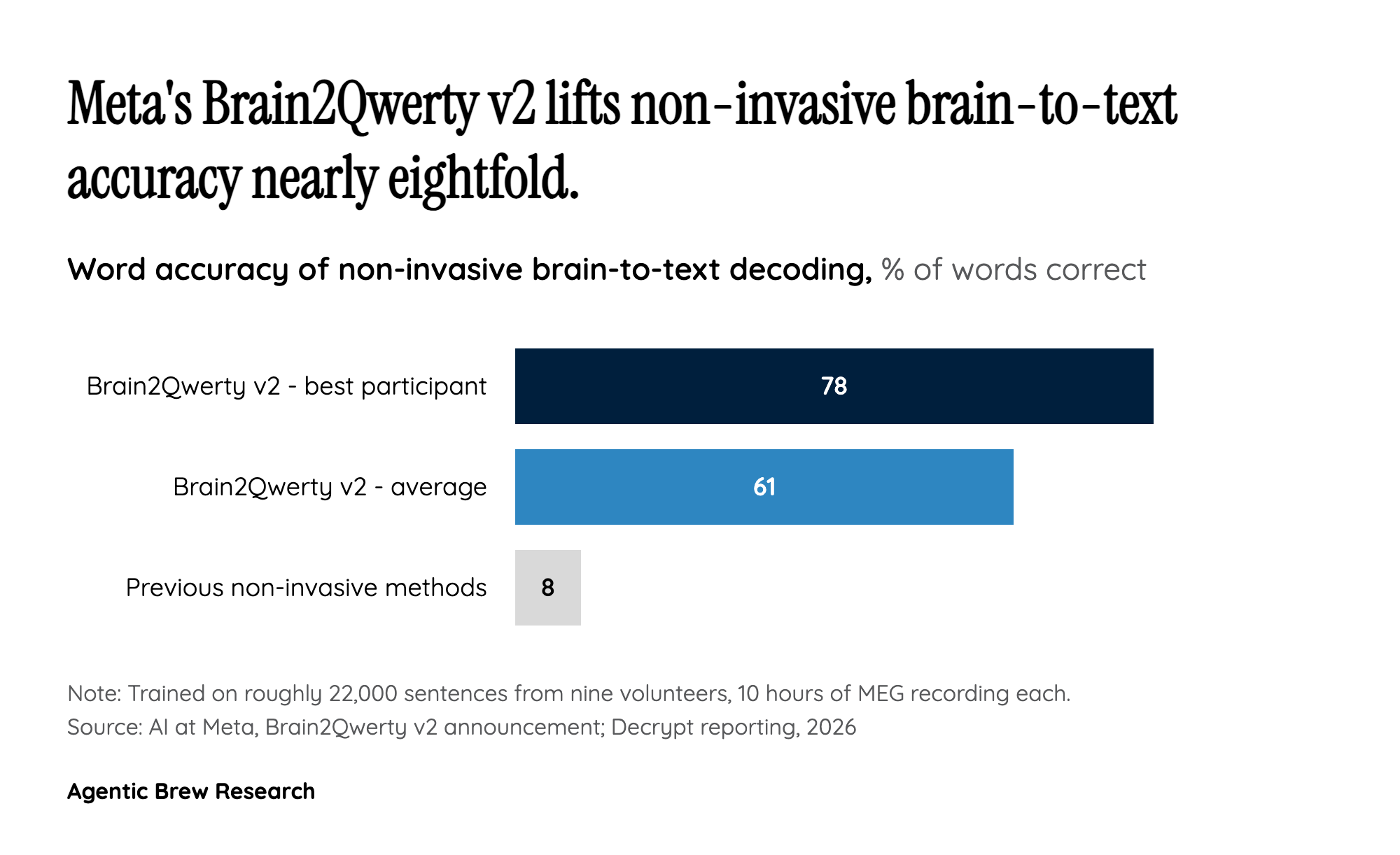
Non-invasive word accuracy: previous methods ~8%, Brain2Qwerty v2 averages 61%, with 78% for the best participant.

The headline is a step change, not an increment. Across all nine participants, v2 averages 61% word accuracy, against roughly 8% for previous non-invasive methods - close to an eightfold jump [2]. The best participant hits 78%, with more than half of decoded sentences carrying one word error or fewer [1]. Put against v1, which the team measured in character-error-rate (32% average, 19% for its best subject) on 35 volunteers, v2's move to a word-accuracy framing and a far larger per-subject dataset signals a model that is now competing on usable output rather than raw signal recovery [5]. The fuel for that gain is mostly scale: roughly 22,000 sentences and 10 hours of MEG per person, about ten times v1's training budget [4]. The honest read, echoed in community threads, is that 61% is genuinely impressive for surgery-free decoding yet still error-prone enough that nobody should mistake it for finished - and the nine-person sample keeps it firmly in the research-result column.

The hardware reality: a breakthrough that cannot leave the lab

Here is the catch that no amount of model tuning fixes. MEG scanners are room-sized, magnetically shielded machines that belong in research labs, not living rooms [3]. So while the decoding accuracy is the story, the sensor is the bottleneck: the very modality that makes v2 work is the one keeping it off your desk. Coverage and community discussion converged on the same two-part verdict - accuracy is not yet good enough for everyday use, and the hardware is nowhere near portable [3]. Cheaper, wearable EEG would be the obvious path to a home device, but EEG's signal quality lags badly (v1 logged a 67% character-error-rate with EEG against 32% for MEG), so the accuracy that makes the demo compelling currently depends on hardware that cannot ship. That gap between what the AI can do and what the sensor will allow is the real frontier here.

The positioning play: safer than Neuralink, opened to everyone, and the privacy shadow

Meta is drawing a clear contrast with the invasive camp. Where Neuralink, Synchron, and Merge Labs require surgery or implants, Meta frames Brain2Qwerty as the safer, more accessible route - one that gives up some performance in exchange for never opening a skull [2]. The stated motivation is restorative: helping people who have lost the ability to communicate because of brain lesions, with a non-invasive option that carries no surgical risk [1]. The open-science wrapper reinforces the pitch - Meta released the full training code for v1 and v2 and committed a $5M Digital Brain Project fund for open neuroscience datasets, arguing that progress in the open beats progress in silos [2]. Community reception was fascinated but wary: alongside the excitement ran a steady undercurrent of unease about a company famous for ad targeting building anything that reads brain activity, half-joked as 'ads injected into your mind.' It is a reputational tension Meta inherits no matter how clean the science - and one the imagined-typing caveat only partly defuses.

Historical Context

2025-02-18
Meta published the original Brain2Qwerty (v1) paper, 'Brain-to-Text Decoding: A Non-invasive Approach via Typing', decoding typed sentences from 35 healthy volunteers via M/EEG and reaching a 32% character-error-rate with MEG (19% for the best participant) versus 67% with EEG.
2026-06-29
Meta unveiled Brain2Qwerty v2, scaling training data roughly 10x over v1, reaching 61% average and 78% best-participant word accuracy, and releasing the training code plus a $5M open-dataset fund.

Power Map

Key Players
Subject

Meta Brain2Qwerty v2 non-invasive brain-to-text decoding

ME

Meta (FAIR / AI at Meta)

Developer of Brain2Qwerty v1 and v2; released full training code and is funding open neuroscience datasets via its Digital Brain Project to advance non-invasive BCI research.

BA

Basque Center on Cognition, Brain and Language (BCBL)

Research partner releasing the Brain2Qwerty v1 dataset and collaborating on MEG data collection.

NE

Neuralink, Synchron, Merge Labs

Invasive BCI competitors that require surgery or implants; Meta positions its non-invasive approach as a safer, more accessible alternative that trades some performance for safety.

NE

Neurable, AlterEgo

Other non-invasive interface efforts (EEG headphones, neuromuscular signals) referenced as the prior non-invasive landscape Brain2Qwerty v2 improves upon.

Fact Check

5 cited
  1. [1] Brain2Qwerty: Advancing non-invasive brain-to-text decoding
  2. [2] Meta's Brain2Qwerty AI Turns Brain Activity Into Text Without Surgery
  3. [3] Meta's Brain2Qwerty v2 turns thoughts into text, and it doesn't need brain implants
  4. [4] Brain2Qwerty v2 Project Page
  5. [5] Brain-to-Text Decoding: A Non-invasive Approach via Typing

Source Articles

Top 5

THE SIGNAL.

Analysts

"Argues that combining neuroscience advances with modern AI shows non-invasive BCIs are closer than previously believed, and frames the work as open science meant to speed the diagnosis and treatment of neurological disorders rather than progress made in silos."

Meta FAIR research team
AI at Meta

"Stresses the practical limitation that MEG scanners are large, expensive lab machines unsuitable for home use, and that 61% accuracy still produces too many errors for everyday clinical deployment."

Industry commentary (reported)
Reported in coverage
The Crowd

"We're sharing the next major milestone in our non-invasive brain-to-text decoder research: Brain2Qwerty v2. Building on v1, which was published today in @Nature, Brain2Qwerty v2 is the highest-performing end-to-end pipeline capable of real-time sentence decoding from raw brain"

@@AIatMeta10129

"SITUATION EXPLAINED: Meta just introduced Brain2Qwerty v2. • Brain2Qwerty v2 is the highest-performing non-invasive pipeline for real-time sentence decoding from raw brain signals • Uses MEG (magnetoencephalography) instead of EEG, magnetic fields pass through tissue better"

@@MTSlive87

"You won't need to speak to your Hermes agent anymore. Meta just dropped something quietly insane: non invasive brain -> text is starting to actually work. Brain2Qwerty v2 = decoding full sentences from MEG brain signals in real time. No implants. Key numbers: - 61% average"

@@analogalok13

"Meta improves Brain2QWERTY, a system that can decode text from brain activity to enable typing using non-invasive technologies, MEG and EEG"

@u/Distinct-Question-16513
Broadcast
Meta's Brain2qwerty converts your brain signals into a text

Meta's Brain2qwerty converts your brain signals into a text

Meta AI Cerebro a Texto con Brain2Qwerty: ¡Escribir con el Pensamiento es Real!

Meta AI Cerebro a Texto con Brain2Qwerty: ¡Escribir con el Pensamiento es Real!

Will Brain Scanners Replace Traditional KEYBOARDS? Meta's Brain2QWERTY Turns Your Thoughts into Text

Will Brain Scanners Replace Traditional KEYBOARDS? Meta's Brain2QWERTY Turns Your Thoughts into Text