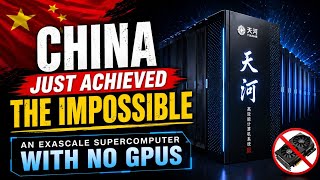
China's LineShine tops TOP500 supercomputer ranking
TECH

China's LineShine tops TOP500 supercomputer ranking

24+
Signals

Strategic Overview

  • 01.
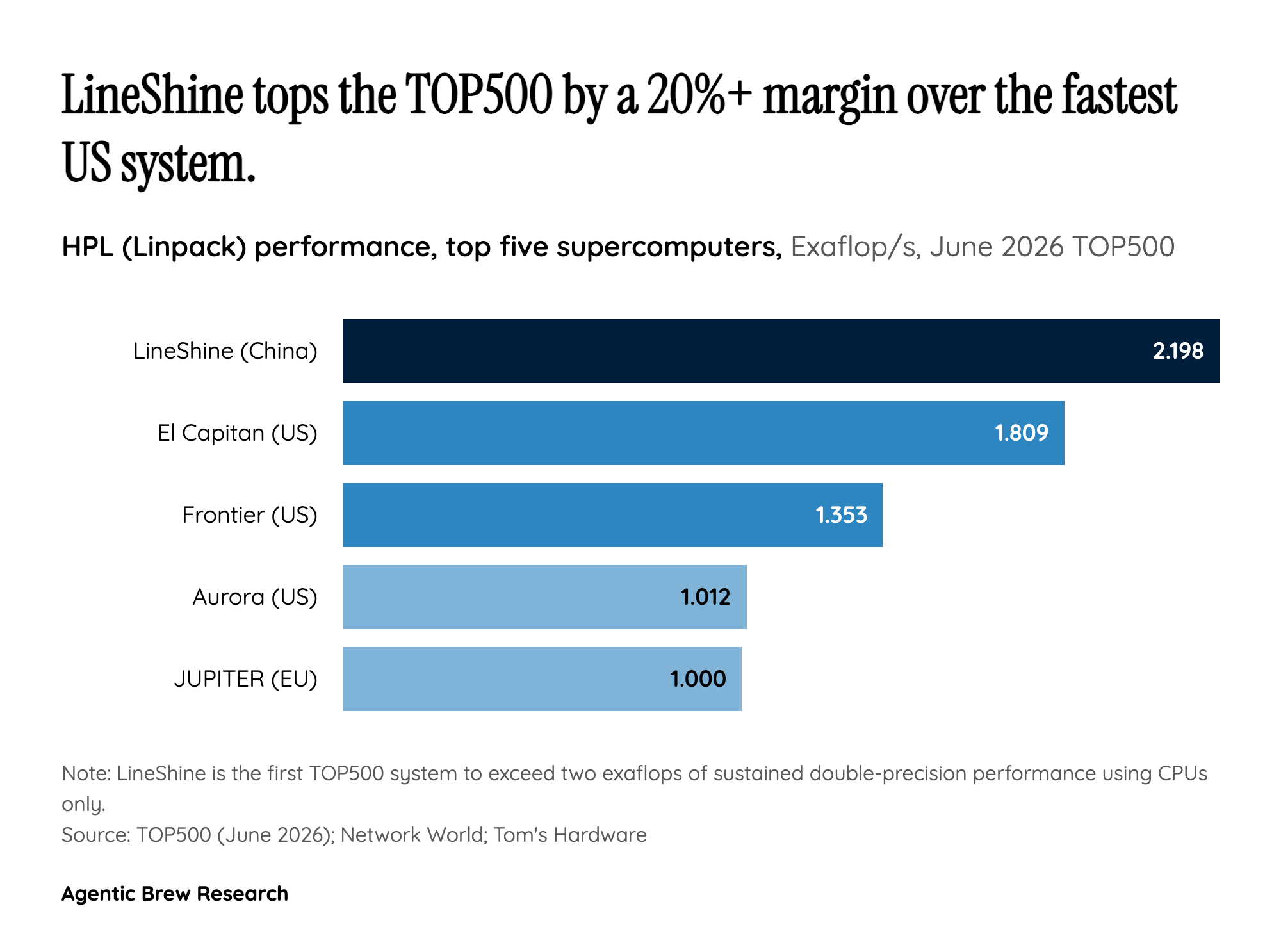
    LineShine debuted at No. 1 on the June 2026 (67th edition) TOP500 list announced June 23, 2026 at ISC 2026 in Hamburg, displacing El Capitan as the world's fastest supercomputer on the HPL (Linpack) benchmark.
  • 02.
    It achieved 2.198 Exaflop/s on HPL (about 80% of its 2.736 EF/s theoretical peak) — the first TOP500 system to exceed two exaflops of sustained double-precision performance using CPUs only.
  • 03.
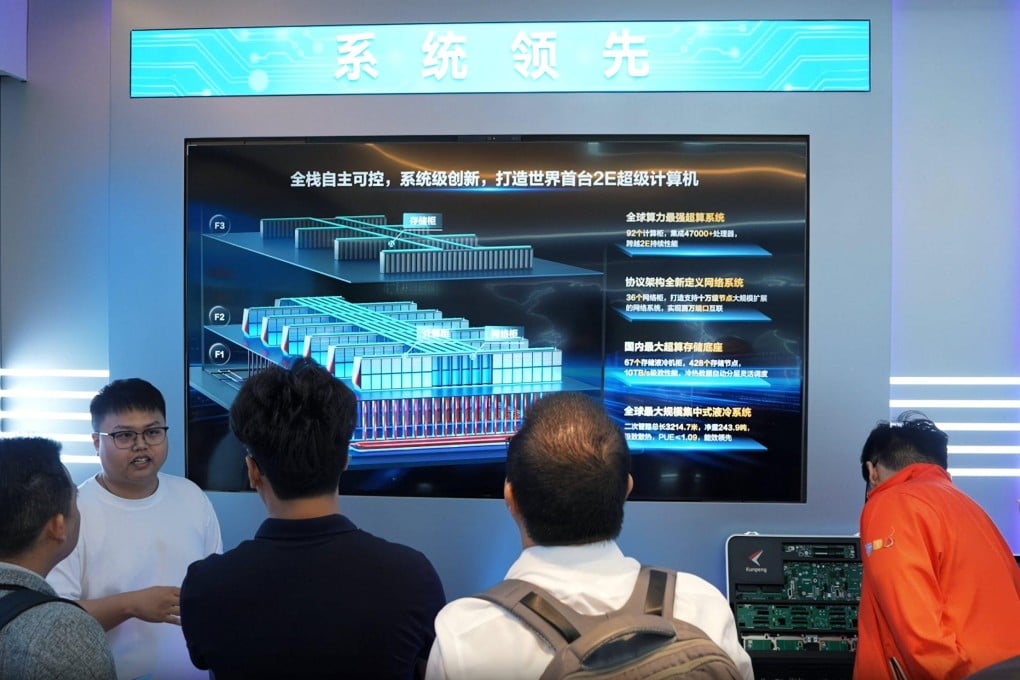
    LineShine is a fully domestic CPU-only design built around China's LingKun platform (304-core Armv9-based LX2 processors at 1.55 GHz, ~13.79 million cores), the proprietary LingQi interconnect, and the Kylin operating system.
  • 04.
    It is the first China-based system to lead the TOP500 since Sunway TaihuLight in 2017, ranking No. 1 on HPCG but only 4th on HPL-MxP, the mixed-precision benchmark that resembles AI training workloads.

Deep Analysis

The breakthrough isn't the CPU — it's stitching 13.8 million cores together

LineShine's headline is that it hit exascale with zero GPUs, but the harder engineering problem it solved is the network. The machine is built from 304-core LX2 processors on China's LingKun platform, totaling roughly 13.79 million cores, and lashes them together with a proprietary LingQi interconnect on the Kylin OS [4]. Reaching 2.198 exaflops on Linpack — about 80% of its 2.736 EF/s theoretical peak — means the interconnect is keeping that ocean of cores fed efficiently enough to sustain double-precision math at scale [1]. Technical readers parsing the design landed on the same conclusion: the standout is the LingQi fabric and the converged HPC-plus-AI topology, not the cores themselves, which several observers note resemble Japan's Fugaku (Fujitsu's A64FX many-core, big-vector approach) far more than they resemble Google TPUs. CPUs with wide vector and matrix extensions, not accelerators, are doing the heavy lifting — and the network is what turns millions of them into one coherent machine.

The export blockade didn't stop the exam — it just changed the questions

LineShine is, by design, a workaround. It deliberately omits the GPUs and AI accelerators that fall under US export controls and is assembled entirely from homegrown Chinese CPUs [2][3]. That all-CPU choice is the policy story in silicon: denied access to the fastest accelerators, China optimized the one path it fully controls. TOP500 co-founder Jack Dongarra read the result as proof that "China can adapt to develop its own version of technology as good as - or maybe even better than - existing technology, despite US export controls" [2]. Analysts also see deliberate messaging in the public submission — China stopped reporting to the TOP500 in 2019 amid US semiconductor restrictions [5], so choosing to surface this system now is itself a signal aimed squarely at the argument that the blockade is working [3].

Fastest at what? HPL #1, AI #4, and the systems nobody submitted

Fastest at what? HPL #1, AI #4, and the systems nobody submitted
HPL (Linpack) performance of the top five supercomputers on the June 2026 TOP500 list, in Exaflop/s.

The "world's fastest supercomputer" label is doing a lot of work. LineShine is genuinely No. 1 on HPL (classical 64-bit Linpack) and No. 1 on HPCG, the benchmarks that matter for traditional scientific computing. But on HPL-MxP — the mixed-precision test that most resembles AI training — it ranks only 4th at 7.92 exaflops [1]. Experts are blunt that this is not the fastest AI machine: Jimmy Goodrich argues that if cloud hyperscalers submitted their AI clusters, this system "would not crack the top five" [3]. That caveat dominated independent commentary too — the recurring honest catch being that topping Linpack with CPUs is a real feat but says little about who wins the AI race, and that the largest AI systems simply aren't on the list.

The efficiency tax of going GPU-free

Raw speed came with a power bill. LineShine draws roughly 42.2 MW and delivers about 52.07 GFLOPS/W, while the El Capitan system it dethroned runs at 60.94 GFLOPS/W despite lower peak performance [1]. In other words, the all-CPU design buys the crown but is meaningfully less energy-efficient per FLOP than the accelerator-based US machine — a tradeoff critics flag as the structural weakness of substituting many CPUs for purpose-built accelerators, where $/FLOP and watts ultimately decide who can run the largest sustained workloads economically.

Historical Context

2016
China's Sunway TaihuLight topped the TOP500 (fastest from June 2016 to June 2018); LineShine is the first Chinese No. 1 since.
2019
China stopped submitting Linpack results to the TOP500 from 2019, partly due to US semiconductor export restrictions; Sugon and NSC Wuxi were placed on the US export blacklist.

Power Map

Key Players
Subject

China's LineShine tops TOP500 supercomputer ranking

NA

National Supercomputing Centre in Shenzhen (NSCS) / Shenzhen Cloud Computing Center

Host site and builder of LineShine

EL

El Capitan (Lawrence Livermore National Laboratory)

Previous No. 1, now No. 2; US system used for nuclear weapons stockpile work

JA

Jack Dongarra

TOP500 co-founder, commented on the milestone

US

US export controls / hyperscalers

Policy backdrop; cloud providers' (uncounted) AI systems would outrank LineShine per analysts

Fact Check

5 cited
  1. [1] LineShine Debuts at No. 1 as the TOP500 Enters a New Global Exascale Era
  2. [2] Return to the top: China's LineShine beats US El Capitan in TOP500 supercomputer rankings
  3. [3] China beats US with world's fastest supercomputer, but race not geared for AI work
  4. [4] China's LineShine dethrones El Capitan as the world's fastest supercomputer
  5. [5] China's supercomputer Sunway TaihuLight falls to sixth place

Source Articles

Top 5

THE SIGNAL.

Analysts

"Argues the 'world's fastest' title is misleading for AI because major cloud AI systems were never submitted: "If the hyperscalers submitted their systems, this 'world's fastest' would not crack the top five." He frames the achievement as Chinese messaging aimed at the policy debate: "China is hoping to convince the world export controls are useless by hoping we ignore the details.""

Jimmy Goodrich
Senior Fellow, UC Institute for Global Conflict and Cooperation

"Says the raw capability was expected but the public bid for recognition was the real surprise: "I'm not surprised it's the number one system. What I'm surprised by is that they submitted it and want recognition for it.""

Addison Snell
CEO, Intersect360 Research

"Reads the result as evidence that domestic substitution is working: "China can adapt to develop its own version of technology as good as - or maybe even better than - existing technology, despite US export controls." He also noted this is the first time a CPU-only computer has reached exascale."

Jack Dongarra
TOP500 co-founder
The Crowd

"China's LineShine supercomputer dethrones El Capitan in Top 500 list https://t.co/wrFMQ4zpoH"

@@tomshardware25

"China plans CPU-only exascale supercomputer with 47,000 homemade processors, record 2 Exaflops of performance without GPUs — Lingshen super said to use Huawei Kunpeng servers and no foreign-made components https://t.co/0nAfHc5WQd"

@@tomshardware68

"China's LineShine supercomputer to hit 2 exaFLOPS with 47,000 CPUs and zero reliance on foreign chips. https://t.co/U5G7rjPlpD"

@@wccftech26

"China bypasses US GPU bans with 1.54-exaflops 'LineShine' supercomputer — CPU-only monster packs 2.4 million Huawei-designed Armv9 cores"

@u/Steap-Edit358
Broadcast
China Just Built The World's Fastest Supercomputer — Without A Single GPU

China Just Built The World's Fastest Supercomputer — Without A Single GPU

China Just Built A Supercomputer With Zero GPUs — And It Might Beat The US

China Just Built A Supercomputer With Zero GPUs — And It Might Beat The US

How Huawei's 2.4 Million-Core LineShine Killed Nvidia's China Moat

How Huawei's 2.4 Million-Core LineShine Killed Nvidia's China Moat