Meta Compute cloud business to sell excess AI compute
TECH

Meta Compute cloud business to sell excess AI compute

29+
Signals

Strategic Overview

  • 01.
    Meta is building a cloud computing business called Meta Compute to sell surplus AI infrastructure capacity to outside customers.
  • 02.
    Meta is weighing two service models - a hosted AI model service similar to Amazon Bedrock, and raw GPU compute sold as infrastructure-as-a-service that would compete directly with CoreWeave and Nebius.
  • 03.
    Meta shares jumped about 8.8% on July 1, 2026 while neocloud rivals CoreWeave and Nebius fell roughly 14-15% and 17% respectively.
  • 04.
    The move is framed as a way for Meta to recoup its colossal AI capex, which it has committed roughly $182.9 billion to and guided at $125-145 billion for 2026.

Deep Analysis

Two Doors Into the Cloud: Bedrock's Twin, or CoreWeave's Understudy

Meta Compute is not one product but a fork in the road. The first path is a hosted AI model service modeled on Amazon Bedrock [1], where enterprises tap models - including Meta's own closed-weight Muse Spark and Llama - through APIs without managing infrastructure. The second is raw GPU compute rented as infrastructure-as-a-service, competing head-on with the neoclouds CoreWeave and Nebius [1].

The two doors imply very different businesses. The hosted-model route keeps Meta higher up the value chain, bundling its software and models where margins can hold. The raw-compute route is closer to a commodity: renting out idle Nvidia capacity by the hour. That distinction matters because it decides whether Meta is selling something differentiated or simply becoming a landlord for GPUs. SemiAnalysis has framed the range of uses even more broadly - Meta could deploy this compute for its own models, ad scaling, SpaceX-style neocloud deals, or hosting third-party models, and may be close to an Anthropic hosting arrangement [6].
Follow the Money: A $180B Buildout in Search of a Return

Follow the Money: A $180B Buildout in Search of a Return
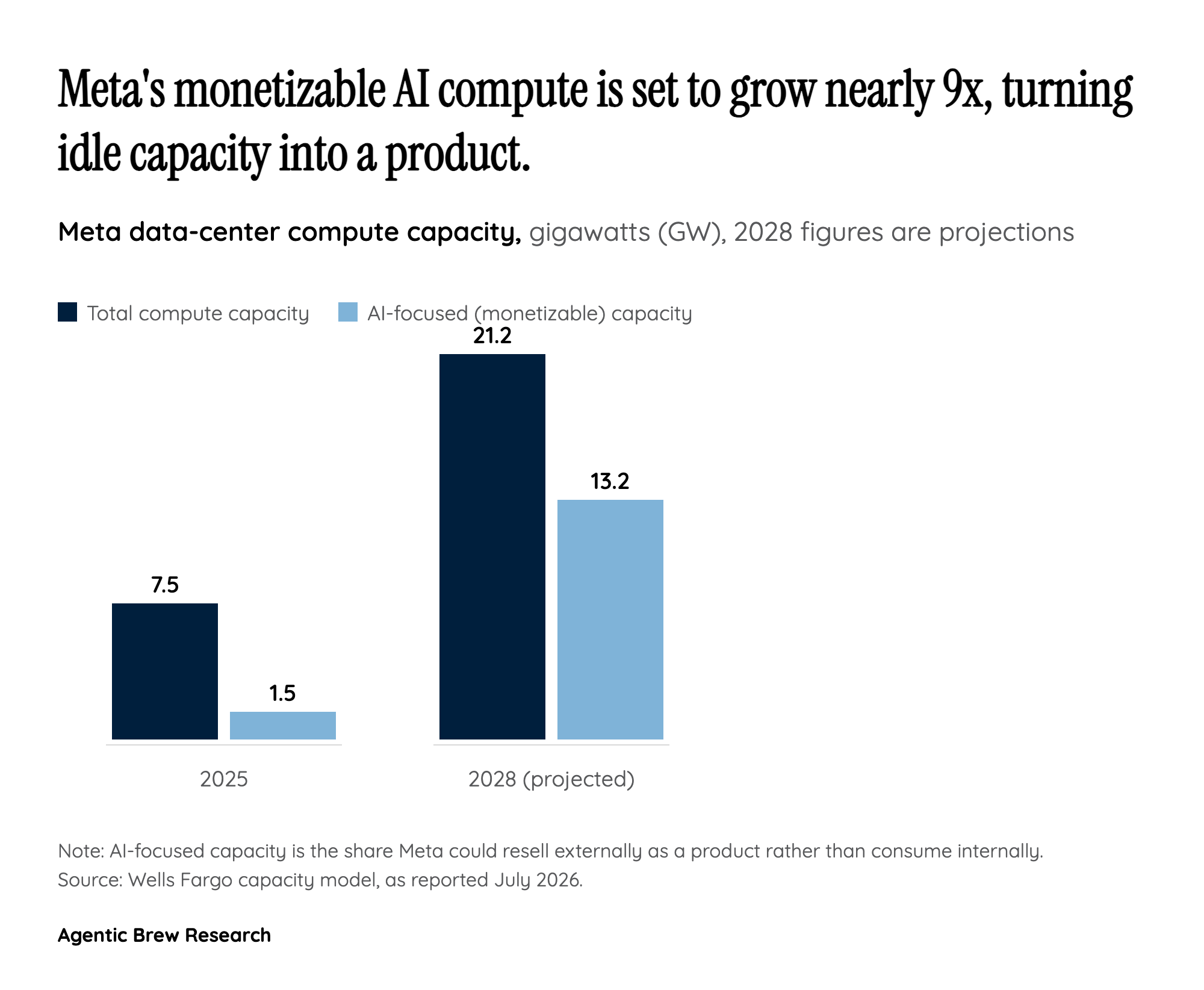
Meta's total data-center compute is set to nearly triple by 2028, while its AI-focused, resellable capacity grows roughly 9x - the surplus that Meta Compute turns into a product.

The financial logic starts with the size of the check. Meta has committed roughly $182.9 billion to AI infrastructure and may copy CoreWeave's playbook to earn a return on that spend [2]. Its 2026 capex forecast climbed to $125-145 billion, and cumulative capex is projected near $850 billion for 2026-2030, implying about 19 GW of capacity at roughly $45 billion per gigawatt [4].

Against that, the upside case is large but conditional. BofA estimates $100 billion to $150 billion in incremental revenue if Meta monetizes half its capacity at $10-15 billion per gigawatt [4]. Wells Fargo's math is even more aggressive, modeling $20 billion in revenue per gigawatt at an 85% operating margin, so a single gigawatt of resale could add around $17 billion in operating income. The catch is concentration: advertising still supplied $55.02 billion of Meta's $56.31 billion in Q1 revenue, and a lower-margin cloud line could pressure the 41% operating margin investors have priced in. The bull case needs scale before the margin math works.

The Contrarian Read: Are These Leftovers or a Land Grab?

The market's applause and the crowd's skepticism are looking at the same fact and drawing opposite conclusions. Bullish voices on X read it as Meta declaring war on AWS, Azure, and GCP, and treat the announcement as validation that AI demand is real and durable. Wells Fargo took a similar line, saying it does not expect a pullback in Meta's capex or that overall compute needs are lower - it reads the pivot as confirmation of the AI infrastructure opportunity.

The Reddit and skeptical-analyst read is the mirror image. If one of the world's largest AI infrastructure buyers now has capacity to spare, the demand it built for may not have materialized. One widely shared framing captured the tension bluntly: six months ago these companies said there was not enough compute in the world, and now Meta is selling its leftovers. One prominent finance commentator argued the market may go from three or four major AI compute sellers to six just as customers get more efficient with tokens, warning of a possible speed bump. Even the bullish outlets concede the capex read-through is ambiguous: excess compute could signal a lower forward bill, or it could be a bet on the breadth of downstream demand rather than a demand-down tell [5].

Who Wins, Who Loses: A Supplier Turns Competitor

The cleanest casualties are the pure-play neoclouds. CoreWeave fell about 14-15% and Nebius roughly 17%, with IREN and Cipher also hit, as investors discounted the survival odds of independent compute providers now facing a well-capitalized hyperscaler entrant [1]. The twist is that Meta is simultaneously CoreWeave's largest customer through a roughly $21 billion commitment, against a backlog near $99.4 billion [3]- so Meta is entering the market of the very supplier it depends on.

Not every analyst reads the neoclouds as dead, though. Some argue the selloff overshoots, framing CoreWeave and Nebius as undervalued and the Meta announcement as proof the infrastructure category is where the value accrues. Meta's own margin story is the counterweight to its revenue story: BofA cautions that without scale, chip-cost, or model advantage the enterprise compute business could be structurally low-margin [4], which is exactly why Wall Street's initial cheer may need to be tempered as the unit economics come into focus.

Historical Context

2026-01
Meta became CoreWeave's largest customer via a roughly $21 billion commitment signed earlier in 2026, part of a backlog that reached $99.4 billion.
2026-07-01
Bloomberg reported Meta is building a cloud business called Meta Compute to sell excess AI compute, triggering Meta's stock surge and a selloff in neocloud names.

Power Map

Key Players
Subject

Meta Compute cloud business to sell excess AI compute

SA

Santosh Janardhan

Meta's Head of Infrastructure; co-leads the Meta Compute initiative overseeing the buildout and operations of AI infrastructure.

DI

Dina Powell McCormick

Meta President; co-leads Meta Compute alongside an executive from Meta Superintelligence Labs, signaling the effort has top-level backing.

MA

Mark Zuckerberg

Meta CEO, who had publicly said entering this business was definitely on the table and noted companies routinely ask Meta to buy compute from it.

CO

CoreWeave (CRWV)

Pure-play neocloud rival whose stock fell about 14-15% on the news; it is also Meta's supplier, with Meta as its largest customer via a roughly $21 billion commitment.

AM

Amazon AWS, Microsoft Azure, Google Cloud

Incumbent hyperscalers Meta would compete against; AWS Bedrock is the explicit reference model for Meta's hosted-model offering.

Fact Check

6 cited
  1. [1] Meta Unveils Meta Compute Cloud Business to Sell Excess AI Infrastructure to Outside Customers
  2. [2] Meta, like SpaceX, looks to turn excess AI compute into cash
  3. [3] Meta AI compute push could reshape the neocloud market
  4. [4] Meta's Potential AI Cloud Business Could Drive Higher Capex To Build Out Infrastructure, BofA Says
  5. [5] Meta surges on report it is entering the cloud business to sell excess compute
  6. [6] Meta Compute: Everyone Wants to Be a Neocloud

Source Articles

Top 5

THE SIGNAL.

Analysts

"Maintained a Buy rating with an $835 price target, estimating $100 billion to $150 billion in incremental revenue potential if Meta monetizes 50% of capacity externally at $10-15 billion per gigawatt."

Justin Post
Analyst, BofA Securities

"Warns that building an enterprise compute business without an established scale, chip cost, or model advantage could result in a low-margin business."

Justin Post
Analyst, BofA Securities

"Sees Meta following in the footsteps of neoclouds such as CoreWeave and Nebius that offer AI-specific compute built on Nvidia chips and systems."

Mark Mahaney
Analyst, Evercore ISI

"Argues Meta getting into the cloud business has been inevitable for a long time as it seeks to diversify beyond ad revenue and monetize its AI buildout, noting Meta has 5 GW of compute across data centers."

M.G. Siegler
Writer, Spyglass
The Crowd

"$META is up 7% on the Meta Cloud announcement. Zuck just declared war on AWS, Azure, and GCP."

@@InTheAssembly469

"We went from 3, maybe 4 major AI compute sellers to potentially 6 Amazon, Microsoft, Google, maybe Oracle. Now add SpaceX and Meta... just as customers are getting more efficient w tokens. "You could have a pretty decent-sized speed bump in here" - @DanielTNiles"

@@dee_bosa290

"CoreWeave and Nebius are two of the most undervalued stocks in the entire AI infrastructure space (Save this). And the Meta cloud announcement this week just made the case more obvious than ever. When Meta announced it is building a cloud business to sell excess compute at"

@@MilkRoadAI262

"Meta Is Building a Cloud Business to Sell Excess AI Compute"

@u/jsg24fps747
Broadcast
Meta to build cloud infrastructure business to sell AI compute

Meta to build cloud infrastructure business to sell AI compute

Meta to Build Cloud Business to Sell Excess AI Compute | Bloomberg Tech 7/01/2026

Meta to Build Cloud Business to Sell Excess AI Compute | Bloomberg Tech 7/01/2026

ALERT: Meta Is Building an AWS-Style Cloud to Monetise Its $145B AI Spend

ALERT: Meta Is Building an AWS-Style Cloud to Monetise Its $145B AI Spend