Google AI Mode ad formats
TECH

Google AI Mode ad formats

29+
Signals

Strategic Overview

  • 01.
    At Google Marketing Live 2026, Google unveiled a Gemini-powered ad stack for AI Mode and Search including Conversational Discovery ads, Highlighted Answers, AI-powered Shopping ads and Business Agent for Leads.
  • 02.
    Conversational Discovery ads use Gemini to dynamically generate creative tailored to the user's exploratory prompt rather than relying on keyword targeting, while Highlighted Answers place ads directly inside AI Mode's recommendation lists.
  • 03.
    Business Agent for Leads embeds a Gemini-powered brand chatbot inside lead-gen ads so users can chat instead of filling out a static form; it is in open beta in English.
  • 04.
    Google also integrated Gemini Omni, its multimodal model, into Asset Studio so advertisers can generate text, image and video assets in one workspace, and added 1-Click Creative Testing.

The Ad Just Moved Inside the Answer

For two decades, paid results on Google sat next to the page that answered your question. Marketing Live 2026 broke that convention. Highlighted Answers makes high-quality ads eligible to appear directly inside AI Mode's recommendation lists rather than alongside traditional search results, moving ads closer to the recommendation itself [1]. Conversational Discovery ads go further: instead of relying primarily on keyword targeting, Gemini generates tailored creative and surfaces product features tied to the context of the conversation [1]. The ad surface is no longer a slot on a results page; it is a sentence inside a generated answer.

The mechanism reaches into the lead-gen and shopping funnels too. Business Agent for Leads embeds a Gemini-powered brand chatbot directly within a lead-gen ad so a user can click 'Chat' and get site-grounded answers instead of filling out a static form, and it is already in open beta in English [2]. AI-powered Shopping ads let Gemini pull a brand's most relevant products and instantly write a custom explainer highlighting why a given product may be the right choice for a specific shopper, aimed at high-consideration purchases like TVs, appliances and espresso machines [3]. The structural change is that the conversion experience now happens inside the ad unit itself.
Why Google Had to Do This Now

Why Google Had to Do This Now
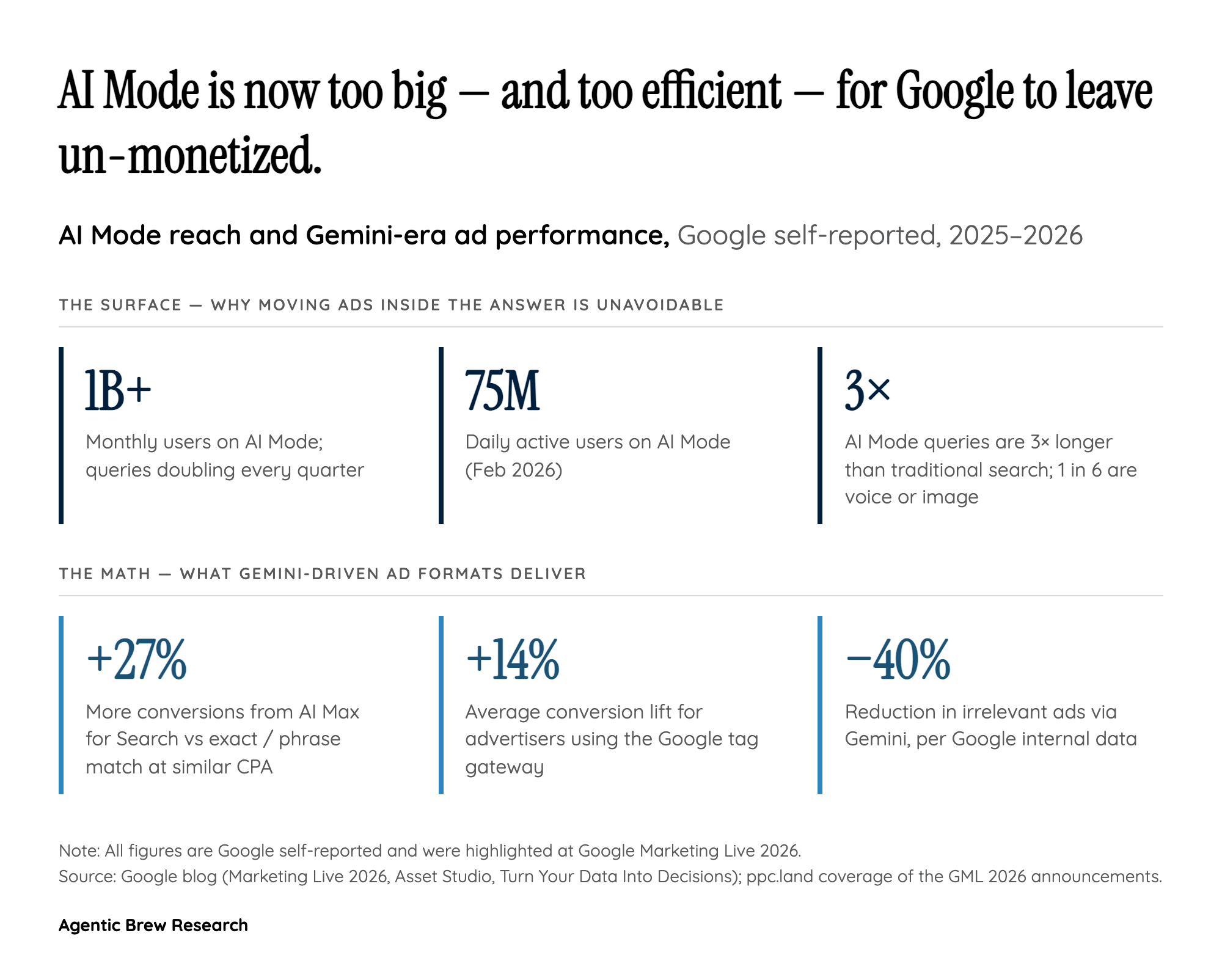
AI Mode growth (1B monthly users, 75M DAU, 3x longer queries) sets up the math (+27% conversions, +14% lift, -40% irrelevant ads) that makes embedding ads inside the Gemini answer rational defensive monetization.

Google did not invent Conversational Discovery ads because they were elegant. It built them because the search ads business has to follow users into a generative surface where the old slot model does not exist. AI Mode has surpassed 1 billion monthly users with queries more than doubling every quarter, and as of February 2026 the surface was already running at 75 million daily active users [4]. Behavior is also moving away from keyword shapes: AI Mode searches are on average 3x as long as traditional searches, and 1 in 6 queries are non-text (voice or image) [4]. Every one of those longer, multimodal sessions is a query Google previously had no native way to monetize.

The economic argument lines up. Google reports that 75% of people make faster, more confident decisions using AI Mode in Search [3], and AI Max for Search delivers 27% more conversions at a similar CPA or ROAS versus exact and phrase match [4]. Advertisers using the Google tag gateway see an average 14% conversion lift [5], and Gemini reportedly reduces irrelevant ads by 40% in Google's internal data [6]. Stitch those numbers together and the picture is consistent: longer queries, more confident buyers, higher conversion rates, lower waste — exactly the conditions under which moving ads inside the answer is rational defensive monetization against ChatGPT and other AI assistants.

The 'Sponsored' Tag Problem

When the ad sits next to the answer, a small label is enough. When the ad is the answer, the label is the entire defense. MakeUseOf calls the embedded conversational ads 'somewhat dystopian' and warns that 'if you don't know the difference already, you might end up falling for a conversational answer that's really just an advertisement' [7]. Google insists all formats are clearly labeled 'Sponsored' and are being tested in the U.S. on mobile and desktop [2], but the labeling burden is now on a tiny tag attached to recommendation copy that reads in the same voice and font as Gemini's own.

Practitioner sentiment matches the editorial concern. The r/PPC reaction skews toward resignation and skepticism: AI Max is repeatedly framed as a 'trap' that pushes advertisers into a broad-match black box, reporting for the new placements is described as thin, and there is real anxiety about ads being baked into the model's answers themselves rather than served alongside them. There is a credibility gap on the other side too: secondary commentary on X notes that Google is drawing a careful line — Gemini stays ad-free, AI Mode gets ads — even as the same Gemini model writes the explainer copy, generates the creative and chats with the user inside the ad. That line is hard to hold once the model is on both sides of the transaction.

What Advertisers Should Actually Do

The blunt practitioner advice from r/PPC is to not flip to AI Max overnight: ease in via broad match, pair AI with value-based bidding, and treat landing-page quality as the lever you actually control. That maps cleanly onto Brooke Osmundson's warning that the keywordless shift raises the bar on creative, landing pages and first-party signals, and that 'measurement and optimization may become far more complicated as searches become longer, more conversational, and less tied to traditional keyword behavior' [1]. The advertisers who lose in the next two quarters will be the ones who let Gemini generate creative against thin product feeds and weak conversion signals.

The near-term playbook is concrete. Get structured product data and landing pages in shape before turning on AI-powered Shopping ads, because Gemini will pull your most relevant products and write a custom explainer from whatever it can read [3]. Stand up first-party measurement — Gaurav Bhaya frames it bluntly: 'measurement is your engine for growth in the AI era' [5]. Then test the new formats where they map to a real funnel: Business Agent for Leads is in open beta for lead-gen advertisers like universities [2], Conversational Discovery ads and Highlighted Answers are in U.S. test on mobile and desktop, and Asset Studio's Gemini Omni and 1-Click Creative Testing roll out globally in English this summer 2026 [8]. The asymmetry favors SMBs — 83% of U.S.-based small businesses are already using AI through Google's ads platform [9]— because generative creative collapses the production cost that used to keep them out of video and multimodal campaigns.

Historical Context

2024-05
Google first deployed AI Overviews in the United States, beginning the embedding of generative AI into search results.
2025-08-04
Search Engine Land reported on an internal Google briefing that AI Mode ads (Performance Max and AI Max for Search) would expand to over 100 million users in Q4 2025, with targeting based on full conversation context.
2026-02
AI Mode hit 75 million daily active users and Vidhya Srinivasan publicly emphasized that Gemini is now used everywhere in the ads stack.
2026-05-20
At Google Marketing Live 2026, Google unveiled Conversational Discovery ads, Highlighted Answers, Business Agent for Leads, AI-powered Shopping ads, Direct Offers expansion and Gemini Omni in Asset Studio.
2026-05-20
Google announced it is replacing Dynamic Search Ads with AI Max for Search for all advertisers, moving AI Max out of beta.

Power Map

Key Players
Subject

Google AI Mode ad formats

GO

Google (Ads & Commerce)

Platform owner rolling out Gemini-powered ad formats; controls placement of ads inside AI Mode answers and recommendation lists, monetizing the AI search surface.

AD

Advertisers and brands

Must adapt to keywordless, conversational targeting; success now depends more on creative quality, structured product data and first-party signals fed to Gemini.

SM

Small and mid-sized businesses (SMBs)

Stand to gain visibility in AI-driven discovery moments previously dominated by large brands; 83% of U.S. SMBs already use AI through Google's ads platform.

LE

Lead-gen advertisers (e.g., universities)

Early adopters of Business Agent for Leads; a prospective student can chat directly inside the ad and receive instant answers grounded in the advertiser's site.

UC

UCP merchants and travel partners (Booking, Expedia)

Pilots for Direct Offers expansion with native checkout and travel deal surfacing inside AI Mode.

CO

Content creators and publishers

Face displacement risk as ads embed inside AI answers themselves, potentially diverting attention and revenue away from organic web results.

Fact Check

10 cited
  1. [1] Google Introduces New Ad Formats In AI Mode
  2. [2] Google tests new conversational ad formats in AI Mode and Search
  3. [3] Search Ads and AI Mode: Google Marketing Live 2026
  4. [4] Google's new AI search ad formats reshape how brands reach buyers
  5. [5] Turn Your Data Into Decisions at Google Marketing Live 2026
  6. [6] Asset Studio gets Gemini Omni and 1-Click Creative Testing at GML 2026
  7. [7] Google's New AI Search Will Have Ads Hidden in Your Answers
  8. [8] Asset Studio: Updates from Google Marketing Live 2026
  9. [9] Most Small Businesses Are Using AI for Ads. What's Working, According to a Google Exec
  10. [10] Upgrading Dynamic Search Ads to AI Max for Search

Source Articles

Top 4

THE SIGNAL.

Analysts

"Frames the launch as Google's transition from 'marketing automation to marketing intelligence' and from AI's potential to its everyday reality: 'I see us fully transitioning from AI's potential into its everyday reality.'"

Dan Taylor
VP of Global Ads, Google

"Emphasizes that Gemini is now woven across every Google Ads surface, including the new conversational formats and Asset Studio: 'We use Gemini everywhere.'"

Vidhya Srinivasan
VP and GM of Google Ads and Commerce

"Positions measurement as the prerequisite for unlocking AI-era growth: 'Measurement is your engine for growth in the AI era.'"

Gaurav Bhaya
VP & GM Buying, Analytics and Measurement, Google

"Warns that the keywordless shift raises the bar on creative, landing pages and first-party signals, and that 'measurement and optimization may become far more complicated as searches become longer, more conversational, and less tied to traditional keyword behavior.'"

Brooke Osmundson
Staff writer, Search Engine Journal

"Describes the embedded conversational ads as 'somewhat dystopian' because the small 'Sponsored' tag is easy to miss: 'if you don't know the difference already, you might end up falling for a conversational answer that's really just an advertisement.'"

MakeUseOf editorial
Consumer tech publication
The Crowd

"At Google Marketing Live we shared updates on how we're testing new ad formats built with Gemini in Search (and AI Mode), and expanding our Direct Offers pilot to help brands allow different types of promotions."

@@NewsFromGoogle34

"Asset Studio: Your creative home in Google Ads. We've integrated our most advanced models - Gemini, Veo and Nano Banana - into Asset Studio. And this summer, we're adding our latest model, Gemini Omni. Ingest, scale, and measure your assets in one place. #GML2026"

@@GoogleAds20

"Conversational attributes: In the coming months, we're rolling out dozens of new data attributes in Merchant Center designed for easy discovery in the conversational commerce era, on surfaces like AI Mode, Gemini and Business Agent."

@@GoogleAds4

"Google Ads are now in Google AI Mode and supposedly in AI Overviews. Have you already seen them?"

@u/mr_google_DE8
Broadcast
Google Marketing Live 2026

Google Marketing Live 2026

Google Ads in 2026: Everything You Need to Know in 5 Minutes

Google Ads in 2026: Everything You Need to Know in 5 Minutes

Google Marketing Live 2026 in under 15 minutes

Google Marketing Live 2026 in under 15 minutes