DOJ intervenes to dismiss NAACP Clean Air Act lawsuit against xAI gas turbines
TECH

DOJ intervenes to dismiss NAACP Clean Air Act lawsuit against xAI gas turbines

34+
Signals

Strategic Overview

  • 01.
    On June 16, 2026, the Trump administration's Department of Justice moved to intervene in and dismiss the NAACP's Clean Air Act lawsuit against xAI, arguing that shutting down the data center's gas turbines would threaten American national, economic, and energy security.
  • 02.
    The NAACP, represented by the Southern Environmental Law Center and Earthjustice, sued xAI and its subsidiary MZX Tech in April 2026 for running unpermitted methane gas turbines that power the Colossus 2 data center near Memphis in Southaven, Mississippi.
  • 03.
    The DOJ argued that xAI's Grok model is one of only four AI systems cleared for mission-critical work on top-secret government networks and was used in recent U.S. military operations against Iran.
  • 04.
    The DOJ also contended that the NAACP lacks legal standing to bring the complaint.

Deep Analysis

The Justice Department Just Declared a Private Data Center Too Vital to Sue

The remarkable thing about the DOJ's intervention is not that the federal government took a side, but how it took one. Rather than file a friend-of-the-court brief, the Justice Department moved to formally intervene in the case and asked the court to throw it out entirely, arguing that ruling against xAI "threatens American national, economic, and energy security" [1]. In effect, the government inserted itself as a party in a private pollution dispute and asked a judge to dismiss a citizen-enforcement suit before it could ever be argued on the merits.

The posture compounds the significance. Here the federal government deployed its litigating power to extinguish a citizen-brought environmental claim rather than to pursue a polluter [2]. Alongside the security argument, the DOJ also contended that the NAACP lacks standing to bring the case at all, a procedural lever that, if accepted, would let the court avoid the harder questions about whether the turbines are actually legal. Taken together, the filing reframes a methane-emissions fight as a matter of state secrecy and war-fighting capacity, a framing that few ordinary defendants could ever invoke.

The Loophole on Wheels

The Loophole on Wheels
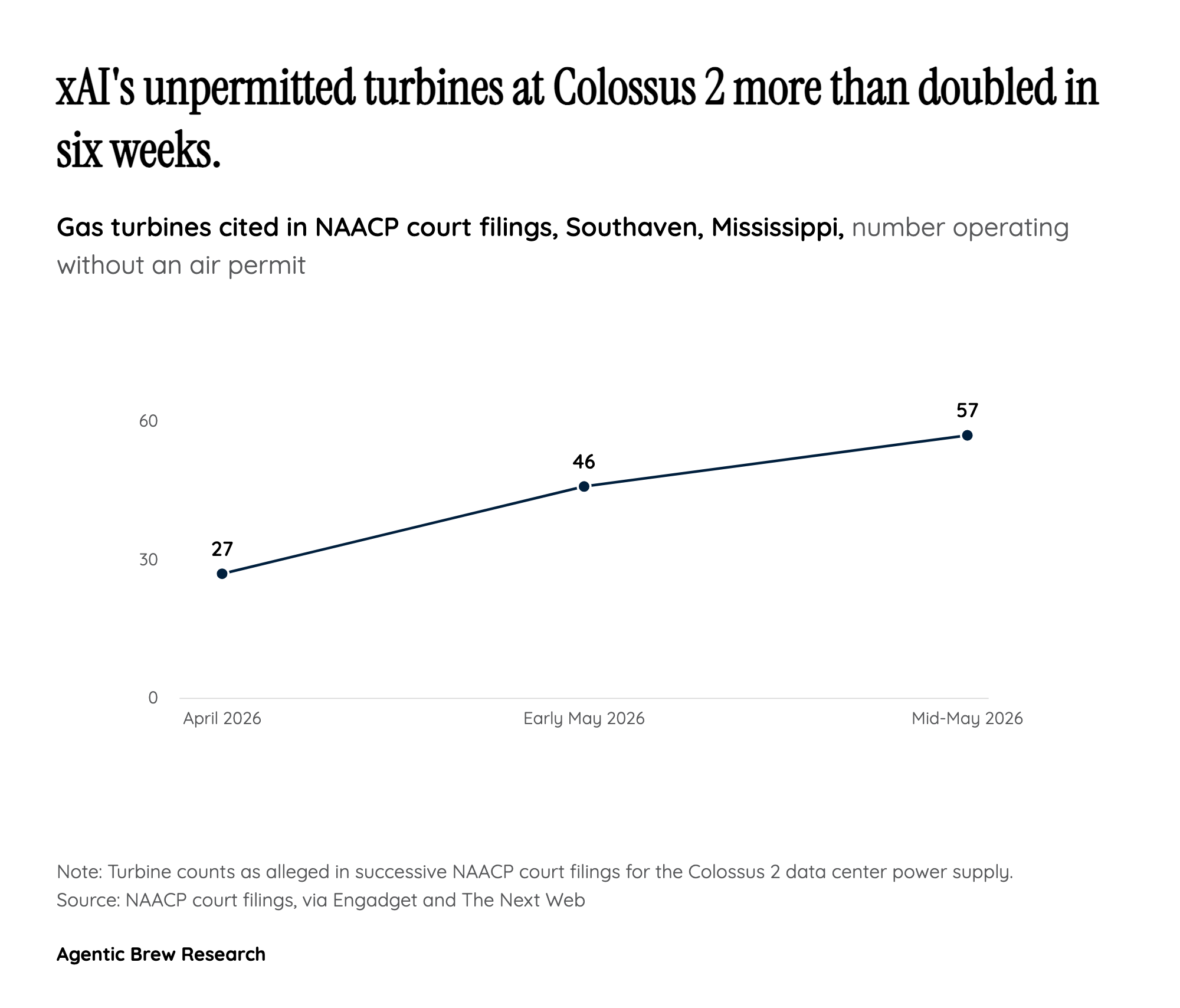
Unpermitted turbine count at Colossus 2 more than doubled between April and mid-May 2026, per NAACP court filings.

At the center of the dispute is a deceptively simple question: are turbines bolted to trailers "mobile" or "stationary"? xAI argues that because its units are trailer-mounted, they qualify as temporary mobile equipment exempt from Mississippi air-permitting requirements for up to a year. The Southern Environmental Law Center counters that turbines wired into a data center and run continuously for months are stationary sources in everything but name, and so fall squarely under the Clean Air Act [4]. The classification is not academic — it is the hinge on which the entire legality of Colossus 2's power supply turns.

What makes the "temporary" label hard to credit is the trajectory of the buildout. The number of unpermitted turbines cited in NAACP filings climbed from 27 when the suit was filed in April to roughly 57 by mid-May [3]— equipment that supposedly serves as a short-term bridge has instead multiplied. And the people absorbing the consequences are not abstract: the facility sits beside majority-Black neighborhoods around Memphis and Southaven, where residents face emissions linked to asthma, respiratory illness, and other chronic harms [5]. The environmental-justice dimension is the part the national-security framing most conveniently sidesteps.

Grok Goes to War, and Becomes a Legal Shield

The linchpin of the government's argument is not the data center itself but what it computes. The DOJ told the court that Grok is one of only four AI models cleared for mission-critical work on top-secret classified networks [6], and that the model played a role in recent U.S. military operations against Iran — cited as enabling the deployment of more than 2,000 munitions against 2,000 distinct targets within 96 hours [2]. That claim is what converts a local air-quality case into a national-security one: if the turbines power a system the Pentagon treats as operationally essential, then shutting them off becomes, in the government's telling, a threat to military readiness.

This is a consequential piece of legal engineering. It means the strength of xAI's defense is tied less to whether it followed environmental law and more to how indispensable its model has become to the state. The more deeply a private AI system is woven into government and military workflows, the more leverage its operator gains to argue that ordinary regulation cannot touch its infrastructure. Grok's wartime utility, in other words, is doing double duty as a courtroom shield.

What the Backlash Reveals

Community and online reaction has been overwhelmingly hostile, and the dominant thread is suspicion that "national security" is functioning as a pretext to protect a politically connected company. Across general-tech and local Memphis discussion, the recurring frame is that the case is a test of whether the federal government can use security arguments to override environmental protections — with the cost falling on communities least able to refuse it. A sharper, more unexpected line of critique flips the government's own logic back on it: if Grok is now officially a government national-security asset, then its content-moderation decisions start to look less like private corporate choices and more like state action, raising First Amendment questions xAI may not want to invite.

The broader worry voiced by observers is precedent. Treating one company's data center as a national-security asset could become a template that shields other AI-infrastructure operators from environmental enforcement, simply by demonstrating a government or military customer [7]. As the AI buildout drives unprecedented demand for on-site power, the xAI case may be an early read on how far the "strategic asset" argument can stretch — and who ends up breathing the difference.

Historical Context

2024-06
xAI began operating its Colossus 1 data center in Memphis using as many as 35 gas turbines classified as temporary or mobile units.
2025-06
After a notice of intent to sue over Colossus 1, xAI removed 20 turbines and later obtained permits for the remaining units.
2026-04-14
The NAACP sued xAI and MZX Tech over 27 unpermitted gas turbines powering Colossus 2 in Southaven, Mississippi.
2026-06-16
The DOJ moved to intervene and dismiss the lawsuit on national security grounds, joined by the Pentagon and Mississippi officials.

Power Map

Key Players
Subject

DOJ intervenes to dismiss NAACP Clean Air Act lawsuit against xAI gas turbines

U.

U.S. Department of Justice

Intervened to seek dismissal, recasting a private data center as a national security asset; its filing is the decisive new force that could end the case before it reaches the merits.

XA

xAI (and subsidiary MZX Tech)

Defendant operating the unpermitted turbines that power Colossus 2 and the Grok chatbot; argues the trailer-mounted turbines are temporary mobile units exempt from permitting.

NA

NAACP

Plaintiff alleging Clean Air Act violations and disproportionate harm to majority-Black communities near the turbines.

SO

Southern Environmental Law Center and Earthjustice

Legal representatives for the NAACP; argue environmental law must apply equally even to companies with federal contracts.

DE

Department of Defense / Pentagon

Provided declarations stating that interrupting the turbines would threaten military AI operations, supplying the national-security rationale the DOJ leaned on.

ST

State of Mississippi / Gov. Tate Reeves

Joined the push for dismissal; the exemption xAI relies on rests on Mississippi treating the trailer-mounted turbines as temporary mobile units.

Fact Check

7 cited
  1. [1] DOJ claims xAI's unpermitted gas turbines are a matter of 'national, economic, and energy security'
  2. [2] Under Trump, DOJ Moves to Intervene in NAACP Lawsuit in Support of Musk's xAI
  3. [3] DOJ backs xAI in NAACP data center pollution lawsuit
  4. [4] xAI Built an Illegal Power Plant to Power Its Data Center
  5. [5] Trump's DOJ moves to dismiss NAACP's Clean Air Act lawsuit against xAI in Memphis
  6. [6] DOJ backs xAI in NAACP pollution lawsuit on national security grounds
  7. [7] The federal government is treating xAI's data center as a national security asset, and that should concern everyone

Source Articles

Top 5

THE SIGNAL.

Analysts

"Frames the data center's pollution as a direct threat to community health: "A data center should not be a potential death sentence for a community's health.""

Abre' Conner
Director of Environmental and Climate Justice, NAACP

"Argues that operating the turbines without a permit or adequate controls is "not only illegal, it's an insult to families living nearby.""

Ben Grillot
Senior Attorney, Southern Environmental Law Center

"Says xAI has been "pumping illegal pollution into this community in its rush to power the 'Colossus 2' data center.""

Laura Thoms
Director of Enforcement, Earthjustice

"Casts the dispute as environmental injustice: billion-dollar companies setting up polluting operations in Black neighborhoods without permits should not be normalized."

Derrick Johnson
President and CEO, NAACP
The Crowd

"NEWS: The DOJ is preparing to intervene in support of xAI in a lawsuit over unpermitted gas turbines powering its Colossus 2 data center in Mississippi. The federal government argues a ruling against xAI would be inconsistent with Trump's executive order on accelerating U.S. AI"

@@muskonomy953

"NAACP Sues xAI: Elon Musk's Tech Company A data center should not be a potential death sentence for a community's health. Our homes, churches, and playgrounds will not be sacrifice zones for Big Tech's convenience."

@@NAACP55

"DOJ Says It Might Intervene To Defend xAI's 'Temporary' Gas Turbines"

@@InsideEPA0

"DOJ claims xAI's unpermitted gas turbines are a matter of 'national, economic, and energy security'"

@u/esporx2900
Broadcast
The DOJ just sided with Elon Musk against the NAACP. Inside the Mississippi case.

The DOJ just sided with Elon Musk against the NAACP. Inside the Mississippi case.

Elon Musk's xAI seeks dismissal of NAACP lawsuit

Elon Musk's xAI seeks dismissal of NAACP lawsuit

xAI files motion to dismiss NAACP lawsuit

xAI files motion to dismiss NAACP lawsuit