Samsung and SK Hynix's $880B South Korea AI memory-chip bet
TECH

Samsung and SK Hynix's $880B South Korea AI memory-chip bet

28+
Signals

Strategic Overview

  • 01.
    On June 29, 2026, South Korean President Lee Jae Myung unveiled a national semiconductor and AI mega-project alongside the leaders of Samsung Electronics and SK Hynix, pledging investments of more than $576 billion over several years to cement the country's industry leadership.
  • 02.
    The government is coordinating roughly 1,350 trillion won (about $880 billion) in planned corporate investment spanning high-end memory chips through the AI data centers that consume them, with Samsung Group alone committing around $649 billion over ten years across chips, data centers, and robotics.
  • 03.
    The buildout - which includes four new fabs (two each from Samsung and SK Hynix) in South Korea's southwest - aims to double the country's memory chip production capacity within five years and ease an AI-driven DRAM shortage that has sent prices soaring.
  • 04.
    Reaction is sharply split: analysts disagree on long-term oversupply risk, the buildout is stoking fears of a painful reckoning if AI spending cools, and the memory giants have been named together in price-fixing antitrust litigation tied to the shortage.

Deep Analysis

A national bet the size of an economy, timed to the HBM supercycle
A national bet the size of an economy, timed to the HBM supercycle
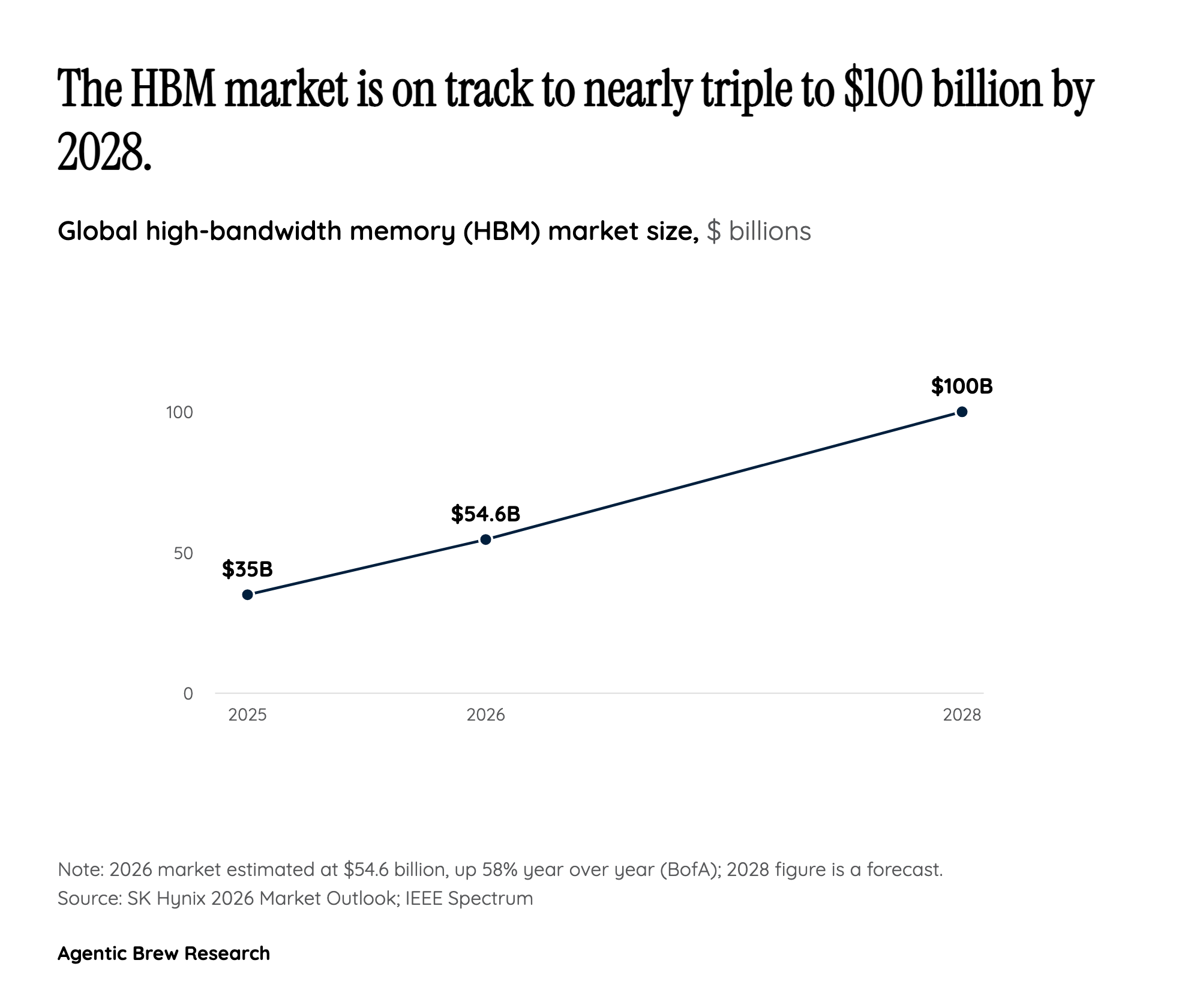
Global HBM market size, $ billions: an estimated $35B in 2025 rising to $54.6B in 2026 and a projected $100B by 2028.

The scale is the story. South Korea is coordinating roughly 1,350 trillion won - about $880 billion - in planned corporate investment, with President Lee Jae Myung publicly pledging more than $576 billion over several years [1]. That coordinated figure equals roughly 5% of South Korea's 2024 GDP, concentrating national economic exposure in effectively two firms [2]. Inside it sits an 800 trillion won (about $518 billion) national semiconductor ecosystem project under which Samsung and SK Hynix will each build two new fabs in the country's southwest, while Samsung Group alone commits roughly 1,000 trillion won (about $649 billion) over ten years across chips, AI data centers, and physical AI such as robotics [1]. The stated ambition is to double South Korea's memory production capacity within five years [1]. The timing is not accidental: the two companies together supply about 80% of global HBM, the high-bandwidth memory that feeds AI accelerators, and the 2026 HBM market is estimated at $54.6 billion, up 58% year over year, with projections running from $35 billion in 2025 to $100 billion by 2028 [1][3]. This is a bet placed at the peak of a supercycle.

The market punished a record investment - because the capex is the risk

The counterintuitive twist is that a historic pledge of growth capital was greeted as bad news. When the spending plans were first reported, investors sold the news rather than bought it, and the loudest community reaction fixated on capital intensity - the sense that the firms are now pouring a large share of operating income into new fabs and taking on debt to fund it. The market's wariness is easier to read against the run-up: SK Hynix stock is up 307% year to date and Samsung 179% [4], so enormous upside is already priced in, and a spending shock lands as margin risk rather than expansion. Fabs also take years to come online, so the capacity being funded now is a 2028-2030 story, not near-term relief. That gap - huge cash out today against payoff years away and demand that could soften - is exactly what spooked the tape. One professor summed up the stakes as the kind of investment that could determine a company's future, adding that no one knows what the situation will look like three years from now [4].

Why this shortage is stickier - and why consumers pay for it

The structural mechanism behind both the shortage and the price pain is a production tradeoff. Data centers now consume an estimated 70% of memory produced worldwide, and DRAM contract prices rose roughly 90-95% quarter over quarter in Q1 2026, with a further 58-63% increase projected for Q2 2026 [5][7]. The reason capacity cannot simply flex back is that every bit of HBM produced forgoes roughly three bits of conventional memory on Micron's 3-to-1 basis, so shifting fabs toward AI memory mechanically starves the consumer DRAM and NAND pool [5]. That is why relief is not expected before late 2027 or 2028: Micron's CEO expects demand to outstrip supply for the foreseeable future, and Intel's CEO sees no relief until 2028 [5]. The bill lands on buyers - PC makers have warned of 15-20% price increases in 2026, and the fab expansion is the primary lever to eventually refill both AI and consumer memory [5][7]. The takeaway from skeptical community analysis is blunt: for prices to crater again, the AI demand bubble itself would have to pop.

Supercycle or glut - and the lawsuit alleging the shortage was engineered

The central tension is whether this buildout rides a durable supercycle or seeds the next glut. On one side, analysts warn that accelerating capex over the next decade raises long-term oversupply risk and that a memory downturn is a clear threat if hyperscaler spending cools, though producers retain flexibility to slow their investment pace if excess capacity appears [4]. On the other, the demand case leans on AI infrastructure remaining sold out through the decade. Overlaying the whole debate is a more adversarial narrative that dominated the social conversation: Samsung, SK Hynix, and Micron have been named together in price-fixing antitrust litigation [6], and the community framing pushes further - casting the shortage not as an accident of demand but as an engineered scarcity, with the memory makers accused of throttling supply while steering capacity toward higher-margin AI and HBM. That framing sits uneasily beside the official story of national-champion investment: the same firms being celebrated as national heroes are, in this telling, accused of manufacturing the scarcity their expansion now promises to relieve.

Historical Context

2025-01-01
The current global memory supply shortage began in 2025 as makers reallocated capacity toward high-margin HBM for AI data centers, later nicknamed 'RAMageddon'.
2025-12-31
DRAM prices rose 172% throughout 2025 as AI demand overwhelmed conventional memory supply.
2026-06-28
Reports emerged that Samsung and SK plan to invest roughly $880 billion (about $1.3 trillion in some coverage) over ten years to drive Korea's AI lead, ahead of the official government unveiling.
2026-06-29
President Lee Jae Myung officially unveiled the semiconductor and AI mega-project alongside Samsung and SK Hynix leaders.

Power Map

Key Players
Subject

Samsung and SK Hynix's $880B South Korea AI memory-chip bet

SA

Samsung Electronics

World's largest memory chipmaker and co-anchor of the plan, committing roughly 1,000 trillion won ($649B) over ten years and building two new southwest fabs. Together with SK Hynix it supplies about 80% of global HBM.

SK

SK Hynix

World's second-largest memory chipmaker and HBM leader with over 50% share (about 62% of HBM shipments in Q2 2025); building two new southwest fabs and named a memory-industry top pick by analysts.

SO

South Korean government / President Lee Jae Myung

Orchestrator and coordinator of the roughly $880B plan, which was tied directly to the nation's economic future and the goal of becoming a top-three global AI power.

MI

Micron Technology

Third major DRAM and HBM maker whose CEO's supply commentary anchors shortage-timeline expectations; also named alongside Samsung and SK Hynix in price-fixing antitrust litigation.

AI

AI hyperscalers

Demand driver whose sustained capital spending determines whether the memory boom holds; large AI infrastructure projects reportedly consume a substantial share of global DRAM supply and have partnered with Samsung and SK Hynix to secure it.

Fact Check

7 cited
  1. [1] South Korea, Samsung and SK Hynix to invest hundreds of billions in AI and chips
  2. [2] South Korea is betting $880 billion on the next AI race
  3. [3] 2026 Market Outlook: Focus on the HBM-Led Memory Supercycle
  4. [4] Samsung, SK Hynix make one of the biggest bets yet on AI boom
  5. [5] The DRAM Shortage
  6. [6] 2024-present global memory supply shortage
  7. [7] Memory Chip Shortage 2026

Source Articles

Top 4

THE SIGNAL.

Analysts

"Warns that memory pricing remains a function of demand and supply, and that accelerating capex over the next decade further increases the risk of an oversupply longer term."

Jing Jie Yu
Analyst, Morningstar

"Sees a memory-industry downturn as a clear risk to the plan, but notes producers retain the flexibility to adjust their investment pace if signs of excess capacity emerge."

Sanjeev Rana
Senior Analyst, CLSA

"Frames the scale as an existential, future-defining bet under deep uncertainty, noting no one knows what the situation will look like three years out."

Lee Jong-ho
Professor of Electrical and Computer Engineering, Seoul National University

"Expects demand to outstrip supply substantially for the foreseeable future, with the shortage lasting through 2027 and only gradual improvement by 2028."

Sanjay Mehrotra
CEO, Micron Technology

"Sees no relief from the memory shortage until 2028."

Lip-Bu Tan
CEO, Intel
The Crowd

"South Korea, Samsung, and SK hynix are investing $880 billion to expand memory chip production, AI data centers, and robotics"

@@interesting_aIl547

"RAM prices now expected to jump another 40% to 50% as a lawsuit accuses Samsung, SK Hynix, and Micron of turning scarcity into market power. Jefferies Research was told by memory consultant Ethan Tan that prices may rise 40% to 50% in Q3-26, then 30% to 40% in Q4-26, with relief"

@@rohanpaul_ai134

"MEMORY GIANTS FACE CLASS-ACTION LAWSUIT OVER ARTIFICIALLY CREATING A GLOBAL MEMORY CRISIS Samsung, Micron, and SK Hynix have been hit with a Federal Class-Action lawsuit alleging they coordinated DRAM production cuts since 2022 while shifting capacity toward higher-margin AI"

@@coinbureau158

"Memory Trio Samsung, SK Hynix & Micron Face Class Action Lawsuit As Prices Reach Historical High Due To Shortages"

@u/Budget_Coffee11900
Broadcast
Samsung, SK Hynix shares surge on news of OpenAI chip deal | REUTERS

Samsung, SK Hynix shares surge on news of OpenAI chip deal | REUTERS

SK Hynix overtakes Samsung as South Korea's most valuable company

SK Hynix overtakes Samsung as South Korea's most valuable company

BREAKING: The $640M HBM Gamble That Made SK Hynix Beat Samsung in AI

BREAKING: The $640M HBM Gamble That Made SK Hynix Beat Samsung in AI