Anthropic Custom AI Chips for Claude
TECH

Anthropic Custom AI Chips for Claude

31+
Signals

Strategic Overview

  • 01.
    Anthropic publicly confirmed, for the first time, that it is building an in-house custom silicon team to co-design chips with its Claude models, aiming to run faster and more efficiently.
  • 02.
    The company is hiring silicon engineers paid $320,000 to $485,000 a year, while insisting it will keep a multi-chip approach across AWS, Google, Nvidia and AMD rather than replacing existing hardware partners.
  • 03.
    Anthropic has reportedly held talks with Samsung Electronics about manufacturing its custom chip, potentially on Samsung's 2nm process, though no timeline has been disclosed.
  • 04.
    Separately, Broadcom will supply Anthropic with roughly 3.5 gigawatts of Google TPU capacity starting in 2027, on top of 1 gigawatt already coming online in 2026, as Anthropic's annual revenue run rate passes $30 billion.

Deep Analysis

Why Now: The Arithmetic Behind the Chip Bet
Why Now: The Arithmetic Behind the Chip Bet
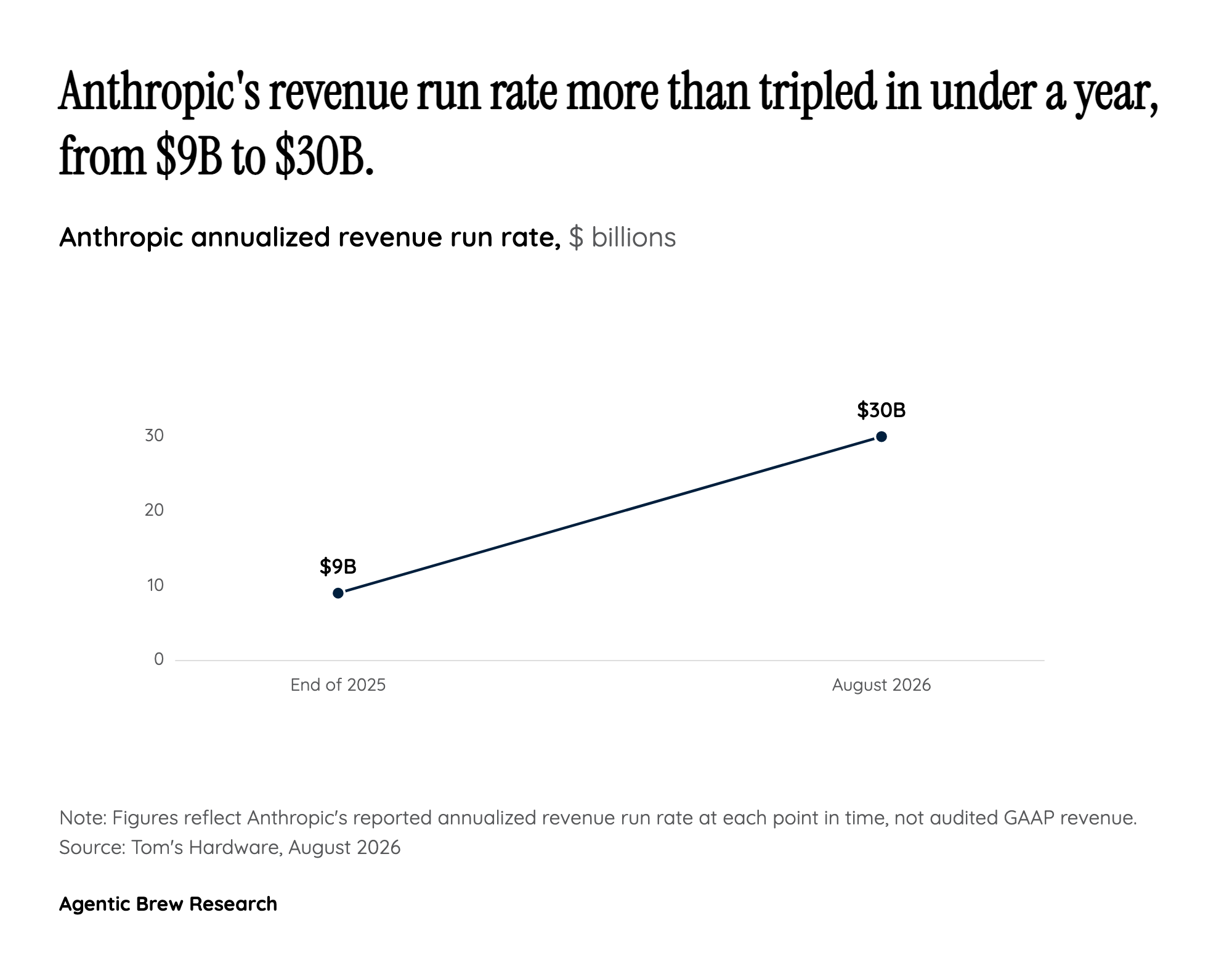
Anthropic's annualized revenue run rate climbed from $9B at the end of 2025 to $30B by August 2026.

Anthropic's move looks less like a moonshot and more like cost accounting at scale. The company's annual revenue run rate has passed $30 billion, up from $9 billion at the end of 2025[1], and even marginal reductions in per-token inference cost compound fast when billions of tokens are served daily. Forbes columnist Jon Markman frames the push as fundamentally a cost-optimization program rather than an attempt to escape Nvidia, noting the economics become straightforward arithmetic once a company reaches Anthropic's scale[2]. Reporting has pegged the target of co-designing chip and model architecture together at roughly halving Claude's per-token inference costs[3]. That number, if it holds, explains why Anthropic is willing to run a chip design effort alongside - not instead of - its existing hardware deals.


A Five-Front Hardware Strategy

What's easy to miss in the 'Anthropic builds chips' headline is how many parallel hardware bets it is running at once. Beyond the new in-house design team, Anthropic is set to draw on roughly 3.5 gigawatts of Google TPU capacity via Broadcom starting in 2027, on top of 1 gigawatt already coming online in 2026[1]. AWS is supplying over a million Trainium2 chips through its Rainier cluster[4], AMD has agreed to invest up to $5 billion in Anthropic tied to as much as 2 gigawatts of Instinct MI450 deployment starting in H1 2027[5], and Anthropic has reportedly held talks with Samsung Electronics about manufacturing its custom chip on a 2nm process[6]. Job postings for the new silicon team explicitly seek engineers comfortable making consequential calls without a large organization behind them[2]- language that signals a lean, fast-moving unit rather than a multi-year moonshot lab. Reaction on X since the confirmation has largely echoed this framing: coverage of the announcement leaned matter-of-fact, though replies carried a skeptical undertone that a design team is not the same as shipped silicon, situating the news within a wider pattern of Nvidia's biggest customers all pursuing their own hardware in parallel.

Who Actually Captures the Margin

Custom silicon doesn't remove Anthropic's dependence on the chip supply chain so much as redistribute where the spending lands. Markman notes that even as Anthropic designs its own chip, companies like Broadcom, TSMC and Arm still stand to benefit, since any custom design still needs a foundry and IP partners to become real hardware[2]. Anthropic itself is careful to frame the move the same way, insisting it will keep a multi-chip approach across AWS, Google, Nvidia and AMD even as the in-house team ramps up[2]. That margin-focused reading has resonated in developer discussion elsewhere online, where the dominant argument is that AI labs pursuing custom silicon are chiefly chasing the markup chip vendors currently capture at each link of the supply chain - with skeptics countering that alternatives like TPUs aren't necessarily faster than Nvidia GPUs, just cheaper, and pointing to OpenAI's own custom-chip effort, reported to have taken roughly nine months and about half a billion dollars to reach this stage, as a reminder that the payoff is neither quick nor cheap.

Teaching Claude to Test Its Own Silicon

One detail in Anthropic's plan stands out: the company intends to use Claude itself in the verification process for its future chips, building simulations in which the model learns to test newly developed chip designs[6]. It is a small recursive loop - a model helping validate the hardware built to run its successors - and it lines up with Anthropic's stated rationale of co-designing chips and models together rather than treating silicon as a fixed constraint models must be optimized around after the fact. Coverage of Anthropic's parallel hardware talks - including with an inference-chip startup and a major hyperscaler's in-house silicon - has read this breadth as continuity with Anthropic's long-standing preference for staying agnostic across as many capable suppliers as possible, though observers are split on whether that breadth signals confidence or reflects compute demand that no single supplier can currently satisfy alone.

What's Still Unconfirmed

For all the headlines, Anthropic hasn't disclosed when a first custom chip might actually ship, or whether it plans to manufacture in-house versus exclusively through a foundry partner[7]. Talks with prospective manufacturing partners remain early-stage, with no timeline disclosed[6]. And the payoff from Anthropic's other big hardware commitments still depends on its revenue growth continuing at its current pace[1]. That combination of an unproven chip program and capacity commitments sized for continued hypergrowth is the clearest read on how much execution risk sits behind this week's announcement.

Historical Context

2025-10-24
Anthropic agreed to buy up to one million Google TPUs, bringing more than a gigawatt of new computing power online by end of 2026.
2026-05-21
Anthropic was reported to be in early talks to use Microsoft's Maia AI chips.
2026-06-09
Anthropic secured a $35 billion chip financing deal underpinned by Google backstops on data-center lease payments.
2026-07-03
Reports first surfaced that Anthropic was in early-stage talks with Samsung Electronics about manufacturing a custom AI chip, potentially on a 2nm process.
2026-07-22
AMD agreed to invest up to $5 billion in Anthropic as part of a multi-gigawatt chip deployment deal covering Instinct MI450 accelerators.
2026-08-05
Anthropic publicly confirmed, for the first time, that it is building an in-house custom silicon team to design chips for Claude, after Business Insider first reported the news.

Power Map

Key Players
Subject

Anthropic Custom AI Chips for Claude

AN

Anthropic

AI lab building Claude; assembling an in-house custom silicon team to co-design chips with its models while keeping a multi-vendor hardware strategy.

SA

Samsung Electronics

Potential foundry manufacturing partner for Anthropic's custom chip, reportedly considering its 2nm process and advanced packaging.

GO

Google / Broadcom

Supplying Anthropic with 3.5 gigawatts of Google-designed TPU capacity from 2027 (routed via Broadcom), plus earlier backing on a $35 billion chip financing deal.

AW

AWS

Existing compute partner providing Trainium chips; Anthropic is set to use over a million Trainium2 chips via AWS's Rainier cluster.

AM

AMD

Agreed to invest up to $5 billion in Anthropic as part of a multi-gigawatt deployment, supplying up to 2 gigawatts of Instinct MI450 chips from H1 2027.

NV

Nvidia

Remains part of Anthropic's multi-chip mix even as the company pursues custom silicon and diversifies away from sole reliance on Nvidia GPUs.

Fact Check

7 cited
  1. [1] Broadcom expands Anthropic deal to 3.5GW of Google TPU capacity from 2027
  2. [2] Anthropic enters the AI chip race with in-house chip team
  3. [3] Anthropic confirms in-house chip team; co-design bet could cut Claude inference costs in half
  4. [4] Amazon launches AI infrastructure project
  5. [5] AMD to invest up to $5 billion in Anthropic chip deal, WSJ says
  6. [6] Confirming rumors, Anthropic reveals plan to develop custom chip
  7. [7] Anthropic is hiring an AI chip design team

Source Articles

Top 5

THE SIGNAL.

Analysts

Frames the move as fundamentally a cost-optimization program rather than an escape from Nvidia, arguing the economics are 'arithmetic' at Anthropic's scale, and that custom silicon redistributes rather than removes spending across the chip industry, still benefiting Broadcom, TSMC and Arm.

Jon Markman
Columnist, Forbes
The Crowd

BREAKING: Anthropic confirms it is building in-house custom chips which will be used to run Claude faster and more efficiently. Details include: 1. The company is currently hiring engineers to design custom chips for its Claude 2. Anthropic says it will co-design its hardware and models to run "at the scale our customers need" 3. Anthropic will adopt a "multi-chip approach" in which hardware from AWS, Google, Nvidia, and AMD will remain essential In-house AI chips are the next big trend.

@@KobeissiLetter3559

Anthropic is building its own AI chips @AnthropicAI is hiring for a custom silicon team, per its own job listings, and the company says it plans to co-design hardware and models so Claude runs faster and more efficiently. The Information reported last month that Anthropic had

@@BSCNews16

Jensen Huang at Davos, listing who's getting rich off AI: TSMC, Foxconn, Micron, SK Hynix, Samsung. Notice who isn't on that list. The companies buying it all. This week Anthropic confirmed it's designing its own chips. It already has a near $11B order placed with Broadcom.

@@0xCapexOG3

Why is every AI lab suddenly trying to build their own chips?

@u/stark_10041093
Broadcast
Anthropic's AI Chip Alternative to Nvidia

Anthropic's AI Chip Alternative to Nvidia

Why Anthropic Wants Microsoft's AI Chips

Why Anthropic Wants Microsoft's AI Chips

Anthropic in talks with Samsung for custom AI chip

Anthropic in talks with Samsung for custom AI chip