Meta stock surges 18% on cloud computing push and Muse Spark 1.1 launch
TECH

Meta stock surges 18% on cloud computing push and Muse Spark 1.1 launch

31+
Signals

Strategic Overview

  • 01.
    Meta's stock rocketed roughly 18% on Friday (around July 10, 2026), powered by a double shot of news - a major cloud-infrastructure and compute-monetization play and Thursday's surprise launch of the Muse Spark 1.1 AI model.
  • 02.
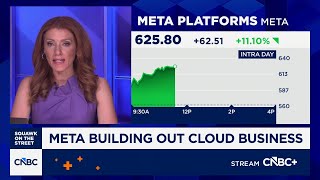
    An earlier leg of the move came July 1, when Meta shares climbed about 9% (to roughly $612.91) after reports that it would begin leasing surplus computing power to outside customers, a business referred to internally as 'Meta Compute'.
  • 03.
    Muse Spark 1.1 is a proprietary multimodal reasoning model focused on coding, tool use, and computer use, now in public preview via the Meta Model API - a departure from Meta's open-source Llama strategy toward a pay-as-you-go developer ecosystem.
  • 04.
    The week became Meta's best weekly performance since early 2024, with CNBC's Jim Cramer having flagged an 18% pop as possible on the cloud news before it happened.

Renting out your own GPUs is either capex discipline or a confession

The market's core read on 'Meta Compute' is that Meta will lease surplus computing power to enterprise customers rather than let expensive data centers idle [1]. Bulls frame this as discipline: with Meta guiding 2026 capex to as much as $145B, raised from a prior $115B-$135B range and aimed largely at AI data centers, a compute-rental revenue path helps justify the spend and re-rate previously discounted infrastructure value [2][3]. The bearish counter-read, surfaced in community discussion, is that a company selling its 'excess' AI capacity is quietly admitting its own AI products cannot fill it. Both interpretations coexist in the tape, and that ambiguity is exactly why analysts must now weigh a lower-margin future against a fully-utilized-fleet upside.
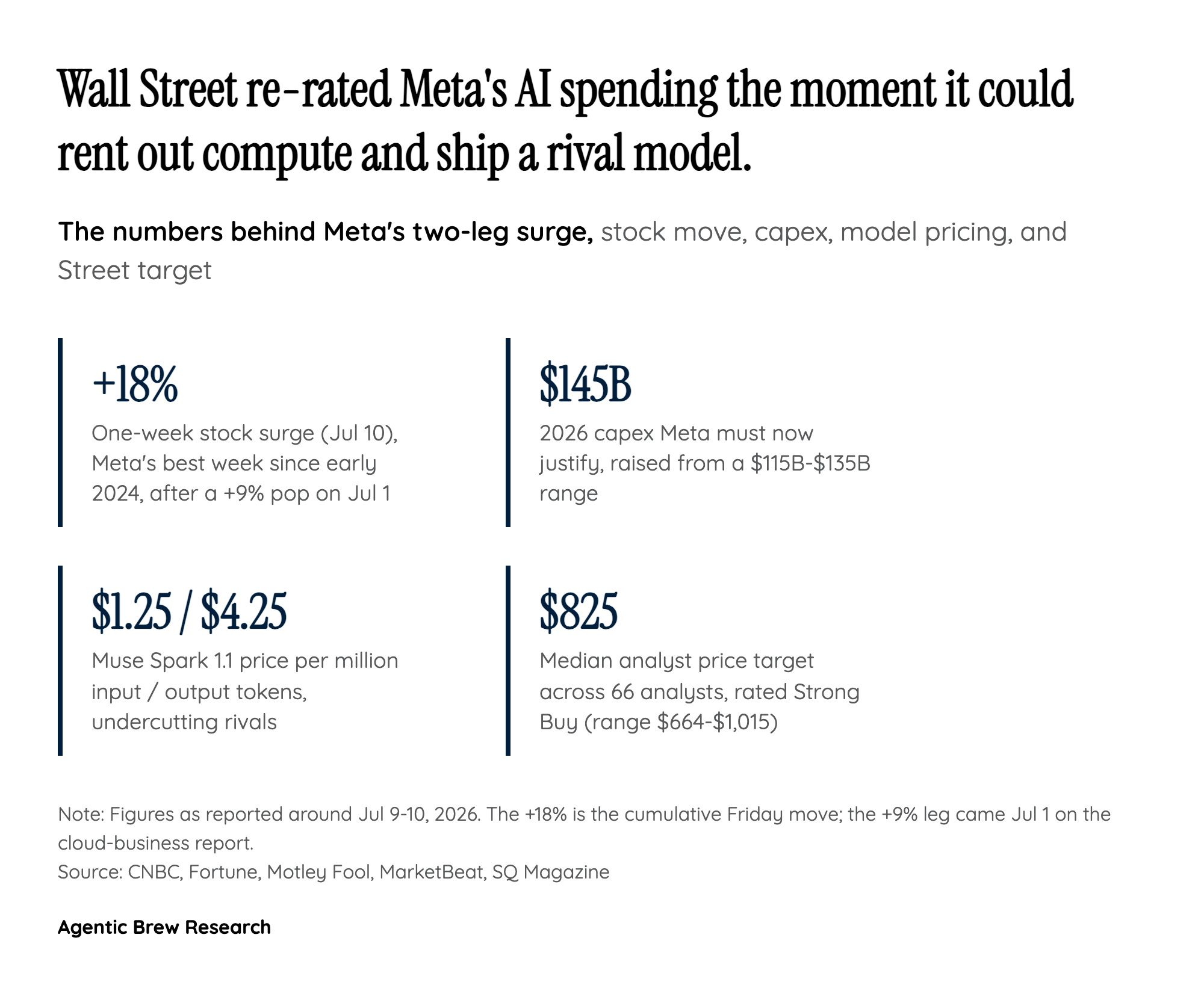

By the numbers: an 18% surge with a proprietary-pricing engine underneath

By the numbers: an 18% surge with a proprietary-pricing engine underneath
Meta +18% one-week surge, $145B 2026 capex, Muse Spark 1.1 token pricing, and the $825 median analyst target.

The move came in two legs. Shares rose about 9% on July 1 (to roughly $612.91) on the initial cloud reports, then surged about 18% on Friday July 10 as the Muse Spark 1.1 launch stacked on top, making it Meta's best week since early 2024 [4][5]. Underneath the price action sits an aggressive economic model: Muse Spark 1.1 lists at $1.25 per million input tokens and $4.25 per million output tokens, with $20 in free credits for new US developer accounts, wrapped around a 1-million-token context window and parallel subagents [6]. Analysts covering the stock (66 of them) hold a median target near $825, range $664.46 to $1,015, rating 'Strong Buy' [7]. Meanwhile CoreWeave and Nebius each fell about 12% on the cloud news, a direct wealth transfer from pure-play neoclouds to the hyperscaler entrant [1].

Walling off Llama: the quiet abandonment of open source

Muse Spark 1.1 marks a real strategic break. For years Meta's identity in AI was its open-source Llama family; this model is proprietary and monetized through the Meta Model API on a pay-as-you-go basis, though Meta says an open variant is still in development [8][9]. The pricing is a weapon: at $1.25 input and $4.25 output per million tokens, Meta is undercutting OpenAI and Anthropic on cost while keeping the model behind a paid API rather than a free download [6]. The bet is that developer lock-in and per-token revenue are worth more than the goodwill and ecosystem gravity that open weights once bought Meta.

The vertical stack: chips, capacity, and a model to sell on top

The cloud pivot is not a standalone financial trick; it rests on Meta building its own silicon. Meta plans its first custom AI chip, code-named Iris, to begin manufacturing in September, toward a goal of 14 gigawatts of computing power next year [10]. That vertical integration - custom chips, owned data centers, a hosted model, and raw compute rental - is what lets Meta credibly threaten AWS, Azure, and Google Cloud on both raw capacity (a CoreWeave-style offer) and hosted models (an AWS Bedrock-style offer) at once. It also explains why the re-rating was so violent: investors are pricing a new, structurally different revenue line, not just a good quarter.

The circular-demand question the crowd keeps asking

Community sentiment splits sharply and usefully. The skeptical camp on investing forums keeps returning to a single worry: if every large company is building AI infrastructure to sell to other companies, who is the actual end buyer - the 'Nvidia in a trench coat' problem - and does that invite race-to-the-bottom pricing. The bullish camp reframes the same facts as a positive: that Meta is signaling it will cap hyperscaler capex growth and lift free cash flow by monetizing overcapacity. This is not noise around the edges; it is the central unresolved debate, and it maps precisely onto the margin question analysts flagged - cloud and compute rental carry far lower margins than Meta's roughly 82% gross-margin ad business [3].

Historical Context

2025
Meta acquired a 49% non-voting stake in Scale AI for $14.3 billion and brought in Alexandr Wang, who reorganized Meta's AI efforts into Meta Superintelligence Labs.
2026-04-08
Meta debuted its first major AI model under the reorganized unit (the original Muse Spark), about three months before the 1.1 update.
2026-07-01
Meta shares jumped roughly 9% on reports it would start a cloud computing business selling excess AI compute; neocloud stocks CoreWeave and Nebius fell about 12% each.
2026-07-10
Meta shares surged roughly 18% Friday; the week became its best weekly performance since early 2024 as optimism built around Meta's AI strategy.

Power Map

Key Players
Subject

Meta stock surges 18% on cloud computing push and Muse Spark 1.1 launch

MA

Mark Zuckerberg

Meta CEO; driving the cloud pivot to turn AI capex into a new revenue stream and framing Muse Spark's low-cost, aggressive-pricing strategy.

AL

Alexandr Wang

Meta's first-ever Chief AI Officer and head of Meta Superintelligence Labs; publicly promoting Muse Spark 1.1's capabilities and pricing, promising 'more to come.'

AM

Amazon (AWS), Microsoft (Azure), Alphabet (Google Cloud)

Incumbent cloud leaders Meta would compete against by offering both raw compute and hosted AI models.

CO

CoreWeave and Nebius Group

Neocloud rivals whose shares fell roughly 12% each following Meta's cloud news, as investors priced in new competition.

OP

OpenAI and Anthropic

AI-model rivals Muse Spark 1.1 targets on price and capability, undercut while Meta's API strategy shifts to a walled, paid ecosystem.

CA

Cathie Wood / ARK Invest

Boosted its Meta stake by over $20M around the Muse Spark release, per reporting.

Fact Check

10 cited
  1. [1] Meta plans to build a cloud computing business to sell access to AI compute
  2. [2] Mark Zuckerberg's Meta Stock Surged 9% on New Cloud Business
  3. [3] Meta's push into cloud excites Wall Street despite lower margins
  4. [4] Meta Surges 18% on Cloud Push and Muse Spark 1.1 AI Launch
  5. [5] Meta shares surge as optimism grows on its AI strategy
  6. [6] Meta launches Muse Spark 1.1 AI coding model
  7. [7] Meta Platforms (META) Stock Forecast and Price Target
  8. [8] Meta releases Muse Spark 1.1 as Alexandr Wang's Superintelligence Labs ramps up
  9. [9] Meta Challenges Rivals With New Proprietary Muse Spark 1.1 AI Model
  10. [10] Meta stock rises as AI chip plans and Muse Spark 1.1 rollout take focus

Source Articles

Top 3

THE SIGNAL.

Analysts

"Positions Muse Spark 1.1 as Meta's strongest agentic and coding model with aggressive pricing versus rivals, and signals more releases ahead. He highlighted its developer differentiators: 'strong tool use, a million-token context window, parallel subagents, and advanced capabilities in computer use,' adding 'Indeed, more to come!'"

Alexandr Wang
Chief AI Officer, Meta / Head of Meta Superintelligence Labs

"Frames Meta's model strategy around cheap, capable agentic and multimodal models: 'Our focus is on delivering strong agentic and multimodal models at very low cost. More to come soon.'"

Mark Zuckerberg
CEO, Meta

"Median price target around $825 (range $664.46 to $1,015), average rating 'Strong Buy'. The cloud pivot adds upside but forces investors to accept slimmer margins than the ad business: 'The jump into cloud will likely force investors to reckon with slimmer margins compared with the company's hugely profitable ad business.'"

Wall Street analyst consensus (per MarketBeat, 66 analysts)
Sell-side analysts covering META
The Crowd

"(1) Today we're releasing Muse Spark 1.1 -- a strong agentic and coding model at a very low price. It's available through our new Meta Model API and in Meta AI."

@@finkd45019

"1/ muse spark 1.1 is an industry-competitive agentic and coding model. across many agentic evals it rivals gpt-5.5 and opus-4.8. available now through the new meta model api and in meta ai."

@@alexandr_wang3635

"Meta just declared war on OpenAI and Anthropic and their weapon is price (Save this). Today Meta launched Muse Spark 1.1, their most capable model yet, built specifically for agentic tasks, the kind of autonomous, multi-step work driving the next wave of AI demand."

@@MilkRoadAI91

"Meta Is Building a Cloud Business to Sell Excess AI Compute"

@u/jsg24fps759
Broadcast
Meta unveils Muse Spark AI model to rival top chatbots

Meta unveils Muse Spark AI model to rival top chatbots

Meta AI Muse Spark IS INCREDIBLE! Powerful Coding & Multimodal Model! (Fully Tested)

Meta AI Muse Spark IS INCREDIBLE! Powerful Coding & Multimodal Model! (Fully Tested)

Meta to build cloud infrastructure business to sell AI compute

Meta to build cloud infrastructure business to sell AI compute