China's AI decoupling: restricting model access and reducing Nvidia reliance
TECH

China's AI decoupling: restricting model access and reducing Nvidia reliance

44+
Signals

Strategic Overview

  • 01.
    China's Ministry of Commerce spent the past month meeting top tech firms about potentially restricting overseas access to the country's most advanced AI models, including models not yet released, covering both closed-source and more open versions.
  • 02.
    In parallel, China plans to let leading AI firms - including Alibaba, ByteDance, and DeepSeek - buy a limited amount of Nvidia H200 chips to ease a severe compute crunch, reversing an effective ban on local firms buying compliant Nvidia hardware.
  • 03.
    The H200 allowance is capped: authorities are considering approving fewer than 200,000 chips in total - less than half of what companies requested earlier this year - and firms must state how many chips they need and why.
  • 04.
    DeepSeek is separately developing its own AI inference chip - for the stage where a trained model generates responses, not training - to reduce reliance on both Nvidia and Huawei silicon, after roughly a year of talks with chip-design, foundry, and memory partners.

Deep Analysis

The Two-Way Squeeze: Loosening and Tightening at Once

The most striking thing about this week's China AI news is that it points in two opposite directions on the same day. On one side, Beijing is preparing to let top firms buy compliant Nvidia H200 chips again, easing an effective ban that had forced a self-reliant supply chain [2]. On the other, the Ministry of Commerce spent the past month meeting Alibaba, ByteDance, and startup Z.ai about curbing overseas access to their most advanced models - Qwen, Doubao, and GLM-5.2 - with the scope still under discussion and possibly applying only to future releases [1]. The unifying logic is that China now treats frontier AI as a strategic national asset, mirroring the US. Officials even discussed making leak or theft of proprietary AI technology an offence under the national security law [1]. So the H200 loosening is not a reversal of decoupling - it is a pragmatic patch for a compute crunch domestic hardware cannot yet fill, bought while the longer-term wall around China's own models keeps rising.
By The Numbers: Nvidia's China Retreat and the Domestic Surge

By The Numbers: Nvidia's China Retreat and the Domestic Surge
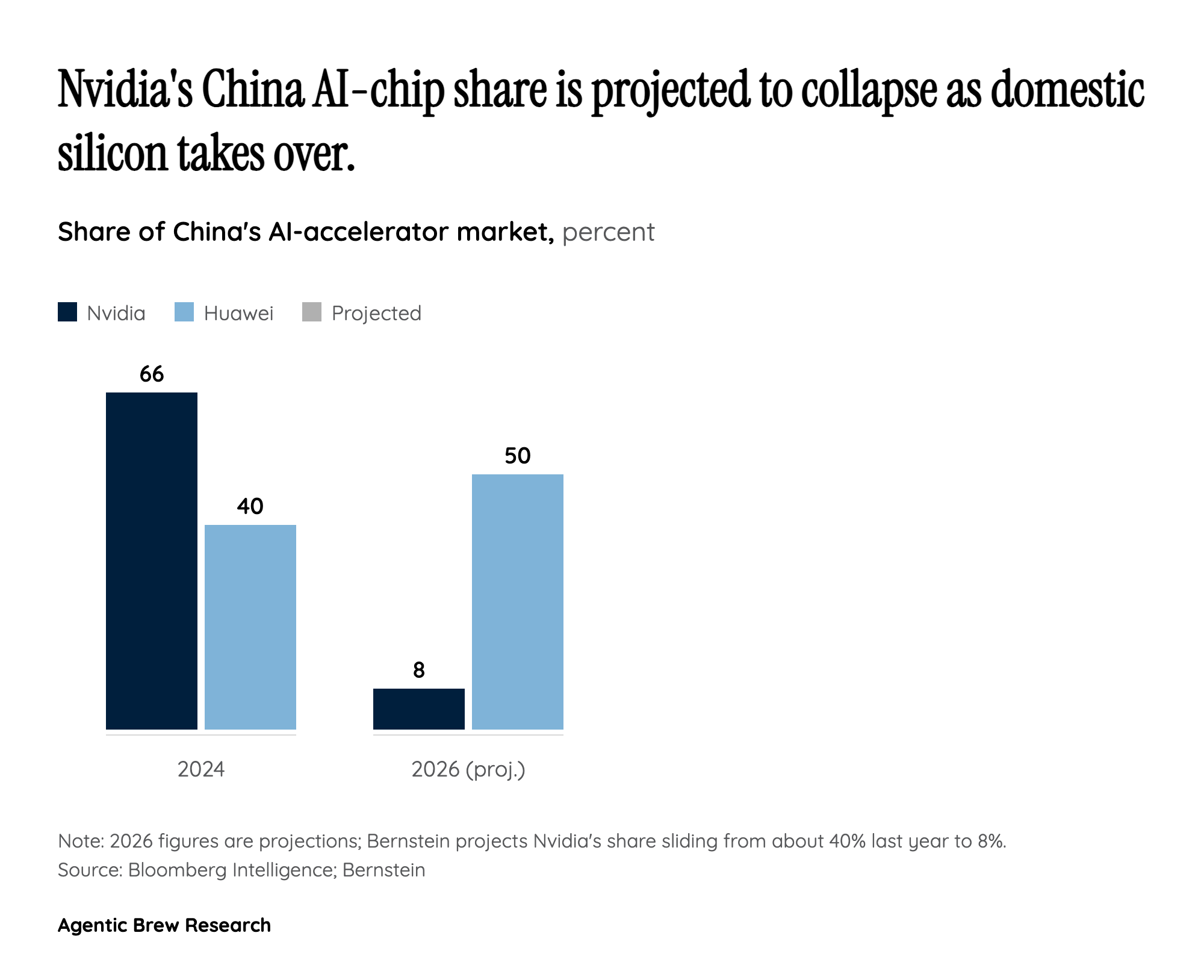
Nvidia's projected share of China's AI-accelerator market falls from 66% in 2024 to 8% in 2026 as Huawei climbs past 50%.

The financial story underneath the policy drama is a market share collapse. Nvidia's Chinese AI-chip share is projected to fall from roughly 66% in 2024 toward 8% in 2026, with Bernstein projecting a slide from about 40% last year to 8% and Huawei's share surpassing 50% [6]. A Bloomberg Intelligence survey of 60 executives found they plan to route 46% of AI-accelerator budgets to domestic products over the next 12 months, up from 30% today, even as 80% said total AI infrastructure spending is over-budget this year [5]. The state is underwriting the shift: China is allocating roughly 2 trillion yuan, about $294 billion, for data-center buildout over five years, targeting at least 80% domestically supplied core technologies [5]. That is the backdrop for the capped H200 approval of fewer than 200,000 chips, less than half of what firms requested [2], and for a domestic influence that already stretches into usage - Chinese open models rose from 1.2% of global usage in late 2024 to roughly 30% in 2025 [7].

The Openness Paradox: Reversing the Strategy That Built the Influence

China's global AI reach was built almost entirely on giving models away. Qwen and DeepSeek turned constrained compute into an advantage by releasing openly and harvesting external feedback, and by August 2025 Chinese open-weight models had passed the US in share of global downloads [7]. The US-China Economic and Security Review Commission warned in its Two Loops report that this open strategy is a self-reinforcing advantage that US export controls were not designed to counter [8]. Now Beijing is weighing a three-tier regime: basic open-source tools would need only registration, advanced technologies would face a security review, and the most sensitive frontier models would either not be released publicly or be limited to domestic use [4]. The irony is sharp - the same openness that spread Chinese influence is what Beijing may now clip, and overseas users, especially in Europe, face lock-out risk and a double dependency between two superpowers treating AI as leverage [4].

Is The Restriction Story Even Real? The Community Pushback

The developer community met the restriction reporting with unusual skepticism. The most-upvoted community response argued the MOFCOM meetings were about foreign acquisitions, investment, and talent-outflow controls rather than blocking foreigners from using the models, and even the original poster edited in that the framing was debunked shortly after publication. Two recurring points carried weight: open weights cannot be un-released once downloaded, and any curbs read most naturally as reciprocity for US export controls, pointing toward a tiered outcome where frontier and dual-use models get gated while open weights stay a tier behind. Explainer and developer channels leaned toward the structural angle too, treating Huawei-adapted training and DeepSeek's own inference-chip pivot as the more consequential story than the export-control headline. That pivot has real limits: an industry analyst cited by Reuters said DeepSeek has almost no chance of selling silicon outside China without access to leading-edge manufacturing [3].

Historical Context

2025-01
DeepSeek released its R1 reasoning model, matching leading Western systems reportedly at a fraction of the cost and catalyzing China's open-model surge.
2025-07
China released its Global AI Governance Action Plan calling for cross-border open-source communities and lower thresholds for innovation; Premier Li Qiang said China's innovation is open and open-source at the WEF.
2025-08
Chinese open-weight models captured 17.1% of global AI model downloads in the year ending August 2025, surpassing the US share of 15.86% for the first time.
2025-12
Granted a one-year waiver permitting export of Nvidia's H200 chips to China.
2026-06
Beijing issued sweeping new rules tightening control of overseas deals involving Chinese investors, technology, data, and national security, and investigated Manus and other startups that moved abroad over possible export-control violations.
2026-07-07
Reuters reported DeepSeek is quietly developing its own AI inference chip.
2026-07-08
The Information reported China plans to let top AI firms buy a limited amount of Nvidia H200 chips, while Reuters reported Beijing is weighing curbs on overseas access to its top AI models.

Power Map

Key Players
Subject

China's AI decoupling: restricting model access and reducing Nvidia reliance

CH

China Ministry of Commerce (MOFCOM)

Led the meetings on restricting overseas access to top AI models; the driving force treating frontier AI as a strategic national asset.

AL

Alibaba

Attended MOFCOM talks; maker of Qwen, the most-downloaded open model family; a named recipient in the H200 purchase plan; began launching cloud-hosted offerings rather than fully open releases in early 2026.

BY

ByteDance

Attended MOFCOM talks; maker of the Doubao model; a named recipient in the limited H200 purchase plan.

DE

DeepSeek

Named H200 recipient while simultaneously developing its own inference chip to cut dependence on both Nvidia and Huawei; a symbol of China's open-model breakthrough.

NV

Nvidia

US chipmaker whose Chinese AI-chip market share is projected to collapse from roughly 66% in 2024 toward 8% in 2026; the H200 is the compliant chip at issue.

HU

Huawei

The leading domestic Nvidia alternative; its share of the Chinese AI-semiconductor market is projected to surpass 50%, and it is among nine chips certified for state procurement.

Fact Check

8 cited
  1. [1] Exclusive: Beijing is looking at curbing overseas access to China's top AI models, sources say
  2. [2] China Plans to Let Top AI Firms Buy Limited Amount of Nvidia H200 Chips
  3. [3] China's DeepSeek to build AI chip to cut Nvidia, Huawei reliance
  4. [4] China eyes export curbs on its top AI models, and Europe is caught in the middle
  5. [5] Chinese companies are ditching Nvidia for local AI suppliers
  6. [6] Chinese Firms Leave Nvidia for Local AI Suppliers, Survey Shows
  7. [7] How China's open-source AI models took over the world
  8. [8] Two Loops: How China's Open AI Strategy Reinforces Its Industrial Dominance

Source Articles

Top 5

THE SIGNAL.

Analysts

"Called for a Chinese equivalent to a US-style controlled framework for frontier AI, reflecting the security-driven pressure to lock down top models. As he put it, both superpowers now treat their best AI models as strategic assets."

Zhou Hongyi
Founder, security firm 360

"Argues China's open-source AI strategy is building a self-reinforcing competitive advantage that US export controls were not designed to counter; controls target the digital loop of chips for training but not the physical loop of deployment-driven data accumulation across China's manufacturing base."

US-China Economic and Security Review Commission
US congressional advisory commission

"Nvidia is at zero in China and staying there. DeepSeek has almost no chance of selling silicon outside of China unless it gets access to leading-edge manufacturing."

Industry analyst (via Reuters)
Industry analysis cited in Reuters coverage
The Crowd

"Beijing IS NOT looking at curbing overseas access to China's top AI models (Debunking the Reuters report)"

@u/Stannis_Loyalist997

"China is considering restricting overseas access to its top AI models, including open-weight ones"

@u/TorturedPoet30665

"7 Chinese companies are already shipping H100/H200-class AI chips, most IPO'd in the last 6 months. I mapped all of them."

@u/awfulalexey538
Broadcast
China's New AI Breakthrough That Doesn't Need Nvidia

China's New AI Breakthrough That Doesn't Need Nvidia

China May Lock Down Its Best Open-Source AI... Goodbye GLM 5.2 & DeepSeek?

China May Lock Down Its Best Open-Source AI... Goodbye GLM 5.2 & DeepSeek?

Beijing looks at curbing overseas access to its top AI models, sources say

Beijing looks at curbing overseas access to its top AI models, sources say