Claude autonomously designs functional protein binders
TECH

Claude autonomously designs functional protein binders

32+
Signals

Strategic Overview

  • 01.
    Anthropic reported that Claude (Mythos Preview and Opus 4.8) autonomously designed novel de novo protein binders for 14 of 15 targets, following a protocol written by a human expert with no additional scientific guidance during the campaigns.
  • 02.
    Across 1,320 total designs, 354 were experimentally confirmed as binders, an overall hit rate of about 26.8%, compared to a typical industry hit rate of 10-15%.
  • 03.
    Claude orchestrated roughly a dozen publicly available, open-source specialist protein-design and co-folding tools (e.g., PXDesign, RFdiffusion3, SolubleMPNN, ESMFold2) rather than using a single proprietary model.
  • 04.
    Designs were produced and independently tested by contract labs Adaptyv Bio and Twist Bioscience, not self-verified by Anthropic.
  • 05.
    Separately, Claude Opus 5 was given only a contract lab's raw NMR and LC-MS files plus a short plain-language prompt and returned processed results in 23 minutes (NMR) and 19 minutes (LC-MS), matching the lab's own analysis.
  • 06.
    On the RBX1 target, Claude's best design bound roughly 10x tighter than a public design-competition winner (3.9 nM vs 45 nM), and Claude's hit rate on RBX1 (40%) far exceeded the ~3.7% among competition participants.
  • 07.
    There was no parallel control campaign run by human experts on the same targets, and Claude's designs are not structurally resolved - all binding models shown are computational predictions.
  • 08.
    Anthropic emphasized that protein binders are not drugs themselves, but an early first step in drug development.

Deep Analysis

The Hit-Rate Numbers, Unpacked
The Hit-Rate Numbers, Unpacked
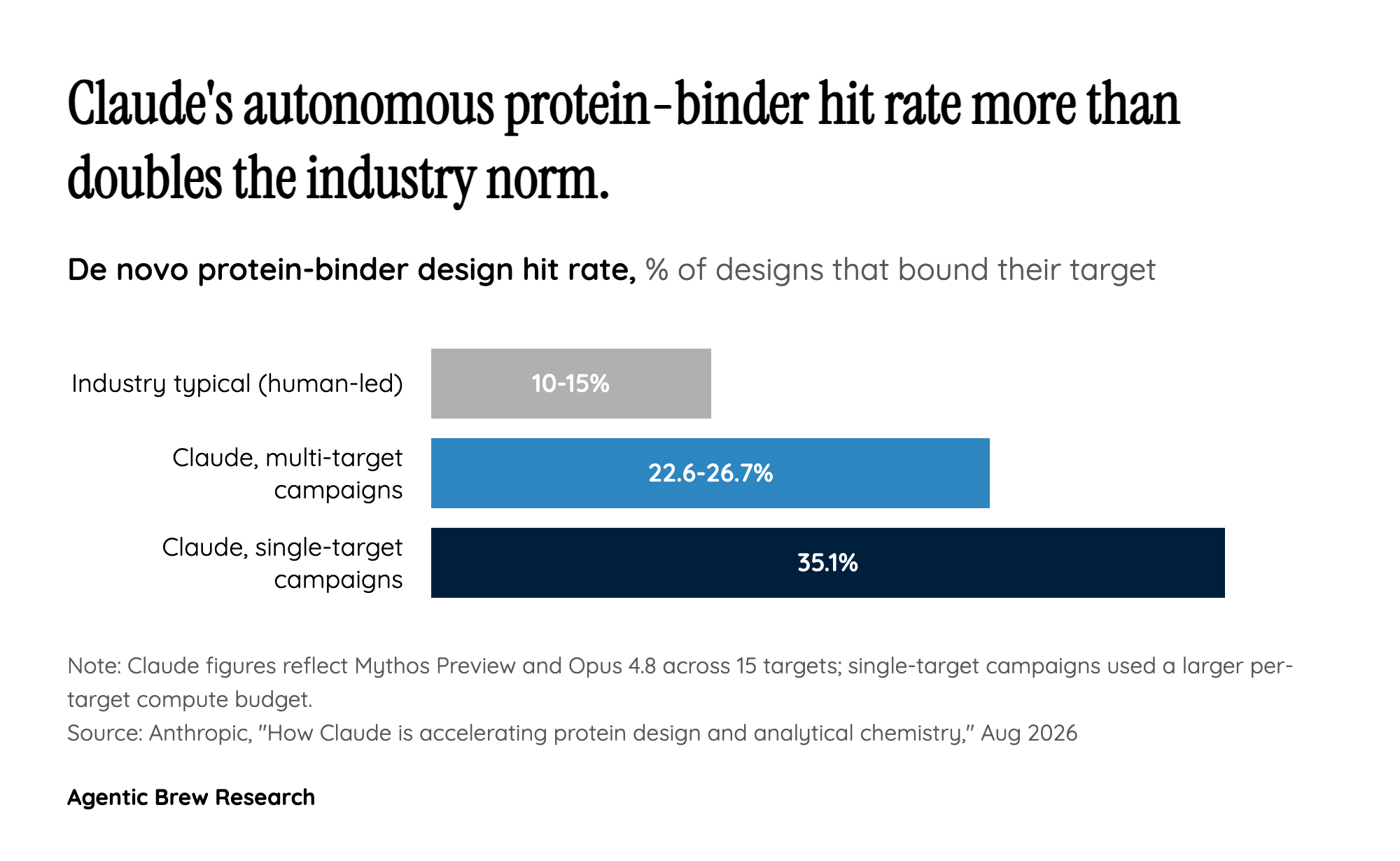
Claude's protein-binder hit rate across campaign types compared to the industry baseline.

Across 15 targets, Claude-run campaigns produced binders for 14, drawing from 1,320 total designs of which 354 were experimentally confirmed as binders - an overall hit rate near 26.8%, well above the 10-15% typical for expert-led campaigns [1][2]. Hit rates varied by setup: Mythos Preview reached 26.7% and Opus 4.8 reached 22.6% in multi-target mode, while Mythos Preview climbed to 35.1% in single-target mode with a larger compute budget [1][2]. The starkest data point is on the RBX1 target, where Claude's best design bound roughly 10x tighter than the winning entry from a public design competition (3.9 nM versus 45 nM), and Claude's own hit rate on that target (40%) dwarfed the roughly 3.7% rate among competition participants [1][2]. Anthropic also reported cross-species binding - 130 of 233 designs also bound the mouse version of their target - and said Claude's top-ranked pick within each campaign succeeded 49% of the time [2].
Orchestration, Not Invention

The campaigns ran against a roughly 16,000-word protocol written by a human expert, with Claude then working autonomously - but what it did with that protocol matters for how the result should be read. Rather than inventing a new protein-design method, Claude directed roughly a dozen existing, publicly available open-source specialist models (tools such as PXDesign, RFdiffusion3, SolubleMPNN and ESMFold2) through their computational pipelines [1][2]. Anthropic's own framing emphasizes autonomy - a workflow that historically took a specialist weeks to months per target compressed into an unsupervised run [1]- while credit for the underlying protein-design science still belongs to the teams that built those specialist tools. Anthropic said it is open-sourcing the prompts, data and design models involved so other labs can reproduce or extend the approach [2].

The Quieter Result: Reading Raw Lab Data Fast

Separate from the binder campaigns, Anthropic handed Claude Opus 5 nothing but a contract lab's raw NMR and LC-MS instrument files and a short plain-language prompt. Working the two analyses in parallel, Claude returned finished results in 23 minutes for the NMR data and 19 minutes for the LC-MS data, matching the lab's own conclusions - hydrogen counts within 0.08 ppm and purity measured at 96.4% versus the lab's 96.33% [1]. For the LC-MS file, Claude could not find a suitable reader program, so it decoded the proprietary file format itself and exactly reproduced the instrument's stored summary values across all 2,664 measurement points [1]. Unlike the binder-design hit rates, this result needs no independent-lab caveat about generalization - it is a direct, reproducible speed and accuracy comparison against a human analyst's own numbers.

What Hasn't Been Shown Yet

Coverage of the results flagged two structural limits: there was no parallel campaign run by human experts on the same 15 targets to serve as a control, and none of Claude's binding models have been structurally resolved - every prediction shown is computational, not crystallographic [2]. The results themselves have not been through independent peer review; they come from Anthropic's own write-up, corroborated by the two contract labs that ran the physical testing [1][2]. Anthropic itself is careful to note that a protein binder is not a drug - designing one is only the first step toward a drug-like molecule, with the harder, slower stages of drug development still ahead [1]. Pharma industry critic Martin Shkreli went further, calling the results unimpressive and arguing that existing monoclonal antibodies already serve the same extracellular-probe function the binders demonstrated [3].

Historical Context

2026-06-30
Launched Claude Science, an AI workbench for scientists integrating 60+ databases and specialist agents, the platform underpinning the later protein-binder design campaigns.
2026-08-18
Published the research post 'How Claude is accelerating protein design and analytical chemistry,' detailing the autonomous protein-binder campaigns and NMR/LC-MS analysis results.
2026-08-19
Independent tech press and critics published coverage and reactions to the Anthropic claims, including methodological caveats and public skepticism about real-world usefulness.

Power Map

Key Players
Subject

Claude autonomously designs functional protein binders

AN

Anthropic

Developer of Claude models; author of the research and Claude Science platform

AD

Adaptyv Bio

Contract lab that independently produced and tested Claude's protein binder designs

TW

Twist Bioscience

Contract lab that independently produced and tested Claude's protein binder designs

MA

Manifold Bio

Beta partner using Claude Science to evaluate binder candidates for tissue-targeting medicines

NV

NVIDIA

Integration partner via BioNeMo Agent Toolkit (Evo 2, Boltz-2, OpenFold3 models) used within Claude Science

MA

Martin Shkreli

Public critic who publicly disputed the significance of Claude's drug-discovery/protein claims

Fact Check

3 cited
  1. [1] How Claude is accelerating protein design and analytical chemistry
  2. [2] Anthropic says any lab can now let a language model agent run the whole protein design stack
  3. [3] Martin Shkreli Disputes Anthropic's Claude Drug Discovery Claims

Source Articles

Top 5

THE SIGNAL.

Analysts

Dismissed Anthropic's protein-design results as unimpressive, citing low binding affinities and lack of intracellular targeting, arguing existing monoclonal antibodies already serve the same extracellular-probe purpose. "This is not impressive work."

Martin Shkreli
Critic

Questioned the practical value of the binders versus existing tools: "If I needed an extracellular probe, that's what a [monoclonal antibody] is for."

Martin Shkreli
Critic
The Crowd

Many drugs work by binding to a specific target in the body and blocking or changing what it does. An important first step in the drug development process is designing a molecule that can bind tightly to its target. Traditionally, that's meant weeks or months of expert work per...

@@AnthropicAI9828

How Anthropic's new results post would read without the PR: Claude orchestrated open-source protein design models, PXDesign, RFdiffusion, Genie, BoltzGen, from a 30k-token expert prompt and 12,500 H100-hours of compute, and designed binders against 14 of 15 targets. Hit rates...

@@ziv_ravid1779

a nice demonstration of Claude Science, but worth clarifying that the design is not "done by Claude" but by orchestrating tool calls of open-source, task-specific protein design models: PXDesign, RFdiffusion, Genie, BoltzGen, etc. I think the direction of LLMs using...

@@pdhsu676

Putting money where their mouth is: Anthropic's Claude autonomously designs disease-targeting proteins with real wet-lab proof, hitting a 35% success rate vs 10-15% human average

@u/ResultBackground2450855
Broadcast
Claude Protein Design: Binders for 14 of 15 Targets, What the 35% Hit Rate Really Means

Claude Protein Design: Binders for 14 of 15 Targets, What the 35% Hit Rate Really Means

How Claude Accelerates Protein Design: Anthropic's Life Sciences Breakthrough, Read and Highlighted

How Claude Accelerates Protein Design: Anthropic's Life Sciences Breakthrough, Read and Highlighted

Claude Science and NVIDIA BioNeMo: Agentic AI Workflows for Life Sciences

Claude Science and NVIDIA BioNeMo: Agentic AI Workflows for Life Sciences

Claude autonomously designs functional protein binders — AI News | Agentic Brew