DeepSeek's $7.4B funding round at a $50B valuation
TECH

DeepSeek's $7.4B funding round at a $50B valuation

25+
Signals

Strategic Overview

  • 01.
    DeepSeek raised more than 50 billion yuan (about $7.4 billion) in its first-ever external funding round, valuing the company at over $50 billion and making it China's most valuable AI startup.
  • 02.
    Investors had to place capital into a limited partnership managed by CEO Liang Wenfeng rather than investing directly in DeepSeek; commercial backers receive no voting rights and face a five-year lock-up on their shares.
  • 03.
    Liang Wenfeng contributed about 20 billion yuan of his own funds, the round's single largest contribution, and personally vetted every limited partner behind every fund to prevent unknown parties from acquiring shares.
  • 04.
    China's state-backed National AI Industry Investment Fund was the sole investor to take direct equity with voting rights and no lock-up, alongside backers including Tencent and battery maker CATL.

Deep Analysis

A $7.4 Billion Raise Engineered So the Founder Never Loses Control

The headline number is the $7.4 billion and the $50 billion valuation, but the real story of DeepSeek's first external round is the machinery built around the money. Instead of buying equity in DeepSeek, outside investors had to route their capital into a limited partnership managed by CEO Liang Wenfeng [1]. The structure is the point: commercial backers come away with economic exposure but no voting rights and a five-year lock-up on their shares [1]. It is a way to take billions in outside money for the first time while ceding none of the governance that outside money usually buys.

Liang reinforced that control in two ways. He was the round's single largest contributor, putting in roughly 20 billion yuan of his own funds — on the order of $2.8 to $3 billion [2]. And he personally vetted the identity of every limited partner behind every fund that wanted in, specifically to ensure no unknown party could end up holding DeepSeek shares [3]. One analysis frames the whole arrangement as a deliberate fortress: the LP wrapper, the absence of votes, and the lock-up exist to keep Liang in absolute command and to keep the cap table free of surprises [3]. For a company that has positioned itself around long-horizon research rather than near-term revenue, the design is a hedge against investors ever pushing it toward faster monetization.
The Backers Read Like a Map of China's AI Industrial Strategy

The Backers Read Like a Map of China's AI Industrial Strategy
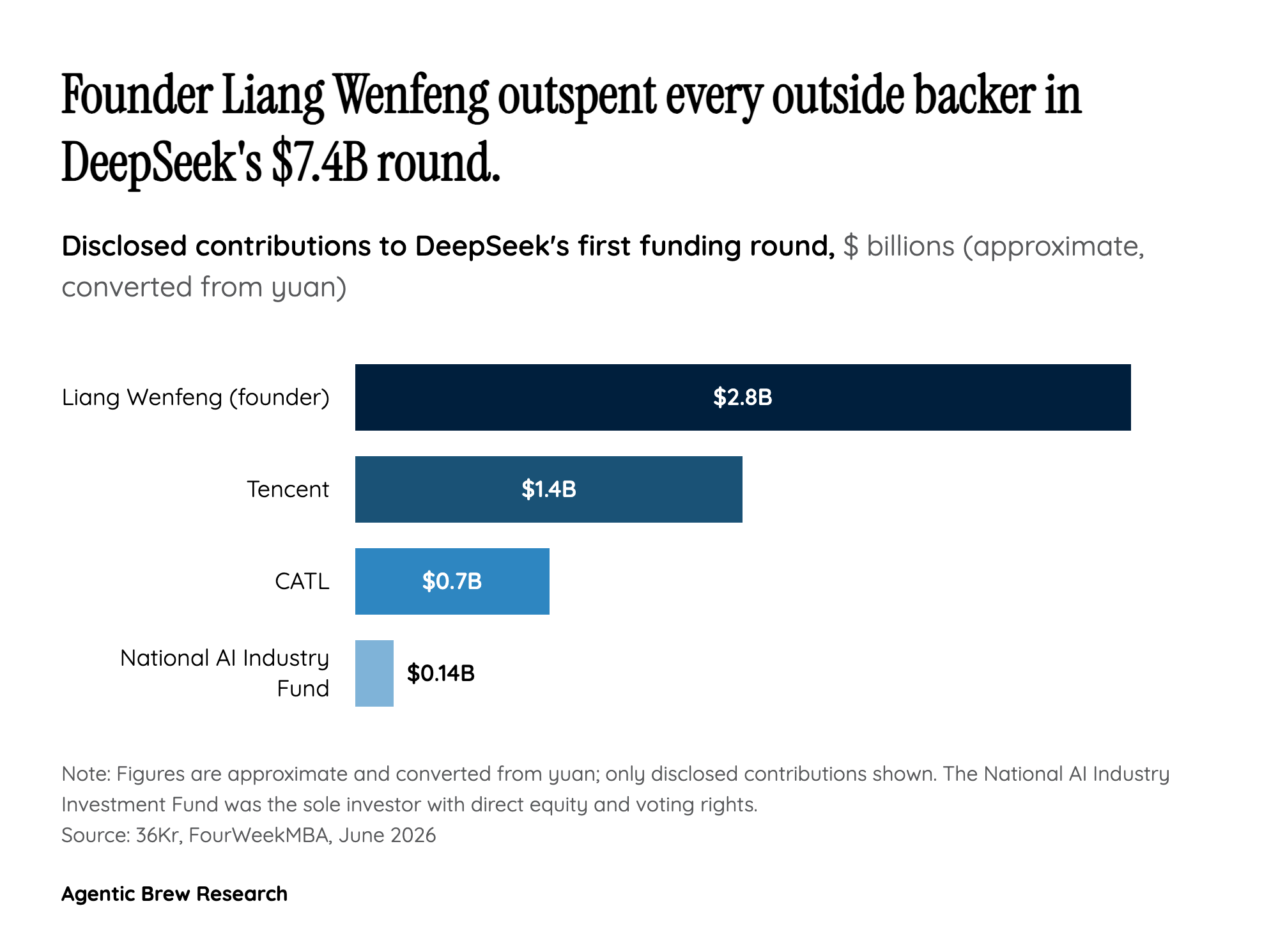
Founder Liang Wenfeng's own ~$2.8B contribution dwarfs every disclosed outside backer; the National AI Industry Fund's $140M check was the smallest but carried unique voting rights.

Who showed up to write checks is as telling as the terms they accepted. Tencent came in as the largest external commercial backer at around 10 billion yuan, with CATL — the battery giant — adding roughly 5 billion yuan, both under the same no-vote, five-year-lockup terms as everyone else [2]. The pairing of a cloud-and-platform titan with an energy-infrastructure leader is not coincidental; observers read the investor list as China assembling a self-sufficient AI stack that spans large models, compute, and the energy to run them [2].

The one investor that did not have to accept the standard terms is the most revealing. China's state-backed National AI Industry Investment Fund — a comparatively small check, around $140 million — was the sole party to take direct equity, keep voting rights, and skip the lock-up entirely [3]. That carve-out turns Beijing's strategic-tech channel into something closer to a governance partner than a passive financier, even as Tencent and CATL are kept at arm's length from the cap table [1]. The combination of a control-obsessed founder and a privileged state vehicle is a distinctly Chinese model of how to fund a frontier lab.

China's Most Valuable AI Startup Is Still a Fraction of OpenAI

DeepSeek now wears the crown of China's most valuable AI startup, but the valuation gap with Western leaders is stark. At over $50 billion it sits well below OpenAI and Anthropic, which are pushing toward the trillion-dollar mark [1]. Analysts and venture investors on both sides of the Pacific peg DeepSeek at somewhere between 5% and 10% of the $300 billion valuation OpenAI reached in its March round [4].

The discount tracks a commercialization lag. DeepSeek has not shipped a next-generation model, releasing only incremental updates, and its estimated sales are a fraction of OpenAI's reported $12 billion annualized run rate [4]. That tension is built into the round itself: Liang told investors before the raise that he prioritizes foundational research and AGI over short-term profit [1]. The bull case is less about today's revenue than about leverage — by scaling the global AI market and pushing capable open weights, DeepSeek could help accelerate the industry's broader shift from training toward inference [5].

The Community's Split Verdict: More GPUs, or a Compromised Mission?

Reaction among developers and AI-watchers was broadly optimistic but genuinely divided. On X the mood skewed bullish, fixated on the headline numbers, Liang's own multibillion-dollar check, and the unusual control structure as evidence of conviction. In technical communities the optimism was concrete: removing capital constraints means more GPUs and more room for aggressive distillation into smaller open models, with many openly hoping for a cheap, Opus- or Sonnet-class model released with open weights.

The counter-current is a worry about mission drift — that this much money corrupts the open-source ethos and shifts the work from advancing the field to making the number go up. A contrarian thread reframes open weights as a strategic weapon precisely because of that: if DeepSeek ships a free model roughly 90% as good as a closed flagship, it undercuts rivals' ability to charge premium prices. Skeptics also questioned whether the no-vote, locked-up instruments amount to ownership at all or something more like bonds, and relitigated the well-worn '$5.6M training cost' myth as a figure that only ever described one pretraining run's shallow compute, not DeepSeek's $1B-plus in owned hardware. On the strategic read, voices in the video conversation argued the platform investors are chasing cloud-customer capture as much as financial return — a reminder that, for some backers, the prize is DeepSeek's workloads, not its cap table.

Historical Context

2026-06-04
Reported to be in talks to raise about $7 billion from Tencent, CATL and other investors ahead of the closing.
2026-06-16
Closed its first external funding round at an over-$50B valuation, becoming China's most valuable AI startup.

Power Map

Key Players
Subject

DeepSeek's $7.4B funding round at a $50B valuation

LI

Liang Wenfeng

DeepSeek founder/CEO; structured the round through an LP he manages and put in ~20B yuan (~$2.8-3B), the largest single contribution, retaining absolute control and all governance power.

TE

Tencent

Largest external commercial backer, investing ~10B yuan (~$1.4-1.5B); receives no voting rights and a five-year lock-up.

CA

CATL (Contemporary Amperex Technology)

Battery maker investing ~5B yuan (~$700-740M); same no-vote, five-year-lockup terms.

NA

National AI Industry Investment Fund

State-linked fund (~$140M); only investor with direct equity, voting rights, and no lock-up — Beijing's strategic-tech channel positioned as a governance partner.

Fact Check

5 cited
  1. [1] DeepSeek takes outside money for the first time at a $50 billion valuation
  2. [2] DeepSeek's $7 billion round: Tencent, CATL and the founder's own billions
  3. [3] Inside DeepSeek's $7.4B funding fortress: the deal structure explained
  4. [4] DeepSeek reportedly now the most valuable Chinese AI startup
  5. [5] What DeepSeek's funding round means for the global AI market

Source Articles

Top 4

THE SIGNAL.

Analysts

"Prioritizes foundational AI research and AGI development over short-term profits, a stance he communicated to investors ahead of the round."

Liang Wenfeng
Founder/CEO, DeepSeek

"Estimate DeepSeek could be worth between 5% and 10% of OpenAI's $300 billion valuation, noting slow commercialization and the absence of a next-generation model."

Analysts and VC investors (China and U.S.)
Unnamed analysts and venture investors cited in reporting
The Crowd

"🚨BREAKING: DeepSeek just raised $7.4 billion at $50 billion+ valuation CEO Liang Wenfeng wrote the biggest check himself: $2.8B >Tencent: $1.4B >CATL: $700M >JD, NetEase, IDG Capital: $420M each >China's National AI Fund: $140M Investors put money into an LP managed by CEO"

@@ns123abc1005

"Today's news: * DeepSeek raises $7.4 billion at $50 billion valuation * SpaceX acquires Cursor for $60 billion * France investing €655M in AI Capital allocation in AI remains higher than ever!"

@@iScienceLuvr141

"Liang Wenfeng wasn't trying to raise $7 billion. DeepSeek's first ever funding round was supposed to be symbolic. $300 million at a $10 billion valuation, just enough to issue employee equity so ByteDance and Xiaomi would stop walking off with the lab's researchers. That target"

@@aakashgupta122

"DeepSeek is pushing forward with $10.29 billion financing round, with Liang Wenfeng committing to continue developing open-source AI models rather than pursuing short-term commercialization goals"

@u/External_Mood4719759
Broadcast
Why Alibaba & Tencent Are Racing to Invest in DeepSeek

Why Alibaba & Tencent Are Racing to Invest in DeepSeek

BREAKING: DeepSeek Hits $50B - Liang Wenfeng Keeps Total Control

BREAKING: DeepSeek Hits $50B - Liang Wenfeng Keeps Total Control

EXPOSED: China's State Funds and Tencent Are Secretly Bankrolling DeepSeek's $7.35 Billion War Chest

EXPOSED: China's State Funds and Tencent Are Secretly Bankrolling DeepSeek's $7.35 Billion War Chest