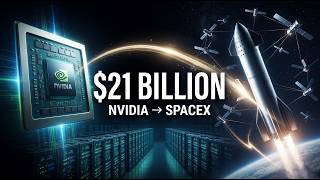
Nvidia disclosed a $21 billion stake in SpaceX and a $30 billion stake in Intel in its Q2 FY2026 regulatory filing, with the SpaceX position traced back to Nvidia's earlier investment in xAI, which SpaceX absorbed in a $1.25 trillion all-stock merger.
TECH

Nvidia disclosed a $21 billion stake in SpaceX and a $30 billion stake in Intel in its Q2 FY2026 regulatory filing, with the SpaceX position traced back to Nvidia's earlier investment in xAI, which SpaceX absorbed in a $1.25 trillion all-stock merger.

37+
Signals

Strategic Overview

  • 01.
    Nvidia disclosed in a regulatory filing on August 14, 2026 that it holds a nearly $21 billion stake in SpaceX and a $30 billion stake in Intel.
  • 02.
    Nvidia held about 122.8 million Class A shares of SpaceX and about 214.8 million shares of Intel as of the June 30 quarter-end.
  • 03.
    The Intel stake's value jumped to about $30 billion as of June 30, up sharply from $9.5 billion three months earlier, built on a $5 billion investment Nvidia made in 2025 tied to a chip co-development partnership.
  • 04.
    The same filing revealed Nvidia's complete exit from its Arm Holdings stock position.
  • 05.
    The SpaceX shares originated from Nvidia's investment in xAI; when SpaceX acquired xAI in an all-stock deal valued at $1.25 trillion in February 2026, every share of xAI converted into SpaceX Class A stock, carrying Nvidia's position along with it.
  • 06.
    Nvidia participated in xAI's $20 billion Series E round, closed in January 2026, contributing roughly $10 billion alongside Valor Equity Partners, the Qatar Investment Authority, and Fidelity.
  • 07.
    In the days after the August 14 disclosure, market moves trimmed the headline numbers: SpaceX shares fell from the June 30 close of $170.86 to about $140, cutting Nvidia's SpaceX stake to roughly $17.2 billion, while the Intel position narrowed to about $22 billion by mid-August.
  • 08.
    Combined, the SpaceX and Intel stakes represent almost 80% of Nvidia's publicly disclosed stock portfolio, which also includes smaller positions in Coherent, Generate Biomedicines, Nebius, Nokia, and Synopsys.

Deep Analysis

A stake Nvidia never set out to buy

The most counterintuitive detail in this filing is that Nvidia didn't decide to become a SpaceX shareholder - it woke up as one. The 122.8 million SpaceX Class A shares trace back to Nvidia's roughly $10 billion contribution to xAI's $20 billion Series E round, closed in January 2026 [1]. When SpaceX absorbed xAI in an all-stock deal valued at $1.25 trillion in February 2026, every share of xAI, Nvidia's included, converted directly into SpaceX Class A stock [3]. Nvidia's regulatory filing on August 14 simply reported the position as it now stood [2]. That distinction matters for how the story gets read: this isn't Nvidia buying influence over a rocket company, it's a chip investment that got swept into an unrelated merger and came out the other side worth billions more.

The circular financing debate

The disclosure landed squarely inside an ongoing argument about whether Nvidia's equity stakes in its own chip customers amount to healthy strategic alignment or a self-reinforcing loop. Nvidia CEO Jensen Huang has pushed back directly, arguing the underlying demand for Nvidia's products is real and that the capital involved isn't recycled Nvidia revenue [4]. Bank of America's Vivek Arya framed Nvidia's separate $500 billion MOU with six financial institutions as a pivot away from the vendor-financing structure that drew circularity criticism in the first place, but Wells Fargo's trading desk stayed unconvinced, noting that in the end Nvidia is still part of the financing [4]. Investor Michael Burry has gone further, describing the pattern across Nvidia's stakes and multi-year purchase commitments as a circular financing web worth an estimated $46 billion in direct equity and $879 billion in commitments [4].

The gain, and how fast it evaporated

Strip out the merger mechanics and the raw numbers are striking on their own. Nvidia's roughly $10 billion Series E contribution to xAI converted into 122.8 million SpaceX shares [1][5], working out to an effective entry price in the neighborhood of $80 a share. Against SpaceX's June 30 close of $170.86, that implies the position had roughly doubled in value before Nvidia ever filed anything about it [6]. That paper gain proved fragile. SpaceX had only completed its IPO on June 12, pricing shares at $135, which put Nvidia's converted stake in the $16 to $17 billion range at the very start of public trading [8], and within a day of the August 14 disclosure the market moved again: by August 15, SpaceX shares had fallen to about $140, cutting the SpaceX stake to roughly $17.2 billion, while Intel's position had narrowed from $30 billion to about $22 billion over the same window [3][7]. Nvidia is still sitting on a large unrealized gain relative to what it effectively paid for the SpaceX shares, but the swing illustrates how much of this story is a snapshot of a single balance-sheet date rather than a stable, current valuation.

Two customers, one balance sheet

SpaceX and Intel together now account for almost 80% of Nvidia's publicly disclosed stock portfolio [3][6], which otherwise consists of smaller positions in companies like Coherent, Nebius, Nokia, and Synopsys. That concentration cuts both ways: it ties the value of Nvidia's investment book directly to the fortunes of two companies it also sells chips to, and it reinforces a lock-in dynamic where SpaceX and Intel are described as exclusive buyers of Nvidia's chips even as Nvidia holds equity in both [4]. A stumble at either company doesn't just affect Nvidia's customer relationship, it shows up on Nvidia's own books.

Two audiences, two very different reads

The disclosure landed very differently depending on which audience was reading it. Financial media and market commentators largely treated the numbers as routine strategic news, framing Nvidia's expanding equity book across SpaceX, Intel, and smaller cloud and compute partners as evidence the company is deepening ties with the infrastructure players central to AI's next buildout phase, with some commentary framing Nvidia as poised to become SpaceX's exclusive AI-compute supplier, including for future AI satellites. Independent analysts leaned on a keiretsu framing, the postwar model of companies cross-holding each other's shares, to explain how a supplier owning equity in its own customer can blunt normal arm's-length pricing dynamics, while noting the SpaceX position was inherited through the xAI merger rather than actively sought. Retail investor communities on stock-focused forums took a far more skeptical line, reaching for terms like circular financing, shell game, and even Enron comparisons to describe a chipmaker holding equity in the same companies that buy its chips. Some of that skepticism rested on a misunderstanding - several discussion threads initially treated the SpaceX stake as a fresh purchase rather than merger-inherited equity, before the correction spread. A counter-read gained traction too: that the position functions less as financial engineering and more as a competitive moat, discouraging Elon Musk from building an in-house chip alternative and keeping that business away from Nvidia's rivals, though skeptics of that argument pointed out that a stake under 2% of SpaceX buys little real influence either way. The gap between the two readings is itself telling: the closer an audience sits to daily SpaceX and Nvidia stock discussion, the less willing it is to take the arrangement at face value.

Historical Context

2025
Nvidia agreed to invest $5 billion in Intel alongside a chip co-development partnership for personal computers and data centers, seen at the time as a surprise move to prop up an ailing rival.
2026-01
xAI closed a $20 billion Series E funding round, with Nvidia contributing roughly $10 billion alongside Valor Equity Partners, the Qatar Investment Authority, and Fidelity.
2026-02
SpaceX acquired xAI in an all-stock deal valued at $1.25 trillion, converting all xAI equity, including Nvidia's stake, into SpaceX Class A shares.
2026-06-12
SpaceX completed its IPO, pricing shares at $135, giving Nvidia's converted stake a public market valuation for the first time.
2026-06-30
As of the June 30 quarter-end, with SpaceX closing at $170.86, Nvidia's SpaceX stake was valued at about $21 billion and its Intel stake at about $30 billion, up from $9.5 billion three months prior.
2026-08-14
Nvidia disclosed the $21 billion SpaceX stake and $30 billion Intel stake in a regulatory filing.
2026-08-15
By this date, market moves had trimmed the disclosed stakes: SpaceX shares fell to about $140, cutting that stake to roughly $17.2 billion, and Intel's position narrowed to about $22 billion.

Power Map

Key Players
Subject

Nvidia disclosed a $21 billion stake in SpaceX and a $30 billion stake in Intel in its Q2 FY2026 regulatory filing, with the SpaceX position traced back to Nvidia's earlier investment in xAI, which SpaceX absorbed in a $1.25 trillion all-stock merger.

NV

Nvidia

Chipmaker that took equity stakes in two of its major AI-chip customers, converting supplier relationships into large equity windfalls disclosed in its Q2 FY2026 regulatory filing.

SP

SpaceX / Elon Musk

Acquired xAI in a $1.25 trillion all-stock deal in February 2026, converting Nvidia's xAI position into 122.8 million SpaceX Class A shares; Musk has pledged SpaceX will build its AI data centers exclusively on Nvidia's Vera Rubin chips.

IN

Intel

Received a $5 billion Nvidia investment in 2025 tied to a chip co-development partnership for PCs and data centers; Nvidia's resulting 214.8 million-share stake reached $30 billion by June 30 before slipping to about $22 billion by mid-August.

XA

xAI

Elon Musk's AI startup that raised a $20 billion Series E in January 2026, with Nvidia contributing roughly $10 billion, before being absorbed into SpaceX; other Series E backers included Valor Equity Partners, the Qatar Investment Authority, and Fidelity.

MI

Michael Burry

Investor who has publicly flagged the Nvidia-SpaceX-Intel arrangement as part of a broader 'circular financing web' in AI infrastructure, tracing roughly $46 billion in direct equity stakes and $879 billion in multi-year purchase commitments forming a self-referential loop.

Fact Check

8 cited
  1. [1] Nvidia's Secret $21 Billion SpaceX Stake
  2. [2] Nvidia discloses $21 billion stake in SpaceX at end of second quarter
  3. [3] Nvidia's Secret $21 Billion SpaceX Windfall: How One Chip Deal Turned Into a Rocket Fortune
  4. [4] Nvidia Discloses $50B Equity Stake in SpaceX, Intel, Both Exclusive Chip Buyers
  5. [5] Nvidia Discloses 122.8 Million SpaceX Shares
  6. [6] Nvidia's $21 billion SpaceX stake and $30 billion Intel shares
  7. [7] Nvidia (NVDA) Holds Massive $17.2 Billion Stake in SpaceX After Stock Decline
  8. [8] Nvidia SpaceX Shares Stake Report

Source Articles

Top 5

THE SIGNAL.

Analysts

Pushed back against 'circular financing' criticism of Nvidia's equity stakes in chip customers, arguing the demand is real and the capital involved is not being recycled as Nvidia's own revenue: "the demand is real ... the capital is not Nvidia revenue."

Jensen Huang
CEO, Nvidia

Characterized Nvidia's separate $500 billion MOU with six financial institutions as an attempt to move away from the vendor-financing structure that had drawn circularity criticism, calling it "a pivot away from vendor-financing ... that drew circularity fire."

Vivek Arya
Analyst, Bank of America

Remained skeptical that Nvidia had meaningfully distanced itself from the financing loop despite the MOU restructuring, noting "in the end NVDA is still a part of the financing."

Wells Fargo traders
Trading desk commentary, Wells Fargo

Has repeatedly warned that AI infrastructure financing, including Nvidia's equity stakes in SpaceX and Intel alongside its massive multi-year purchase commitments, forms a circular, self-referential financing web: "AI is a circular financing web with Nvidia in the middle."

Michael Burry
Investor (known for 'The Big Short')
The Crowd

BREAKING: Nvidia $NVDA just disclosed updated stock positions. They own: -$30B worth in $INTC stock -$21B worth in $SPCX stock -$4.6B worth in $CRWV stock -$3B worth in $COHR stock -$2.2B worth in $NOK stock -$2.1B worth in $SNPS stock -$328M worth in $NBIS stock -$14M worth in $GENB stock

@@TrendSpider1759

Nvidia discloses $21bn stake in SpaceX

@@FT694

NVIDIA just disclosed a ~$17B ownership stake in SpaceX this quarter, according to a new SEC filing (@ $140/share). It is now their second-largest portfolio position. @Nvidia will be the sole supplier of AI compute for @SpaceX, including their AI satellites coming next year. Legendary partnership.

@@niccruzpatane245

Nvidia discloses $21 billion stake in SpaceX at end of second quarter

@u/Force_Hammer829
Broadcast
NVIDIA Reveals $21B SpaceX Stake, Broadcom Debt Panic Dissected [Aug 14 2026]

NVIDIA Reveals $21B SpaceX Stake, Broadcom Debt Panic Dissected [Aug 14 2026]

NVIDIA Invested $21 Billion in SpaceX — Here's What It Really Means

NVIDIA Invested $21 Billion in SpaceX — Here's What It Really Means

Nvidia reveals $21 billion SpaceX stake

Nvidia reveals $21 billion SpaceX stake