Zuckerberg says Meta's AI agents are lagging expectations
TECH

Zuckerberg says Meta's AI agents are lagging expectations

32+
Signals

Strategic Overview

  • 01.
    At an internal town hall on Thursday, July 2, 2026, Mark Zuckerberg told Meta employees that agentic AI development had not accelerated as he expected over the prior four months, and that the company's bets on its new organizational structure had not yet come to fruition.
  • 02.
    Zuckerberg conceded the major reorganization involving job cuts was not as clean as it could have been, that executives miscalculated the timing, and that more mistakes were likely.
  • 03.
    He said Meta should still begin to see more substantial benefits from its AI investments within the next three to six months, toward the end of 2026.
  • 04.
    The admission lands against a raised 2026 capex forecast of up to $145 billion and a May restructuring that laid off roughly 8,000 employees, about 10% of the workforce.

Deep Analysis

A $135 billion bet, and the CEO just questioned the payoff engine

The uncomfortable arithmetic of Meta's AI push now has the CEO's own fingerprints on it. Meta raised its 2026 infrastructure guidance to as much as $145 billion, nearly double the prior year, and when it did so in late April the stock fell over 6% after-hours as investors pressed on returns [1]. The implicit promise underwriting that spend is efficiency - agents that do more work with fewer people. So when Zuckerberg tells staff behind closed doors that agentic development has not accelerated in the way we expected over the last four months, he is not describing a lab curiosity [2]. He is describing the mechanism that is supposed to justify the invoice. Meta's agent ambitions span agentic shopping, commerce, advertising, software engineering, and consumer assistants [3]- the exact surfaces where automation was meant to convert capex into margin. The market-watching corner of X seized on precisely this gap, circulating the admission alongside the tension between $125-145 billion in spending and 8,000 layoffs, with the loudest reactions reading as open doubt about whether the money pays off. Zuckerberg's counter is a clock: he told employees Meta should see more substantial benefits within the next three to six months [4]. That reframes the story from a broken bet into a delayed one, but it also sets a public deadline against which the end of 2026 will be judged.

Why the agents stalled - practitioners saw it coming

The most useful explanation for Meta's stall did not come from Meta. It came from the practitioners reacting to the news, whose recurring point cuts to the heart of the reorg's premise: every agent still needs a human. In that reading, agents drift, fail, and cannot be trusted to run autonomously, which is exactly why the one-person-billion-dollar-company fantasy - agents as white-collar replacements - fell short in the real world. The sharper framing that surfaced was agents as force-multipliers, not replacements: you still need a human driver, but reviewing an agent's work is faster than writing it from scratch. Notably, this crowd was more measured about the technology than about Meta itself, arguing the productive move is to point agents at already-solved, well-documented problems rather than letting them run loose, where an unsupervised loop can quietly burn thousands of dollars in tokens and reward you with sycophantic, plausible-looking wrong answers. Set that against Meta's January and February planning, when leadership was super optimistic about tools like Anthropic's Claude Code and worried Meta would not move fast enough [2]. The restructuring appears to have priced in autonomy that the tools do not yet deliver. If agents are multipliers that still require a human in the loop, then cutting the humans first and expecting the agents to backfill was always going to reveal itself as a timing problem - which is roughly what Zuckerberg conceded when he admitted the reorganization wasn't as clean as it could have been and more mistakes were likely [3].

The human cost of a reorg built on optimism

The human cost of a reorg built on optimism
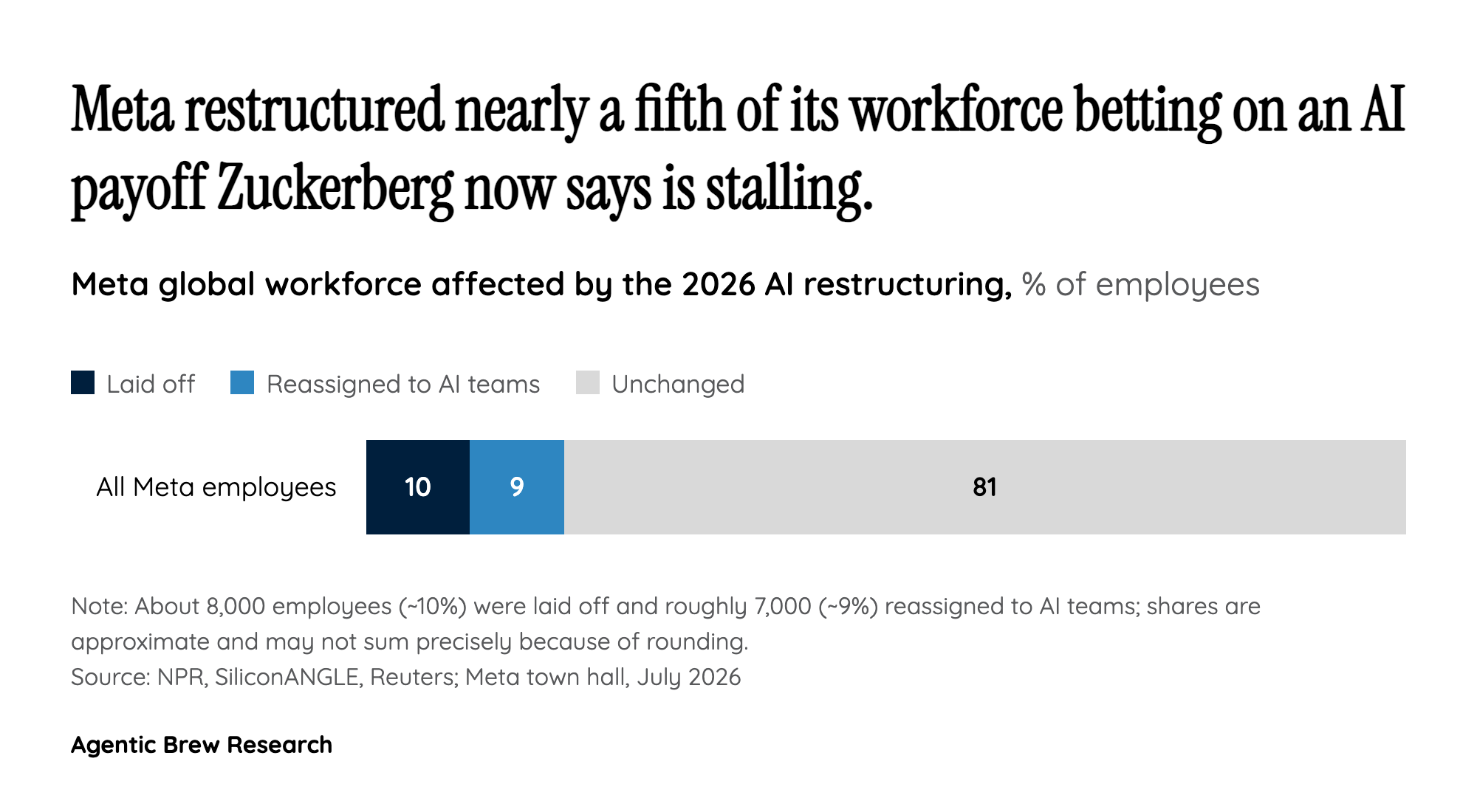
Roughly 10% of Meta's workforce was laid off and about 9% reassigned to AI teams, restructuring nearly a fifth of the company for an AI payoff Zuckerberg now says is behind schedule.

The reorganization was not abstract. Meta laid off roughly 8,000 employees, about 10% of its global workforce, in May, and reassigned around 7,000 more onto newly created AI teams [5]- together touching close to a fifth of the company. Zuckerberg's admission that the process wasn't as clean as it could have been, that the timing was misjudged, and that further mistakes were coming [3]is a rare on-record concession that the disruption ran ahead of the payoff. Commentator video coverage skewed hard on this angle, framing the agentic stumble as a strategic embarrassment tied directly to morale and internal-culture damage, while mainstream outlets led with the raw scale of the layoffs and the capex bet behind them. The same town hall surfaced a second sore point: CTO Andrew Bosworth addressed a data-security review of mouse-tracking software that monitors employee activity for AI training [2]. The review found no employee data made it into training, and the program was paused with a possible opt-in return - but the optics of surveilling the remaining workforce to feed the very AI that thinned it are hard to miss. The through-line across Reddit's derision, YouTube's culture-damage framing, and X's ROI skepticism is consistent: the restructuring was executed on a confidence the tooling had not yet earned.

Is four months even a fair verdict?

There is a contrarian read worth holding: four months is a short window to judge a technology shift, and Zuckerberg himself is not calling agents a failure so much as slower than his own timeline [2]. Some practitioners reinforced the point that serious AI-assisted development workflows may still be one to two years out, with at least one engineer describing a year-plus project compressed into roughly six weeks - evidence the ceiling is high even if the median is not there yet. That cuts both ways for Meta. It supports Zuckerberg's promise that benefits should arrive within three to six months [4], but it also undercuts the premise that justified moving this fast on layoffs and a near-$135 billion midpoint spend [1]. Meanwhile, the heavy-capex incumbents face a structural squeeze that practitioners flagged - the pressure to overcharge for frontier access opens the door for open-source models at 85 to 90% of the quality to eat the low end. Whether Meta's end-of-2026 window vindicates the timeline or confirms that the reorg outran the tools is the question the next two quarters will answer.

Historical Context

2025-06-30
Zuckerberg announced the creation of Meta Superintelligence Labs, led by Alexandr Wang and former GitHub CEO Nat Friedman, following a $14.3 billion investment in Scale AI.
2025-10-01
Meta eliminated roughly 600 jobs within MSL, with Wang framing the cuts as correcting bureaucratic sprawl for a more talent-dense structure.
2025-11-20
Meta's chief AI scientist Yann LeCun left to start a new firm.
2026-04-08
MSL released its first model, Muse Spark, part of the Muse family, which now powers the Meta AI assistant.
2026-04-29
Meta raised its 2026 capex forecast to as much as $145 billion, and the stock fell over 6% after-hours on ROI concerns.
2026-05-20
Meta laid off roughly 8,000 employees, about 10% of the workforce, as part of the AI-focused restructuring, with more cuts planned for the second half of 2026.
2026-07-02
At an internal town hall, Zuckerberg told staff agentic AI development had not accelerated as expected and the reorganization was not clean.

Power Map

Key Players
Subject

Zuckerberg says Meta's AI agents are lagging expectations

MA

Mark Zuckerberg

Meta CEO - delivered the town-hall remarks admitting slower agentic progress and reorganization missteps; sets AI strategy and capex direction.

AL

Alexandr Wang

Meta Chief AI Officer, hired June 2025 from Scale AI; runs Meta Superintelligence Labs, the division at the center of the AI push and reorganization.

AN

Andrew Bosworth

Meta CTO - addressed the employee mouse-tracking data-security review at the same town hall.

AN

Anthropic (Claude Code)

AI vendor whose Claude Code tool Meta leadership was super optimistic about when planning the restructuring; the benchmark for the AI-coding acceleration Meta expected.

ME

Meta employees and laid-off workers

About 10% of the workforce laid off and roughly 7,000 reassigned to AI teams; directly affected by the reorganization Zuckerberg called not clean.

ME

Meta investors

Reacted negatively to raised capex guidance; the stock fell over 6% after-hours on the capex increase amid ROI concerns.

Fact Check

5 cited
  1. [1] Meta's $145 billion AI spending and the ROI question
  2. [2] Exclusive: Zuckerberg says AI agent development has slowed
  3. [3] Mark Zuckerberg says Meta's agentic AI efforts aren't progressing as fast as he'd hoped
  4. [4] Mark Zuckerberg tells staff that AI agents haven't progressed as quickly as he'd hoped
  5. [5] Meta layoffs and the shift of jobs to AI

Source Articles

Top 5

THE SIGNAL.

Analysts

"Told staff that "the trajectory of the agentic development over at least the last four months hasn't really accelerated in the way that we expected" - a candid internal admission that Meta's own agentic AI progress is behind his expectations."

Mark Zuckerberg
Meta CEO

"Said the 2026 reorganization "wasn't as clean as it could have been" - acknowledging the job cuts were poorly executed and that more mistakes were likely."

Mark Zuckerberg
Meta CEO
The Crowd

"META: ZUCKERBERG SAYS AI PROGRESS HAS BEEN SLOWER THAN EXPECTED • ZUCKERBERG SAID AI AGENT DEVELOPMENT HAS NOT ACCELERATED AS EXPECTED OVER THE PAST FOUR MONTHS • SAID META'S 2026 REORGANIZATION "WASN'T AS CLEAN AS IT COULD HAVE BEEN" • TOP EXECUTIVES WERE CONCERNED EARLY"

@@FirstSquawk1202

"🚨META CEO Mark Zuckerberg today: "AI agents haven't accelerated in the way we expected." "We were worried we weren't moving fast enough on AI." "AI productivity gains aren't what's driving the cuts... we'll see how all this stuff trends." >$125-145B capex. 8,000 layoffs"

@@ns123abc801

"JUST IN: Mark Zuckerberg reveals Meta’s AI agent development has not accelerated “in the way we expected.”"

@@Polymarket497

"Mark Zuckerberg tells staff that AI agents haven't progressed as quickly as he'd hoped"

@u/Logical_Welder3467429
Broadcast
Meta's AI Clusterf*ck Is Humiliating Zuckerberg

Meta's AI Clusterf*ck Is Humiliating Zuckerberg

Meta Begins Layoffs As Zuckerberg Bets Big on AI | Vantage on Firstpost | 4K

Meta Begins Layoffs As Zuckerberg Bets Big on AI | Vantage on Firstpost | 4K

Mark Zuckerberg Fails at "Fun" Hackathon for Meta - AI Destroyed Company Culture

Mark Zuckerberg Fails at "Fun" Hackathon for Meta - AI Destroyed Company Culture