AI model prices collapse as attention turns to Gemini 3.5
TECH

AI model prices collapse as attention turns to Gemini 3.5

20+
Signals

Strategic Overview

  • 01.
    Google launched Gemini 3.5 Flash on May 19-20, 2026 at Google I/O at $1.50 per million input tokens and $9 per million output tokens, roughly a 3x increase over the Gemini 3 Flash tier it replaced ($0.50 / $3).
  • 02.
    DeepSeek made a 75% cut to its flagship V4-Pro permanent in 2026, pricing it around $0.44 per million input tokens and $0.87 output, undercutting GPT-5, Opus 4.7, and Gemini Flash by a wide margin.
  • 03.
    OpenAI is weighing steep price cuts for developers and enterprises in anticipation of similar moves from Anthropic, per Wall Street Journal reporting, while both companies have filed confidentially for IPOs.
  • 04.
    Enterprise customers are tightening AI spending and shifting from 'tokenmaxxing' toward efficiency, a change that could slow revenue growth for OpenAI and Anthropic even as per-token prices fall.

Deep Analysis

The Collapse Is Only Half the Story - Who's Cutting and Who's Quietly Raising
The Collapse Is Only Half the Story - Who's Cutting and Who's Quietly Raising
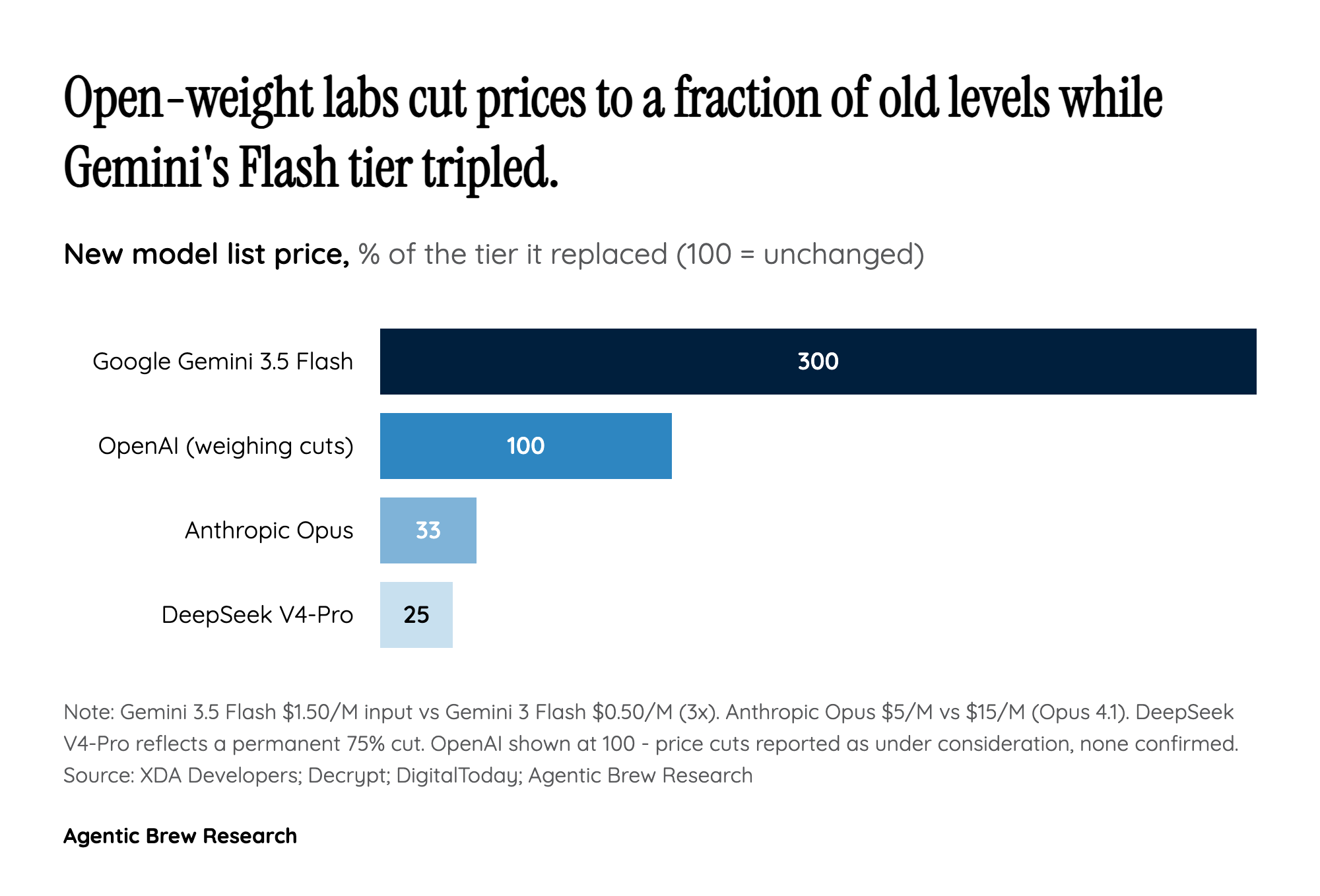
New model list price as a percent of the tier it replaced: DeepSeek and Anthropic cut deeply while Google Gemini 3.5 Flash tripled.

The headline that AI model prices are collapsing is true for one side of the market and false for the other. On the cutting side, DeepSeek made a 75% price reduction to its flagship V4-Pro permanent, landing it near $0.44 per million input tokens and $0.87 output - numbers that undercut GPT-5, Opus 4.7, and Gemini Flash by a wide margin [1]. Anthropic followed the gravity, dropping Opus from $15 per million to $5 per million, a roughly 67% cut [2]. OpenAI, per Wall Street Journal reporting, is weighing steep cuts of its own ahead of a confidential IPO filing [3].

But the model everyone was waiting on moved the opposite way. Google's Gemini 3.5 Flash launched at $1.50 per million input and $9 per million output - roughly a 3x increase over the Gemini 3 Flash tier it replaced [1]. One report frames this as the era of subsidized Western AI pricing coming to an end, arguing those low prices were never sustainable [1]. So the accurate picture is a two-sided market: open-weight labs are collapsing the floor while frontier tiers quietly lift the ceiling. Calling it a uniform collapse misses the actual competitive geometry - the cheap tokens and the expensive tokens are moving apart at the same time.
Cheap Per Token, Expensive Per Answer - The Paradox Wrecking Budgets

The most under-appreciated fact in this cycle is that the price of a token and the size of your bill are decoupling. Inference cost for a fixed capability has fallen about 95% over two years - GPT-4-quality output dropped from around $30 per million input tokens in 2023 to under $0.50 per million in 2026 [4]. Epoch AI puts the broader trend at a median of roughly 50x cheaper per year, rising to 200x for benchmarks measured after January 2024 [5]. By any per-unit measure, intelligence has never been cheaper.

And yet the bills are ballooning. Average enterprise AI budgets reportedly grew from about $1.2M per year in 2024 to $7M per year in 2026 as agentic workloads consume far more tokens per task [6]. That is the paradox: each token is nearly free, but a single agentic 'answer' now spends thousands of them chaining tool calls, retries, and long-context reasoning. The result is a documented shift CNBC reported from 'tokenmaxxing' - throwing tokens at every problem - toward hard efficiency, with buyers metering usage and routing cheaper workloads to the lowest-cost provider [7]. For OpenAI and Anthropic, that behavioral turn is a revenue risk even while their sticker prices drop [7].

Why the War Ignited Now - DeepSeek, IPO Pressure, and the Gemini Countdown

Three forces converged to make mid-2026 the flashpoint. The first is open-weight competition: Chinese labs are shipping frontier-comparable models at a fraction of the cost - DeepSeek roughly one-thirteenth the cost of closed alternatives - which forces Western providers to cut or cede share [3]. The second is the pending liquidity event. Both OpenAI and Anthropic have filed confidentially for IPOs, and the numbers underneath are stark: OpenAI's Q1 2026 adjusted operating margin was reported at -122%, and its share of global generative-AI web traffic fell from 77.6% in May 2025 to 53.7% by April 2026 [3]. Defending market share before going public is now a strategic imperative.

The third force is anticipation itself. As the industry waits on Google's next Gemini release, labs are aggressively pricing new models and floating cuts to lock in developers before the launch reshuffles the board [3]. Underneath the pricing theater, the cost curve is being pushed by real engineering - Epoch AI attributes the declines to hardware moves like H100 to Blackwell and algorithmic efficiency such as quantization, speculative decoding, and mixture-of-experts routing [5]. The competitive trigger is commercial; the ammunition is technical.

What the Skeptics See - Bundling and Total Cost Are the Real Battleground

Away from the benchmark charts, the practitioner community is reading this less as a price collapse and more as a fight nobody is yet winning. The dominant view among developers is that headline per-token prices are still set below true cost, which is why the same providers face pressure to raise limits or quietly cut usage caps - a 'collapse' that partly masks the fact that no one is clearly profitable. Delphi Ventures' Tommy Shaughnessy captured the underlying economics bluntly, arguing the $20-per-month flat fee was always priced below what heavy usage actually costs [3].

The more strategic community read is that the weapon is not the token price at all - it is bundling and total cost of ownership. The recurring argument is that Google can pair a strong model with Workspace, storage, and other consumer products at a single subscription price, pulling users away from standalone AI subscriptions on economics no pure-play lab can match. Product-operator voices frame Google's edge as owning the full stack - chips, data centers, and search cash flow - which lets it compete at both the cheap and premium ends simultaneously. The tension running through the discussion is genuine enthusiasm that competition is finally forcing lower prices, paired with hard skepticism that today's numbers reflect sustainable economics rather than a subsidized land grab.

Historical Context

2025-03-12
Epoch AI analysis found LLM inference prices had fallen between 9x and 900x per year across benchmarks, with a median of roughly 50x per year, accelerating after January 2024.
2026-05-19
Gemini 3.5 Flash launched at Google I/O 2026 with a 3x price increase over its predecessor, a break from the prior trend of steadily falling prices.
2026-06-26
CNBC reported enterprises shifting from 'tokenmaxxing' to efficiency, citing examples like Uber blowing through its annual AI budget in four months and Lindy moving all of its traffic to DeepSeek.

Power Map

Key Players
Subject

AI model prices collapse as attention turns to Gemini 3.5

GO

Google

Frontier lab that raised Gemini 3.5 Flash pricing ~3x while positioning it as its default workhorse model, signaling Western labs are nudging prices up rather than uniformly collapsing them.

OP

OpenAI

Weighing steep developer and enterprise price cuts amid Anthropic's growth and open-source competition; its Q1 2026 adjusted operating margin was reported at -122%.

AN

Anthropic

Cut Opus pricing from $15 per million (Opus 4.1) to $5 per million, a roughly 67% reduction, while its annualized run rate grew from $9B at end 2025 to $47B by May 2026.

DE

DeepSeek

Chinese lab whose permanent 75% price cut on V4-Pro matches frontier benchmarks at a fraction of the cost, forcing Western labs to rethink their pricing.

Fact Check

7 cited
  1. [1] Google Gemini 3.5 Flash costs 3x the model it replaced, and cheap AI may be ending
  2. [2] AI price war begins: the OpenAI and Anthropic dilemma
  3. [3] OpenAI wants a price war with Anthropic as DeepSeek and China close in
  4. [4] How AI inference costs have dropped 95% in two years and what happens next
  5. [5] LLM inference price trends
  6. [6] The AI inference cost crisis of 2026
  7. [7] OpenAI and Anthropic face a new AI reality as users shift from tokenmaxxing to efficiency

Source Articles

Top 1

THE SIGNAL.

Analysts

"Signaled that OpenAI will find ways to give customers more value for less spend amid price-war pressure: 'I think we'll have a lot of ways we can help people get more value for less spend.'"

Sam Altman
CEO, OpenAI

"Argues consumer flat-fee pricing was always set below the true cost of heavy usage: 'The $20/month flat fee rate was always priced below what heavy usage actually costs.'"

Tommy Shaughnessy
Delphi Ventures
The Crowd

"(1) Today we're releasing Muse Spark 1.1 -- a strong agentic and coding model at a very low price. It's available through our new Meta Model API and in Meta AI."

@@finkd44995

"Gemini 3.5 Pro Benchmark Leak -Reportedly outperforming Claude Fable 5 and GPT-5.6 in internal evaluations -Gemini 3.5 Pro Currently undergoing private validation and testing -Significant zero-shot performance improvements -they are Targeting a July 17 launch -Gemini 3.5 Pro"

@@Mr_Salio1079

"🚨 Google delays Gemini 3.5 Pro again ! - Google has delayed the next Gemini Pro model a second time: · Now targeting end of July or later · Full new pre-training run on fresh base model · 2M token context window · Deep Think extended reasoning mode - From leaks the model"

@@LuminaXspace728

"Google just fired a warning shot in the AI subscription price wars"

@u/Logical_Welder34671700
Broadcast
AI Prices Are About to Shock Everyone

AI Prices Are About to Shock Everyone

Google unveils 'Gemini 3 Flash' AI model focused on speed and cost

Google unveils 'Gemini 3 Flash' AI model focused on speed and cost

Gemini 3 Flash: The "Budget" Model That's DESTROYING Premium AI (And It's Free)

Gemini 3 Flash: The "Budget" Model That's DESTROYING Premium AI (And It's Free)