Google launches Nano Banana 2 Lite and Gemini Omni Flash
TECH

Google launches Nano Banana 2 Lite and Gemini Omni Flash

41+
Signals

Strategic Overview

  • 01.
    Google DeepMind released Nano Banana 2 Lite, technically Gemini 3.1 Flash-Lite Image, described as its fastest and most cost-efficient Gemini image model built for high-speed generation and editing at its lowest cost yet.
  • 02.
    Nano Banana 2 Lite produces text-to-image outputs in about four seconds at $0.034 per image at 1K resolution, and is restricted to a 1K canvas rather than the 1k/2k/4k range of the Nano Banana 2 and Pro lines.
  • 03.
    Alongside it, Google widened access to Gemini Omni Flash for video generation and conversational editing, priced at $0.10 per second of video output and currently producing ten-second clips.
  • 04.
    Both models are available in Google AI Studio, the Gemini API, and the Gemini Enterprise Agent Platform, and can be chained through the Interactions API so an image from Nano Banana 2 Lite is passed as a reference to Gemini Omni Flash for animation.

The real product is a pipeline, not two models
The real product is a pipeline, not two models
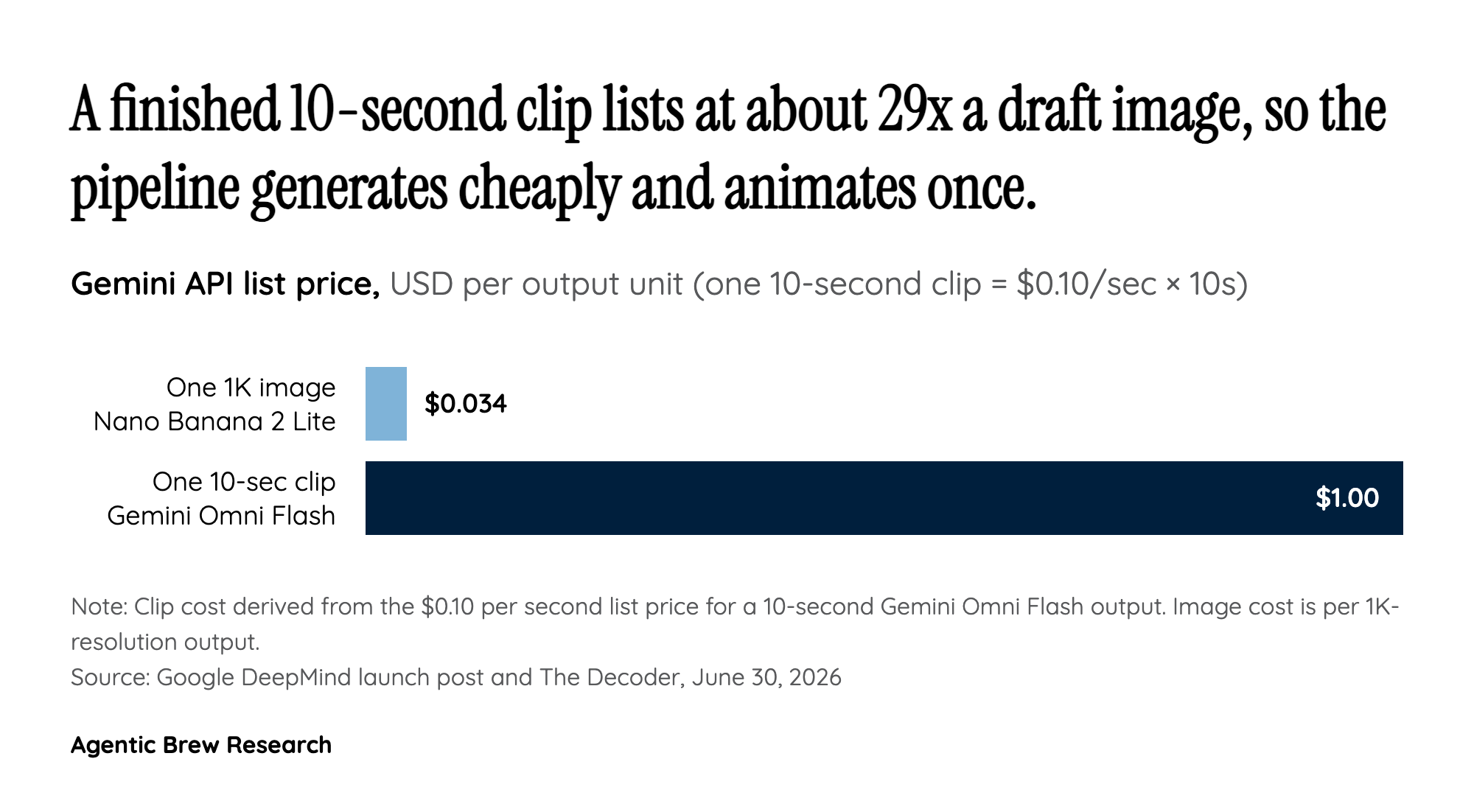
At Gemini API list prices, a 10-second Omni Flash clip ($1.00) costs about 29 times a 1K Nano Banana 2 Lite image ($0.034), which is why the pipeline drafts cheaply and animates once.

Read as separate launches, Nano Banana 2 Lite and Gemini Omni Flash look like a routine tier expansion and a video model finally reaching the API. Read together, they describe a single chained workflow: generate a still with the fast, cheap image model, then hand that image to Omni Flash as a reference to animate into a high-quality clip [1]. The connective tissue is the Interactions API, which preserves session history and context across turns, so a creator can iterate on a scene without re-establishing the whole request each time [1]. Google has effectively packaged an image-to-video assembly line and exposed it as an API primitive.

That framing matters because it changes what the pricing means. A four-second, $0.034 image is not just a cheap picture; it is the low-cost front end of a video pipeline whose back end runs at $0.10 per second of output [3]. Developers can afford to generate and discard many candidate frames before committing to the expensive animation step. The multi-turn design, allowing up to three consecutive edits with preserved context, is what makes that iterate-then-commit loop practical rather than a series of disconnected one-shot calls [3].
Efficiency as strategy, or retreat from the frontier

The launch has split the technical community along a single axis: is a deliberately lighter, cheaper tier a smart way to serve billions of users, or a sign that Google is stepping back from the state-of-the-art race. On one side, developers reading the model as enterprise infrastructure see the point clearly; commentators frame Nano Banana 2 Lite as an instrument built for high-volume workflows where throughput and cost, not benchmark leadership, are the objective [5]. On the other side, more skeptical voices read a Lite tier as a hedge, questioning whether frontier-quality generation is simply too expensive to serve at Google's scale.

The skepticism also fastened onto naming. A lineup that now spans Lite, standard, and Pro, layered on top of a Flash-Lite internal designation, invites the charge of naming sprawl and makes it harder for users to reason about what they are actually buying. Some also reported that free-tier limits feel tighter and that newer Flash tiers can cost more without proportional quality gains. None of that is a verdict; it is a genuine argument, and both readings can be true at once, with Google optimizing for cost-per-served-image while ceding some headroom at the top.

Where the seams show

Google is unusually candid about the limits. Nano Banana 2 Lite can struggle with small faces, accurate spelling, and fine details, and does not always preserve character consistency [2]. The 1K canvas ceiling is a hard constraint that separates the Lite tier from the multi-resolution Nano Banana 2 and Pro lines [4]. These are not edge cases for a model pitched at high-volume production, where text-in-image and repeated characters are exactly the workloads teams tend to run.

The video side has its own gaps. In the API, audio references and scene extensions are not supported yet, and character consistency across scene changes remains limited [3]. That last constraint sits in tension with the chained pipeline pitch: a workflow designed to animate a consistent reference image runs into a model that cannot fully hold that consistency once the scene shifts. The honest capability accounting is welcome, but it also marks the boundary of what this generation of the toolchain can reliably do.

A competitive read on the two-model drop

The timing and packaging read as a distribution move as much as a capability one. Both models ship simultaneously across Google AI Studio, the Gemini API, and the Gemini Enterprise Agent Platform, and Nano Banana 2 Lite is rolling into consumer surfaces including AI Mode in Search [1]. That breadth, plus third-party access through platforms like Runware for Omni Flash, spreads the models across developer, enterprise, and consumer channels on day one rather than gating them behind a single surface.

In the community, the comparison that keeps surfacing is against OpenAI's image model, with worry that competitors have pulled ahead on character consistency and a counterpoint that Gemini's structural edge is the economics of near-unlimited generation. That is the coherent throughline of the whole release: Google is competing less on any single best-in-class output and more on cost, speed, and how deeply the models are wired into surfaces people already use.

Historical Context

2025-08
Google first released the original Nano Banana image model, which went viral and drew millions of users to the Gemini app.
2025-11
Google released Nano Banana Pro with improved visual fidelity, text rendering, and studio-quality control, running on Gemini 3 Pro.
2026-02-26
Google launched Nano Banana 2, Gemini 3.1 Flash Image, and made it the default image engine across the Gemini app.
2026-05-19
Gemini Omni Flash, the first model in the Omni family, was introduced at Google I/O 2026 as Google's most advanced multimodal video generation and editing model.
2026-06-30
Google announced Nano Banana 2 Lite for speed and high-volume workflows, alongside the wider API release of Gemini Omni Flash.

Power Map

Key Players
Subject

Google launches Nano Banana 2 Lite and Gemini Omni Flash

GO

Google DeepMind

Developer and owner of the Nano Banana image family and the Gemini Omni video family; sets pricing and platform availability across Google AI Studio, the Gemini API, and the Gemini Enterprise Agent Platform.

DE

Developers and enterprises

Primary target audience; Nano Banana 2 Lite is positioned for fast ideation, high-throughput developer pipelines, and high-volume enterprise image generation at low per-image cost.

RU

Runware

Third-party platform that launched developer API access for Gemini Omni Flash, extending distribution beyond Google's own surfaces.

Fact Check

5 cited
  1. [1] Start building with Nano Banana 2 Lite and Gemini Omni Flash
  2. [2] Gemini Image Flash-Lite (Nano Banana 2 Lite)
  3. [3] Google launches Nano Banana 2 Lite for fast AI images and Gemini Omni Flash for video via API
  4. [4] Google unveils Nano Banana 2 Lite aka Gemini 3.1 Flash-Lite for low-cost 4-second enterprise image generations
  5. [5] Google announces Nano Banana 2 Lite image generation model targeting high-volume workflows

Source Articles

Top 5

THE SIGNAL.

Analysts

"Frames the launch as an API-first, cost-and-speed play, emphasizing the $0.034 per 1K image and $0.10 per second video economics and the chained image-to-video pipeline, while noting concrete gaps such as unsupported audio references and scene extensions in the API and limited character consistency across scene changes."

The Decoder
AI news publication

"Reads Nano Banana 2 Lite, aka Gemini 3.1 Flash-Lite, primarily as an enterprise instrument: low-cost, four-second image generation aimed at high-volume production rather than at the highest possible fidelity."

VentureBeat
Technology news publication

"Characterizes Nano Banana 2 Lite as explicitly targeting high-volume workflows, treating throughput and cost, not benchmark leadership, as the point of the release."

Neowin
Technology news publication
The Crowd

"gemini omni flash is here: our high-quality, cost-efficient model for video generation and conversational editing designed to support multimodal workflows, it enables you to refine videos using natural language and simple prompting start building with it today via ai studio and the Gemini API"

@@GoogleAIStudio2546

"introducing nano banana 2 lite: our fastest, most cost-effective gemini image model yet built for high-velocity developer pipelines, it delivers text-to-image outputs in 4 seconds at just $0.034 per 1K-resolution image swap it into your workflow today via ai studio and the Gemini API"

@@GoogleAIStudio1763

"We're shipping 2 major releases: 🔘 Nano Banana 2 Lite: our fastest and cheapest Gemini Image model 🔘 Gemini Omni Flash: now available via the Gemini API and in @GoogleAIStudio to help developers generate and edit high-quality videos."

@@GoogleDeepMind763

"Nano Banana flash lite?"

@u/Independent-Wind4462153
Broadcast
Introducing the Gemini Omni Flash API

Introducing the Gemini Omni Flash API

Gemini Omni Flash: Anything to Anything model from Google

Gemini Omni Flash: Anything to Anything model from Google

Nano Banana 2 Lite: IA más rápida, barata y potente

Nano Banana 2 Lite: IA más rápida, barata y potente