FDCEA expiration leaves federal data centers ungoverned
TECH

FDCEA expiration leaves federal data centers ungoverned

28+
Signals

Strategic Overview

  • 01.
    The Federal Data Center Enhancement Act (FDCEA), passed in 2023 as part of the FY2024 National Defense Authorization Act, is set to sunset on September 30, 2026, and neither Congress nor the Trump administration appears to be moving to extend it or pass replacement legislation.
  • 02.
    The act covers facilities wholly or partially owned, operated, or maintained by a federal agency, setting requirements for availability and uptime, sustainable energy use, protection against power failure, defenses against physical intrusion and natural disasters, and IT security.
  • 03.
    OMB Memorandum M-25-03, the implementation guidance that operationalizes the FDCEA and requires energy- and water-efficiency assessments by certified specialists for new builds and major upgrades, also sunsets September 30, 2026.
  • 04.
    If the law lapses without a successor, federal agencies may cease following the requirements and act independently when procuring new data center infrastructure, risking fragmented cybersecurity, resiliency, and sustainability practices.

Deep Analysis

What actually disappears on October 1: the federal data-center rulebook goes dark

The FDCEA is less a single rule than a baseline operating standard for every facility a federal agency owns, operates, or maintains. It bundles five concrete obligations into one statute: keeping facilities available and uptime-resilient, sourcing sustainable energy, hardening against power failure, defending against physical intrusion and natural disasters, and enforcing IT security protections [1]. The teeth, though, live in OMB Memorandum M-25-03, the January 2025 implementation guidance that translates the law into procurement practice. M-25-03 requires agencies planning a new data center or a major upgrade to commission assessments by certified energy-efficiency specialists and to formally weigh energy and water consumption before building [4]. Both the statute and that guidance carry the same expiration stamp: September 30, 2026 [4]. The mechanism of the lapse is therefore unusually clean. There is no partial wind-down, no grandfathering language being negotiated in public. On October 1, the assessment requirement simply ceases to bind, and agencies that were obligated to measure the energy and water footprint of a new build are no longer obligated to do anything at all [2]. The reporting that surfaced the lapse came via Wired and was amplified by The Register and Gizmodo; it is an article-driven story, not a leak of draft replacement text, because no replacement text appears to exist [1].
A deliberate sunset, not a paperwork miss: how this breaks with decades of precedent

The detail that turns this from bureaucratic housekeeping into a story is that letting the FDCEA expire is a choice, and an unusual one. A GSA employee told Wired that nothing like it has happened before: never in the history of data center policy, the employee said, has a policy expired without a successor having been painstakingly worked on for three years behind the scenes [2]. The historical pattern backs that up. When the 2014-era consolidation provisions under FITARA aged out, they were replaced rather than abandoned [1]. The current administration is instead leaning the other direction by design. Its July 2025 executive order moved to accelerate and streamline federal permitting of data center infrastructure, offer financial support, and open federal land to high-capacity AI projects [5]— a posture squarely focused on building faster, not governing tighter. Read alongside the silence on renewal, the lapse looks less like an oversight and more like deregulation by attrition: the rulebook is allowed to die rather than be repealed, which avoids a vote while achieving the same end. On Reddit, the reaction broke uniformly in this direction, with commenters in r/technology framing the expiration as deliberate deregulation favoring the AI industry over communities, energy, and water concerns, and explaining the mechanics — that killing the rule quietly removes the efficiency-assessment requirement without anyone having to defend the decision.

The federalism gamble: pushing standards to 50 states fragments the federal data estate

If Washington steps back, who fills the vacuum? The administration's answer appears to be the states. EPA Administrator Lee Zeldin reportedly argued that individual states, not federal mandates, should set data center standards [1]. That is a coherent ideological position, but it sits awkwardly on top of a federal data estate that spans every agency and crosses state lines. Without a federal floor, The Register notes, agencies may simply cease to follow the requirements and act as they see fit when procuring new infrastructure [1]. The practical consequence is divergence: cybersecurity, resiliency, and sustainability baselines that were uniform under one statute could splinter into agency-by-agency and state-by-state variation, and cloud and colocation providers selling to the government lose a single national standard to build to. Devolving to states also produces uneven coverage rather than no coverage — strong rules in some jurisdictions, none in others — which is precisely the fragmentation the FDCEA was written to prevent. The gamble is that market pressure and state regulation reconstitute a baseline faster than the federal government can dismantle one; the GSA's own warning is that those replacements normally take years to stand up, and none is visibly underway [2].

By the numbers: the guardrails come down exactly as public opposition peaks

By the numbers: the guardrails come down exactly as public opposition peaks
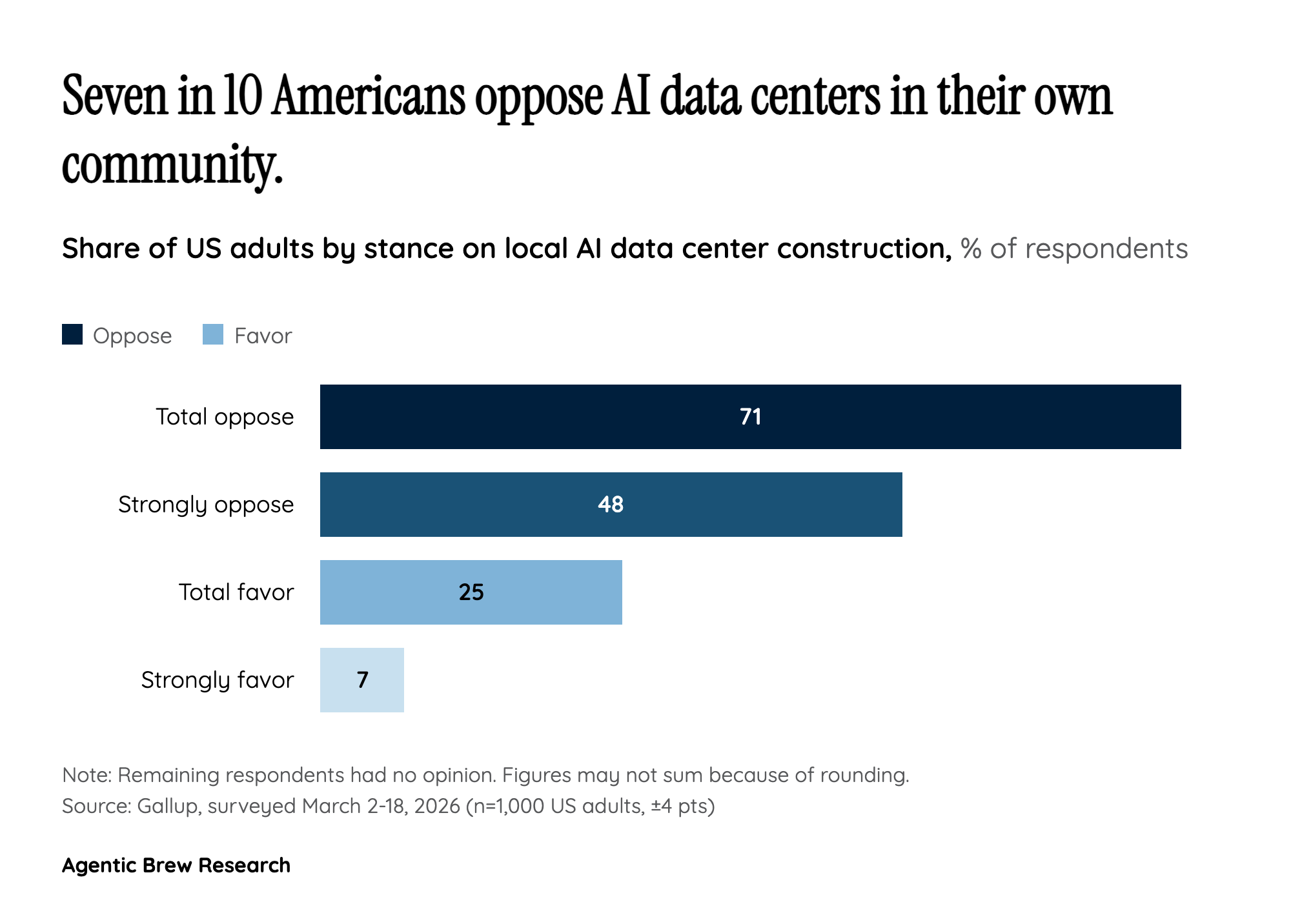
Gallup (March 2026): 71% of Americans oppose AI data centers in their local area and 48% are strongly opposed, while just 25% favor them and only 7% strongly so.

The timing is the sharpest edge of the story. The federal floor is being removed at the moment AI is driving the largest data-center buildout in history and public sentiment is running hard the other way. Gallup polling conducted in March 2026 found that roughly seven in ten Americans — 71% — oppose constructing AI data centers in their local area, with 48% strongly opposed; only about 25% are in favor, and just 7% strongly so [3]. The opposition is not a partisan artifact: a Reuters/Ipsos poll in June 2026 found 57% would oppose a data center in their own community, including two-thirds of Democrats and half of Republicans [6]. The discontent already carries economic weight. In 2025, local opposition contributed to the delay or cancellation of projects totaling roughly US$156 billion, and trackers count 268 local protest groups across 37 states [7]. Against that backdrop, the lapse of M-25-03's energy- and water-efficiency assessments removes one of the few federal levers that forced agencies to even measure the resource footprint communities are protesting [2]. The collision is the insight: demand for oversight is rising while the supply of it is being switched off.

Historical Context

2014
Earlier data center consolidation and optimization provisions under FITARA (the Federal Data Center Consolidation Initiative) governed federal data centers; these were deliberately replaced rather than allowed to lapse as federal needs evolved.
2023-12
The FDCEA of 2023 (S.933, 118th Congress) was enacted within the FY2024 NDAA, directing OMB to set requirements for data center cybersecurity, resiliency, and availability.
2025-01
OMB issued Memorandum M-25-03, the FDCEA implementation guidance, requiring secure and highly available computing infrastructure plus energy- and water-efficiency assessments.
2025-07
Issued an executive order to accelerate and streamline federal permitting of data center infrastructure, provide financial support, and use federal land for high-capacity AI data center projects.
2026-06-15
The Register reported, citing Wired, that the FDCEA is set to lapse on September 30, 2026 with no replacement in sight.

Power Map

Key Players
Subject

FDCEA expiration leaves federal data centers ungoverned

TR

Trump administration

Holds executive power to extend or replace the act but is reportedly taking a hands-off approach, prioritizing AI advancement; issued a July 2025 executive order to accelerate and streamline federal data center permitting and tap federal land for high-capacity AI projects.

US

US Congress

Has the authority to renew or replace the FDCEA but reportedly made no major moves ahead of the September 30, 2026 sunset.

OF

Office of Management and Budget (OMB)

Issued implementation guidance M-25-03, which currently requires agencies planning new data centers or major upgrades to arrange assessments by certified energy-efficiency specialists and to weigh energy and water use.

GE

General Services Administration (GSA)

Provides guidance for incorporating FDCEA requirements and posts agency compliance information; a GSA employee criticized the impending lapse to Wired.

EP

EPA Administrator Lee Zeldin

Reportedly stated that individual states, rather than federal mandates, should determine data center standards.

Fact Check

7 cited
  1. [1] Feds snooze as US datacenter law set to lapse with no replacement in site
  2. [2] US Government Reportedly Allowing Federal Data Center Rules to Expire
  3. [3] Americans Oppose Data Centers in Their Area
  4. [4] Implementation Guidance for the Federal Data Center Enhancement Act
  5. [5] Accelerating Federal Permitting of Data Center Infrastructure
  6. [6] Americans Wary of AI-Driven Data Center Boom, Reuters/Ipsos Poll Shows
  7. [7] Opposition to AI data centers

Source Articles

Top 4

THE SIGNAL.

Analysts

"Characterized the lapse as unprecedented, noting that no prior data center policy has expired without a successor having been developed years in advance."

Unnamed GSA employee
General Services Administration employee, cited by Wired

"Reportedly argued that data center standards should be set by individual states rather than by federal mandate, a stance aligned with the administration's preference for devolving oversight."

Lee Zeldin
EPA Administrator
The Crowd

"US Government Reportedly Allowing Federal Data Center Rules to Expire"

@u/Plastic_Ninja_9014159

"Trump Administration Allows Federal Data Center Enhancement Act to Expire"

@u/Cute-Guarantee-16761
Broadcast