Tesla's Bet: Trade Free Cash Flow Now for an AI Empire Later
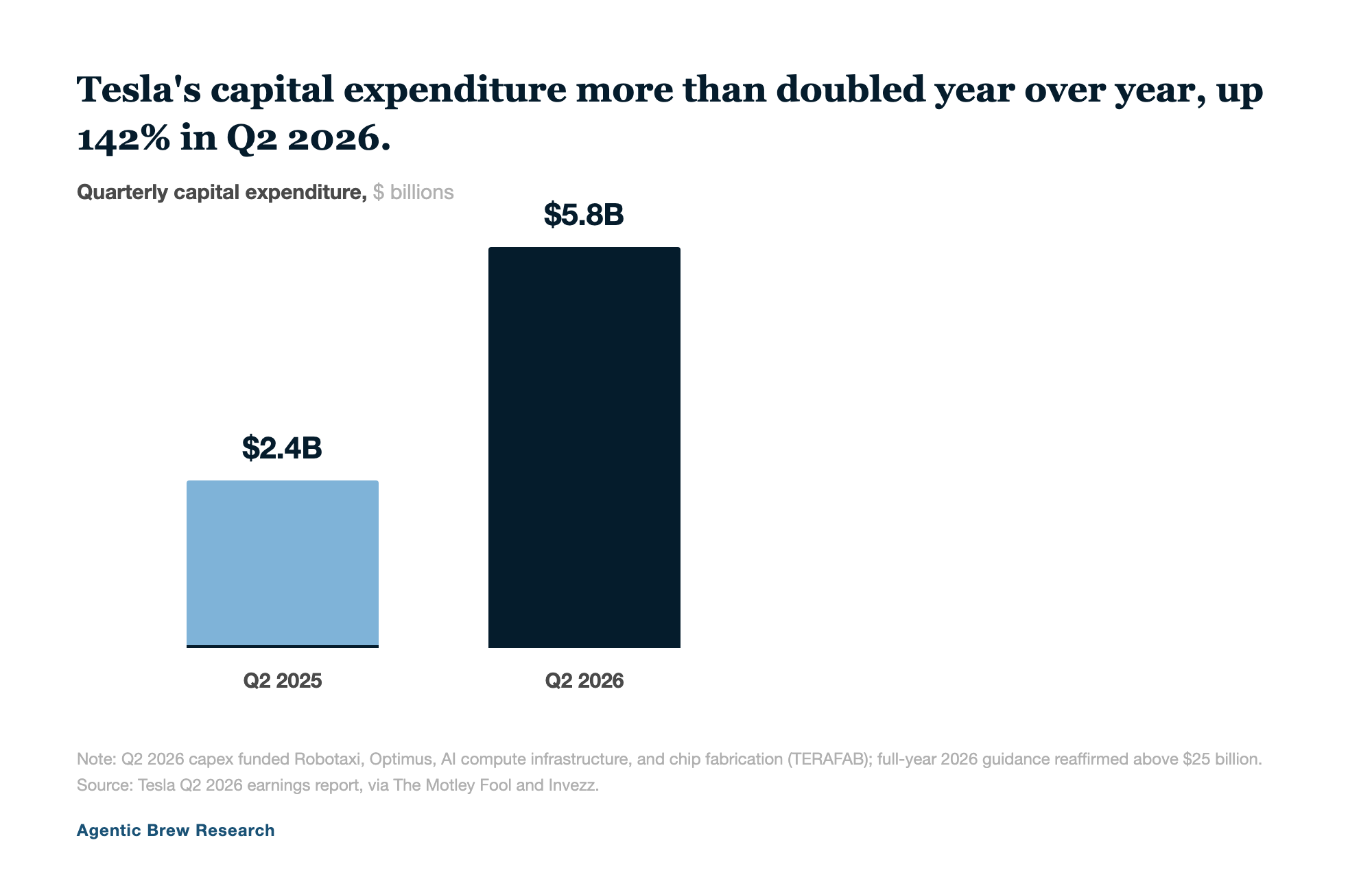
Tesla's capex more than doubled in the quarter - $5.79-5.8 billion, up 142% year-over-year - and the company reaffirmed full-year 2026 guidance above $25 billion, roughly triple what it spent in 2025[1]. That spending is going into Robotaxi, Optimus, AI compute infrastructure, chip fabrication (TERAFAB) and solar manufacturing, and management expects it to keep rising over the next two to three years[1]. The immediate cost showed up in the cash flow statement: free cash flow turned negative for the first time in more than two years, landing around -$1.1 billion, even as revenue hit a record $28.24 billion[2].
Musk's own framing of the tradeoff was blunt on the call - he said Tesla should spend on capex as fast as it can without being wasteful, and that it's 'okay to be a little less capital efficient' if it means getting Optimus, Robotaxi and AI compute built sooner[1]. Wall Street's response was to cut price targets: JPMorgan, Cantor Fitzgerald and Mizuho Securities all trimmed their numbers after the report, and Tesla posted its lowest operating profit in six years despite the record top line[3]. Truist's William Stein kept a Hold rating, describing the AI progress as 'positive, but imperfect', while Direxion's Ryan Lee said the core unresolved question for investors is simply whether any of this AI spending will monetize on a timeline that matters[2]. The bull case and the bear case aren't disagreeing about the size of the bet - they're disagreeing about whether Tesla can afford to wait for it to pay off.