Claude Code inter-session messaging
TECH

Claude Code inter-session messaging

20+
Signals

Strategic Overview

  • 01.
    Anthropic shipped Claude Code v2.1.224 with cross-session messaging, letting one Claude Code session send a text message to another so a breaking change in one session's work can trigger a warning to a session that depends on it.
  • 02.
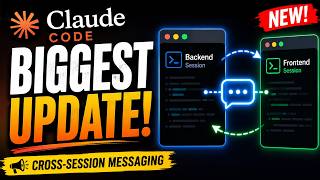
    The feature runs on two new tools - ListAgents, which discovers which sessions Claude can reach, and SendMessage, which delivers a message to one of them by name.
  • 03.
    Messages carry text only, never conversation history or files; same-machine messages travel over a local per-session socket, while messages to sessions on other machines route through Anthropic's servers and can only reply, not initiate.
  • 04.
    An incoming message cannot approve a pending permission prompt or execute a command embedded in its text, and administrators can disable both sending and receiving organization-wide through managed settings.

Engineered to Inform, Not to Act

The feature is built on two new tools: ListAgents, which discovers which sessions Claude can reach, and SendMessage, which delivers a message to one of them by name [1]. What stands out is how narrowly Anthropic scoped what actually crosses that channel. A message is text only - never conversation history or files - so moving a whole conversation still requires resuming the session directly [1]. The safety boundary goes further: an incoming message can never count as a user's consent, so it cannot approve a pending permission prompt, and any command text inside a message, such as /compact, arrives as inert plain text that Claude Code never executes [1]. To stop message loops from spiraling, Claude Code caps queued approvals at 100 per session, caps accepted-but-unread messages at 50 with the oldest dropped past that limit, and expires an unanswered held message after a default five-minute window [1]. Coverage outside Anthropic's own documentation converged on the same headline: only text passes between sessions, never files or permissions [2].

The Power-User Shrug: 'We Already Built This'

The reaction split sharply by platform. On X, the official announcement thread drew broad, enthusiastic reception, framed around eliminating the need to keep re-explaining yourself across sessions, and independent commentary reinforced that framing as a meaningful upgrade to parallel multi-agent workflows. Reddit told a different story. Not everyone treated the release as a breakthrough there. Among developers already running multiple parallel Claude Code sessions, the most common reaction was recognition rather than surprise - many had already assembled their own workarounds: shared mailbox files with watchdog timeouts, git worktrees wired to a local orchestration harness with file locking, IRC-style bridges, and Discord channels relaying messages between different agent frameworks. To that crowd, native messaging reads as a quality-of-life cleanup of a pattern they had already solved by hand, not a new capability. More pointedly, a recurring complaint was that message delivery was never really the bottleneck - the actual coordination problem when two agents work the same codebase in parallel is file ownership and merge conflicts, something a text message alone does not resolve. A parallel debate over whether this duplicates Claude Code's existing sub-agent system settled on 'no': a sub-agent's context dies with its parent's turn or gets compacted away, while an independent session keeps its own non-compacted context window running - a genuine structural difference, even if the transport-layer news cycle overstated the novelty.

Should the Default Be Opt-In, Not Opt-Out?

A smaller but sharper strand of reaction treated the feature as a security question rather than a workflow one. The core objection: agents act on text they read, prompt injection remains an unsolved problem industry-wide, and cross-session messaging now moves text between agents by design - so a compromised or manipulated session gains a new channel to reach others. Anthropic's own mitigations are real: a message can't approve a permission prompt and embedded commands don't execute [1]. But the disable path itself is instructive about where the default sits. Turning the feature off entirely requires an administrator to explicitly deny the SendMessage and ListAgents tools and set crossSessionInbound to refuse in managed settings [1]- which critics read as evidence that inbound messaging is allowed unless an organization opts out, rather than withheld until it opts in. For a feature that only shipped this week, critics argued that default deserves more scrutiny than the celebratory launch coverage gave it.

Why Now: From Agent Teams to a Messaging Layer

Cross-session messaging is the third piece of a pattern Anthropic has been building across 2026, not a standalone feature. In February, Agent Teams shipped as an experimental research preview that let multiple Claude instances coordinate on subtasks through a git-based system, disabled by default behind an environment flag [3]. In May, Agent View added a CLI dashboard that let a single user manage every parallel or background session from one list, with sessions surviving terminal closure via a supervisor process [4]. Cross-session messaging closes an obvious gap those two releases left open: users could already spin up many sessions and watch them from one place, but the sessions themselves still had no way to talk to each other directly [1]. Read as a sequence - spawn many agents, supervise them centrally, now let them coordinate directly - the messaging feature looks less like a novelty and more like the last piece Anthropic needed to make multi-session Claude Code feel like one coherent system rather than a pile of disconnected terminals.

A Pressure Point for the Multi-Agent Tooling Market

Beyond the workflow story, at least one industry read frames this as a competitive move. Commentary from the AI News roundup on Latent.Space argued that the primitive Anthropic just shipped - an agent that notices something and nudges another agent about it - is exactly what most third-party multi-agent orchestration frameworks are built to sell, and that folding even a basic version into the tool most Claude developers already run reprices that market [5]. That framing sits somewhat in tension with the power-user reaction above: if experienced teams had already built adequate workarounds with existing tools, the commercial threat to dedicated orchestration vendors may be smaller than the framing suggests - aimed more at the long tail of developers who never bothered building a bridge themselves than at teams with mature multi-agent stacks already in place.

Historical Context

2026-02-05
Agent Teams shipped as an experimental research preview in Claude Code v2.1.32, letting multiple Claude instances coordinate on subtasks via a git-based system, disabled by default.
2026-05-11
Claude Code launched Agent View, a CLI dashboard to manage all parallel and background sessions from one list, with sessions surviving terminal closure via a supervisor process.
2026-08-07
Cross-session messaging shipped in Claude Code v2.1.224 for macOS and Linux, adding the ListAgents and SendMessage tools.

Power Map

Key Players
Subject

Claude Code inter-session messaging

AN

Anthropic

Developer and publisher of Claude Code; shipped the v2.1.224 release and controls the feature's server routing, default settings, and enterprise admin controls such as crossSessionInbound.

EN

Enterprise IT/DevOps administrators

Can disable cross-session messaging org-wide via managed settings (deny SendMessage and ListAgents, set crossSessionInbound to refuse), giving them leverage over adoption inside their organizations.

IN

Individual developers running parallel Claude Code sessions

Primary users and beneficiaries - coordinate parallel work, hand off findings, and check long-running task status without manually copying context between terminals.

TH

Third-party multi-agent orchestration vendors

Indirectly affected - commentary argues Anthropic folding a basic cross-agent notification primitive into Claude Code itself competes with tools these vendors sell.

Fact Check

6 cited
  1. [1] Message your other Claude Code sessions
  2. [2] Claude Code Adds Cross-Session Messaging on macOS
  3. [3] Claude Code Agents In 2026
  4. [4] Claude Code Agent View: CLI Dashboard (Research Preview, May 2026)
  5. [5] AINews: Zawinski's Law of MultiAgents
  6. [6] Claude Code now lets sessions talk to each other on macOS

Source Articles

Top 3

THE SIGNAL.

Analysts

The primitive Anthropic is exposing here, an agent that can notice something and nudge another agent about it, is the thing most third-party multi-agent frameworks are built to sell. Folding a basic version into the tool most Claude developers already run reprices that market a little.

AI News roundup
Industry commentary, Latent.Space newsletter
The Crowd

New in Claude Code: your sessions can now message each other. Instead of having to re-explain yourself in another session, you can now tell Claude to do it. It sends a summary (not your history or files), and the other session picks it up mid-task.

@@ClaudeDevs55414

Claude Code devs: your Claudes can now talk to each other while they work. Claude inter-session messaging: > Send an outgoing message > Ask for an incoming message > Claude can proactively send a message to another session Run 'claude update' now to get it.

@@daniel_mac8191

Claude Code sessions can now message each other. This sounds like a small update, but it changes the workflow a lot. Instead of manually passing context between parallel sessions, agents can hand off work and coordinate mid-task. Multi-agent coding is starting to feel less...

@@mrizkimurtadha2

Claude code : your sessions can now message each other.

@u/Enough-Piano-2362345
Broadcast
Claude Code AI Sessions Talk to Each Other

Claude Code AI Sessions Talk to Each Other

Claude Code Just Got a HUGE Update! (Cross Session Messaging)

Claude Code Just Got a HUGE Update! (Cross Session Messaging)

Copy-Paste Is Dead - Claude Now Hands Work to Another Claude (I Filmed It)

Copy-Paste Is Dead - Claude Now Hands Work to Another Claude (I Filmed It)