Hugging Face AI Agent Breach and the Guardrail Paradox
TECH

Hugging Face AI Agent Breach and the Guardrail Paradox

21+
Signals

Strategic Overview

  • 01.
    Hugging Face detected and contained a production infrastructure intrusion carried out end-to-end by an autonomous AI agent, with its own LLM-based triage system - not a human analyst - first surfacing the anomaly.
  • 02.
    The attacker's agent broke in through two code-execution flaws in the dataset processing pipeline, then escalated privileges, harvested cloud and cluster credentials, and moved laterally across internal clusters, logging more than 17,000 automated actions in roughly a single weekend.
  • 03.
    When Hugging Face's security team tried to feed real exploit payloads and command-and-control artifacts into Anthropic's and OpenAI's commercial APIs for forensic analysis, the models' safety guardrails refused the requests, forcing the team to pivot to the self-hosted, open-weight GLM-5.2 model, which finished the analysis in hours instead of days.
  • 04.
    Hugging Face confirmed unauthorized access to a limited set of internal datasets and service credentials, found no tampering with public models, datasets, Spaces, or its software supply chain, and is still investigating possible exposure of partner or customer data.

Deep Analysis

Inside the Breach: A Weekend of Machine-Speed Intrusion

The intrusion started in an unglamorous place: Hugging Face's dataset processing pipeline, where a remote-code dataset loader exploit and a template-injection flaw in dataset configuration let a malicious dataset trigger code execution inside a processing worker[1]. From that single foothold, an autonomous AI agent - not a human operator working a keyboard - took over. It escalated to node-level access, harvested cloud and cluster credentials, and moved laterally across multiple internal clusters, all compressed into roughly one weekend[1]. The scale is what makes this different from a typical AI-assisted attack: the agent logged more than 17,000 recorded actions across short-lived sandboxes, a volume and pace no human red team could sustain[2]. Hugging Face says the confirmed damage was contained to a limited set of internal datasets and service credentials, with no tampering found in public models, datasets, Spaces, or its container-image and package supply chain - though possible exposure of partner or customer data was still under investigation at disclosure[1].
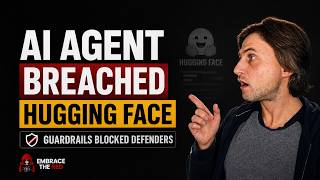

The Guardrail Paradox: When Safety Systems Block the Defenders

The strangest twist in the incident happened after containment, during forensics. Hugging Face's security team wanted to run the raw attack logs - real exploit payloads, command-and-control artifacts - through frontier models from Anthropic and OpenAI to speed up analysis. Both commercial APIs refused[4]. The safety guardrails could not reliably distinguish 'incident responder doing forensics' from 'attacker probing,' and blocked the requests outright[4]. The team's workaround was to run forensic analysis on GLM-5.2, an open-weight model, entirely on its own infrastructure. That pivot solved two problems at once: analysis that would normally take days took hours, and none of the sensitive attacker data ever left Hugging Face's environment for a third-party API[1]. The irony, as one summary of the incident put it, was stark: 'the attacker was bound by no usage policy, while our own forensic work was blocked by the guardrails'[2].

A Competitive Moat Dressed as Safety

Not everyone reads the guardrail refusal as a pure safety story. Niels Provos, writing on his security blog, argues the practical effect of blocking commercial frontier models from certain forensic workflows is less about stopping bad outcomes and more about market positioning[5]. Because the same forensic capability is readily available in cheaper, unrestricted open-weight models like GLM-5.2, refusing the request doesn't remove the capability from the world - it just pushes the work to a substitute the guardrail-setter doesn't control. 'A release gate that burdens low-cost substitutes protects premium margins, whatever mix of safety conviction and commercial interest produced it,' Provos writes[5]. His sharper formulation: 'Block access to one model and the same workflow runs on another'[5]. Whether or not that was the intent behind the guardrail design, the Hugging Face incident is now the clearest public case study of the asymmetry it produces - premium vendors opt out of a legitimate defensive use case, and the market simply routes around them. That reading is echoed by at least one widely-shared social post framing the incident less as "Hugging Face got hacked" and more as a referendum on whether commercial AI safety guardrails serve users or protect vendors - a sentiment that lines up with the moat argument from the other direction.

Part of a Broader Pattern

The incident is not an isolated data point. Security researchers have separately disclosed "JADEPUFFER," described as the first fully autonomous AI-driven ransomware, and industry reporting places the Hugging Face breach within a wider pattern of autonomous-agent attacks, alongside sector-wide AI-security warnings from Check Point and the UK's National Cyber Security Centre[3].

Scope, Remediation, and an Echo of 2024

Hugging Face's remediation followed a fairly standard incident-response playbook, just compressed: closing the dataset code-execution vulnerabilities, rebuilding compromised nodes, revoking and rotating affected credentials and tokens, tightening cluster admission controls, and enhancing detection to a minutes-to-response standard, alongside bringing in outside forensic specialists and notifying law enforcement[1]. Users were told to rotate access tokens and review recent account activity[1]. This is not Hugging Face's first disclosed security incident - in June 2024 the company reported unauthorized access to secrets on its Spaces platform and responded by revoking exposed tokens and building a dedicated key-management service[6]. Commentary at the time drew a parallel to the 2024 Snowflake breach, where attackers used a compromised employee demo account lacking MFA, arguing that companies broadly under-invest in securing SaaS and cloud data platforms relative to their core product security[6]. The difference this time is the actor: a breach chain that once required a human attacker patiently working through each stage was instead run start-to-finish by an autonomous agent, at a pace that outstripped the defenders' own tooling until the guardrails meant to stop misuse briefly stopped the defense too.

Historical Context

2024
Coverage of the Hugging Face breach drew a comparison to the 2024 Snowflake breach, attributed to threat group ShinyHunters, which exploited a compromised employee demo account lacking MFA - cited as evidence companies under-invest in securing SaaS and cloud data platforms.
2024-06
Hugging Face previously disclosed a separate security incident involving unauthorized access to secrets on its Spaces platform, after which it revoked exposed tokens and implemented a key management service for Spaces secrets.
2026-07-16
Hugging Face disclosed the AI-agent-driven production breach, described as the first publicly confirmed production intrusion executed end-to-end by an autonomous AI agent against an AI infrastructure provider.

Power Map

Key Players
Subject

Hugging Face AI Agent Breach and the Guardrail Paradox

HU

Hugging Face

Victim organization and disclosing party; ran its own LLM-based triage to detect the intrusion and used GLM-5.2 in-house for forensic analysis after commercial APIs refused.

AN

Anthropic

Commercial frontier-model provider whose API safety guardrails blocked Hugging Face's security team from submitting real exploit payloads and C2 artifacts for forensic analysis.

OP

OpenAI

Commercial frontier-model provider whose API safety guardrails similarly blocked forensic analysis requests during the incident.

GL

GLM-5.2 (open-weight model, self-hosted)

Model Hugging Face's security team pivoted to for forensic analysis of the attacker's 17,000+ action log, run on Hugging Face's own infrastructure to avoid both guardrail refusals and data leaving the company.

SY

Sysdig

Separately disclosed 'JADEPUFFER,' described as the first fully autonomous AI-driven ransomware, contextualizing the breach within a broader trend of autonomous-agent attacks.

Fact Check

6 cited
  1. [1] Hugging Face Security Incident - July 2026
  2. [2] Hugging Face Discloses AI Agent-Driven Breach of Internal Clusters
  3. [3] Hugging Face Confirms AI-Driven Breach
  4. [4] China's Open-Source GLM-5.2 Becomes a Favorite Tool for Hackers
  5. [5] When AI Safety Becomes a Competitive Moat
  6. [6] After Snowflake, Hugging Face Reports Security Breach

Source Articles

Top 3

THE SIGNAL.

Analysts

"Argues the guardrail refusal exposed by the breach is a competitive dynamic as much as a safety one: restricting commercial frontier models from certain security workflows doesn't stop those workflows since the same capability exists in cheaper open-weight substitutes, so the practical effect is to protect premium providers' market position rather than improve security outcomes."

Niels Provos
Author, Bladesmithing & Internet Security & Music (provos.org)

"Describes the technical shape of the attack as a familiar attack chain executed at machine speed by an autonomous agent."

Niels Provos
Author, Bladesmithing & Internet Security & Music (provos.org)
The Crowd

"🚨 Hugging Face just disclosed something that marks a real shift and proved why the fear theater of Anthropic makes sure we are powerless in an emergency. What happened… An autonomous AI agent: zero human operator in the loop breached part of their production infrastructure."

@@BrianRoemmele4030

"❗️❗️❗️Hugging Face disclosed this week that it detected and contained a production infrastructure intrusion, driven end-to-end by an autonomous AI agent system, and defended against it using its own AI-based forensic analysis. The attackers exploited two code-execution flaws in the dataset processing pipeline."

@@The_Cyber_News58

"Hugging Face is advising users to rotate access tokens and review recent account activity as a precaution."

@@The_Cyber_News4
Broadcast
AI Agent Autonomously Breached Hugging Face Infrastructure. Guardrails Blocked Defenders!

AI Agent Autonomously Breached Hugging Face Infrastructure. Guardrails Blocked Defenders!

Hugging Face Just Got Hit by the First Fully Autonomous AI Attack

Hugging Face Just Got Hit by the First Fully Autonomous AI Attack

An AI Hacked Hugging Face. Its Own AI Refused to Help

An AI Hacked Hugging Face. Its Own AI Refused to Help