A GPT-3 Moment for Speech, or Something Narrower
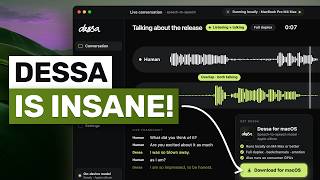
Most of what gets called 'voice AI' today - ChatGPT's voice mode, Gemini Live, Sesame's Maya - is a text-based language model wearing a speech costume: audio comes in, gets converted to text, a text-based model reasons over it, and a separate text-to-speech layer bolts a voice onto the output. Dessa, the model Block unveiled on October 23, 2026, skips that pipeline entirely. It was trained from scratch on raw audio alone, with no text transcripts and no pretrained language model underneath it [1], and it runs full duplex - it can listen and speak at the same time, the way real conversations actually overlap rather than taking strict turns.
Block's own explanation for why is almost philosophical: babies learn to talk by listening long before they can read a word, and the team wanted to find out whether a model could learn the same way [2]. It apparently can, using 'hundreds of times fewer words' of training data than a conventional text-based LLM needs [2]. Project lead Ragavan Thurairatnam has pitched the result as nothing less than 'a GPT3 moment for speech' [3]- and the compute story backs up the ambition of that claim without the usual price tag: Dessa was trained on a single NVIDIA GB200 NVL72 rack, not a sprawling multi-rack cluster [4], and the finished model runs locally, faster than real time, on a MacBook Pro M4 Max [5]. The closest prior research comparison, by outside accounts, is Kyutai's Moshi, an open-weight full-duplex speech model with a roughly 7-billion-parameter core, though Moshi and Sesame's CSM both still lean on text somewhere in the pipeline in ways Dessa doesn't [6].