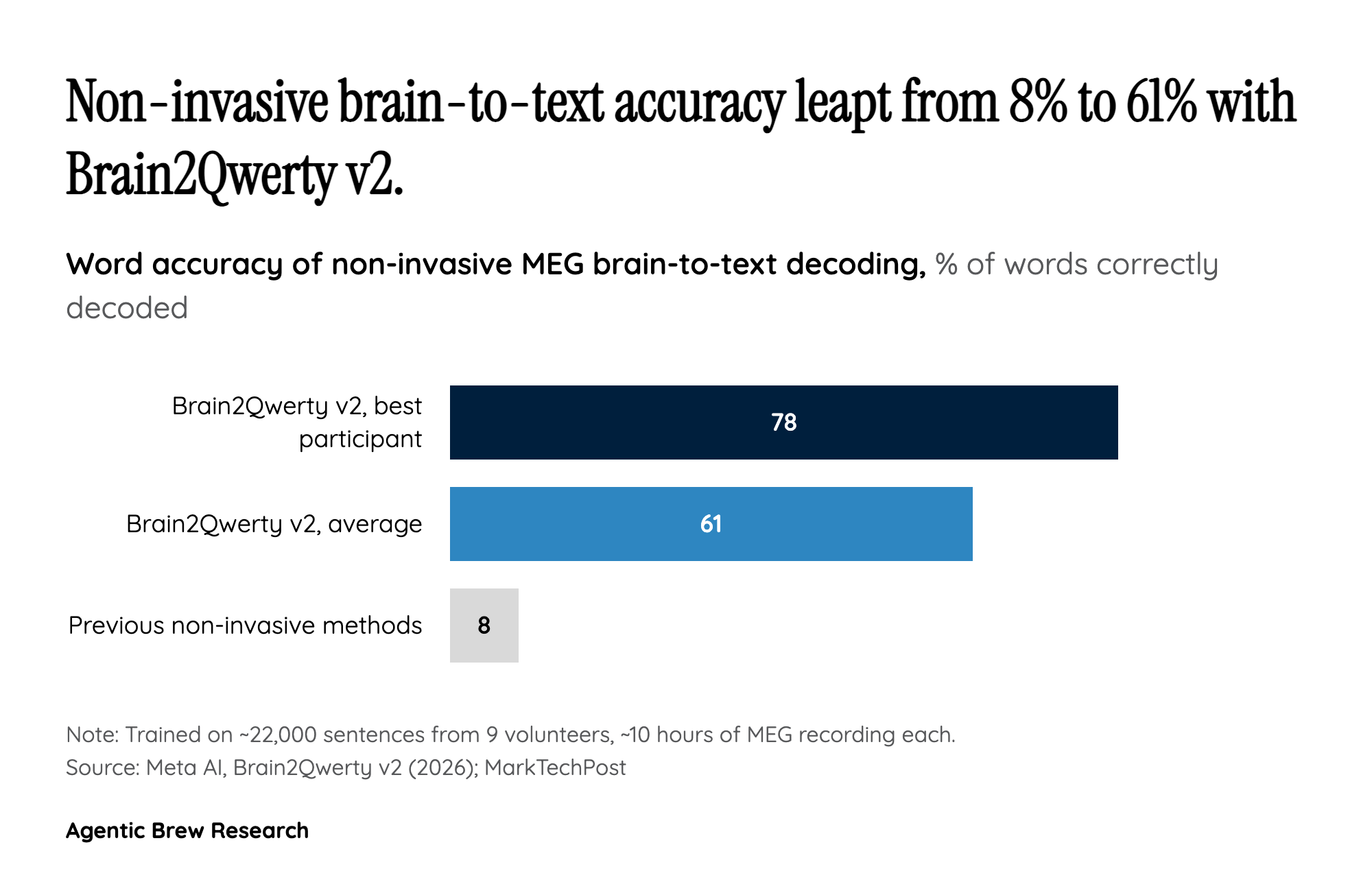
It Reads Your Fingers, Not Your Mind
The most important thing to understand about Brain2Qwerty v2 is what it does not do. It does not read free-floating thoughts. Volunteers sat inside an MEG scanner and actively typed sentences on a QWERTY keyboard while the machine recorded the faint magnetic fields of neurons planning those finger movements [1]. The model learns the neural signature of the keystrokes a person is trying to press, and a language model then cleans up the raw, noisy guesses into readable sentences [2].
A telling detail surfaced in the community discussion around the release: the system's errors cluster around keyboard geography. It will output "firl" for "girl" because f sits next to g - exactly what you would expect if the model is decoding motor intent rather than semantic meaning. That distinction is the whole story. The viral "Meta can read your mind" framing overshoots the research: the system cannot pull memories, inner monologue, or private conversations. It reconstructs what you are deliberately trying to type, and only after extensive per-user calibration [4]. Understanding this collapses most of the science-fiction reaction into a much narrower, and more honest, claim about decoding intentional movement.