Nvidia's Financial Dominance and Growth
TECH

Nvidia's Financial Dominance and Growth

26+
Signals

Strategic Overview

  • 01.
    Nvidia reported Q2 fiscal 2027 revenue of $96.2 billion, up 106% year-over-year, beating analyst estimates of $92.2 billion.
  • 02.
    CFO Colette Kress guided fiscal 2028 revenue growth to roughly 70% year-over-year, far above the 44% average analyst estimate.
  • 03.
    Wall Street's compounded profit growth forecasts imply Nvidia's annual net income could reach roughly $851 billion by 2029, more than five times Saudi Aramco's record corporate profit; separately, Nvidia's projected 2029 revenue of roughly $1.35 trillion would rank it as the 18th-largest economy on Earth.
  • 04.
    Nvidia agreed to acquire Hugging Face for roughly $12.9-13 billion, its second-largest acquisition ever after a roughly $20 billion licensing agreement with chip startup Groq.

Deep Analysis

Supply, Not Demand, Is the Only Constraint Left

When CFO Colette Kress told analysts to expect roughly 70% year-over-year revenue growth in fiscal 2028, she was guiding well above what Wall Street had priced in - the average analyst estimate stood at just 44% [1]. The gap matters because of what came next: management frames the 70% figure as a supply-constrained outlook, arguing that absent bottlenecks in the current supply chain, revenue could actually more than double year-over-year [1]. That reframes the growth story entirely - Nvidia isn't describing a market it needs to go find, it's describing a market it can't yet fully serve.

Two proof points give the guidance teeth. First, Amazon's recent commitment to buy 2 million Nvidia GPUs for delivery across 2027 and 2028 [1]is the kind of multi-year forward order that only makes sense if a hyperscaler believes compute demand keeps compounding well past this earnings cycle. Second, coverage framing the 70% figure as putting Nvidia on track to become one of tech's largest companies by some measures [2]underscores how unusual it is for a company already this large to guide toward accelerating, not decelerating, growth. The same quarter that produced this guidance saw Data Center revenue climb 117% year-over-year to $89.0 billion [3]- the base the 70% number has to build on.
The Math That Would Make Nvidia Bigger Than Switzerland

The Math That Would Make Nvidia Bigger Than Switzerland
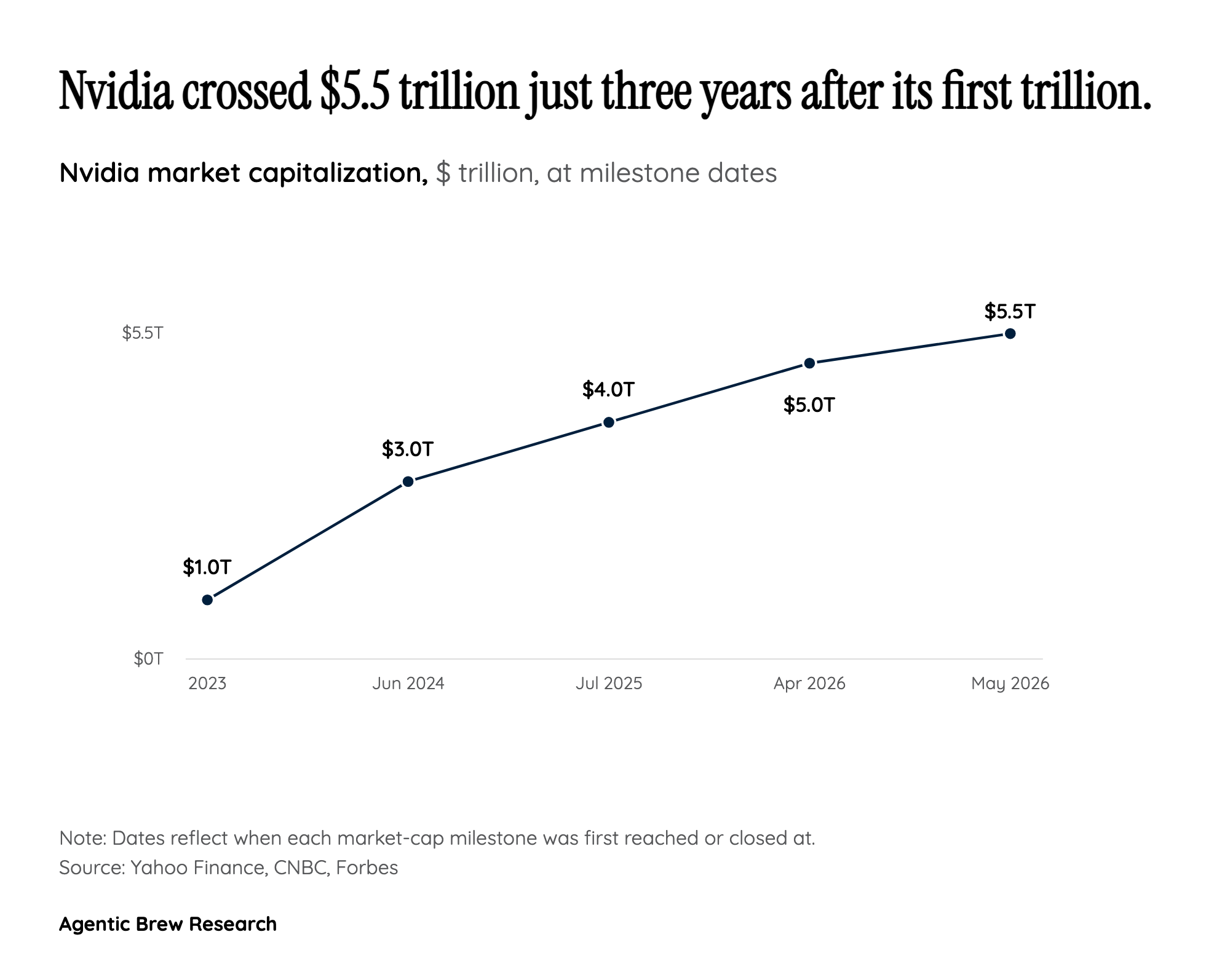
Nvidia market capitalization milestones, 2023-2026 (Yahoo Finance, CNBC, Forbes).

Strip away the quarter-to-quarter noise and the long-run projection is the more startling number. Wall Street's compounded EPS growth forecasts imply Nvidia's annual net income could reach approximately $851 billion by 2029 [4]- more than five times Saudi Aramco's $161.1 billion 2022 profit, itself the largest annual profit any company has ever reported [4]. Run the same trajectory through revenue instead of profit and the comparison gets stranger still: a projected $1.35 trillion in 2029 revenue would rank as the 18th-largest economy on Earth, just behind Saudi Arabia's GDP and just ahead of Switzerland's [4].

The market has already started pricing pieces of this in. Nvidia became the first company to cross a $5.5 trillion market capitalization [5], sitting roughly $1 trillion ahead of the next-largest company, Alphabet [5]. Social commentary has picked up on just how large a share of the market that represents - posts circulating on X this quarter pointed out that Nvidia's roughly $5.2-5.3 trillion valuation alone equals something like 8% of the entire S&P 500 and is comparable in scale to 16% of US GDP, a framing that treats one company's balance sheet as a macroeconomic variable in its own right. Whether or not the 2029 figures hold up, the fact that a single chipmaker is now being measured against sovereign economies by professional forecasters and retail traders alike is itself the story.

The Circular Financing Machine Behind the Guidance

Growth guidance this aggressive raises an obvious question: who is actually paying for all the compute Nvidia says it's about to sell? Part of the answer is that Nvidia itself is. The company's customer guarantees carry a maximum exposure of $108.5 billion, and roughly $105 billion of that is tied to a single 4.25-gigawatt OpenAI data center project in Ohio [6]. In practice, that means Nvidia is backstopping a meaningful share of the very demand it reports as revenue, a structure critics say inflates both Nvidia's top line and its customers' balance-sheet valuations at the same time [6].

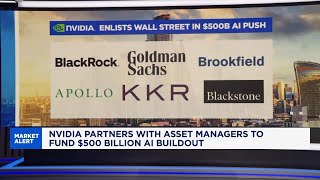
There's a second, quieter risk sitting underneath that arrangement: the hardware itself loses value as newer chips ship, so guarantees written against today's GPUs are, to some degree, a bet that the underlying collateral won't lose value faster than the debt gets repaid. Community discussion on YouTube and Reddit this quarter leaned hard into exactly this mechanic, describing reports of Nvidia arranging large financing packages with outside asset managers to back GPU-collateralized loans, and in some threads drawing explicit comparisons to the vendor-financing loops that preceded the 2008 financial crisis. None of the specific financing figures circulating in that discussion are confirmed in on-the-record reporting used here, but the sentiment itself is notable - a meaningful slice of Nvidia's own audience is now openly asking whether its growth engine and its financing arm are becoming the same thing.

The Skeptics Cashing Out While the Rally Runs

Not everyone is buying the story at these prices, and some of the clearest signals are coming from people who used to own the stock. Peter Thiel sold down a roughly $100 million Nvidia stake, and SoftBank exited a position worth roughly $6 billion [6]- moves that skeptics read less as routine profit-taking and more as an early exit ahead of a broader unwind. That skepticism isn't limited to insiders selling shares. Morningstar's Brian Colello argues the opposite case - that AI demand doesn't appear to be slowing at all [7]- which is precisely the split defining the current debate: is this a company growing into its valuation, or one whose backers are quietly heading for the exits?

The more structural version of that worry comes from commentary on the AI data-center financing boom itself, which warns that once the excitement around AI fades and investors start demanding results, the broader AI bubble will likely deflate [8]. Unlike the circular-financing mechanics in Nvidia's own contracts, this critique targets sentiment and positioning across the whole AI trade - Nvidia included - rather than any single balance-sheet line. Read together, the stock-sale signal and the bubble-deflation warning describe the same risk from two different angles: one is about who's already stepped away, the other is about what happens if everyone else decides to follow.

Buying the Parts of the Stack It Doesn't Already Own

Nvidia's growth strategy is no longer just about selling more chips - it's about owning more of the stack around them. The company agreed to acquire open-source AI platform Hugging Face for roughly $12.9-13 billion, its second-largest acquisition ever, trailing only a roughly $20 billion licensing and technology agreement it struck with inference-chip startup Groq [9]. Both deals point the same direction: buying capability Nvidia doesn't want to build in-house, whether that's an open model ecosystem or competing inference IP.

That same expansionist instinct shows up on the investing side of the business. X and Reddit posts this quarter converged on a claim that Nvidia's equity-investment portfolio has grown to roughly $99 billion - plus another $25 billion in future commitments - up sharply year-over-year, with Reddit's finance community framing it as evidence Nvidia is running something closer to a venture fund than a component supplier and asking outright whether that makes it a moat or a monopoly. Whichever framing wins out, the pattern is consistent: Nvidia is spending Q2's record profits to buy influence over every layer of the AI stack it doesn't already control.

Historical Context

2023
Nvidia's stock rose nearly 240% in 2023 as generative AI demand for GPUs surged, and its market cap surpassed $1 trillion mid-2023.
2024-06
Market capitalization surpassed $3 trillion.
2025-07
Nvidia became the first company to exceed a $4 trillion market cap, briefly touching $5 trillion in October 2025.
2026-04-24
Stock closed at a record high, pushing market cap past $5 trillion again and adding more than $200 billion in value in a single session.
2026-05-13
Nvidia became the first company ever to reach a $5.5 trillion market valuation.
2026-08-26
Reported Q2 fiscal 2027 results of $96.2 billion in revenue and issued 70% fiscal 2028 revenue growth guidance on the earnings call.
2026-09-03
Nvidia confirmed the acquisition of Hugging Face for nearly $13 billion, its second-largest deal ever after the roughly $20 billion Groq agreement.

Power Map

Key Players
Subject

Nvidia's Financial Dominance and Growth

NV

NVIDIA Corporation

Company at the center of the financial dominance narrative, driving both the growth guidance and the financing arrangements underpinning it.

JE

Jensen Huang

Nvidia CEO; says AI has reached an inflection point where compute itself generates revenue, framing the current growth as demand-led rather than speculative.

CO

Colette Kress

Nvidia CFO; issued the 70% fiscal 2028 revenue growth guidance that anchors the entire dominance narrative.

AM

Amazon

Committed to buy 2 million Nvidia GPUs for delivery across 2027-2028, a forward order management cites as evidence the growth guidance is credible.

OP

OpenAI

Recipient of a 4.25-gigawatt Ohio data center project tied to roughly $105 billion of Nvidia's customer guarantee exposure, making it central to the circular-financing debate.

HU

Hugging Face

Open-source AI platform being acquired by Nvidia for roughly $13 billion, extending Nvidia's control beyond chips into the model ecosystem.

Fact Check

9 cited
  1. [1] Jensen Huang's Nvidia Guided for 70% Revenue Growth
  2. [2] Nvidia's 70% Growth Forecast Puts It on Track to Be Tech's No. 2 Company
  3. [3] NVIDIA Announces Financial Results for Second Quarter Fiscal 2027
  4. [4] Nvidia's Profits Could Rival a Country's GDP by 2029
  5. [5] Nvidia Hits $5.5 Trillion Market Cap
  6. [6] Nvidia Earnings Scorecard: AI Demand Strong, But Risks Are Building
  7. [7] Nvidia Crosses $5 Trillion: 5 Charts on the Unstoppable Tech Rally
  8. [8] Is the AI Data Center Boom Creating a Debt Bubble?
  9. [9] Nvidia Confirms Purchase of Hugging Face for Nearly $13 Billion

Source Articles

Top 3

THE SIGNAL.

Analysts

Says AI has reached an inflection point where its output is productive and profitable, meaning compute itself now generates revenue rather than merely enabling it. Quote: "AI has reached its inflection point. It's doing useful work. Its tokens are productive and profitable. Now, compute is revenue."

Jensen Huang
CEO, Nvidia

Argues Nvidia's disclosures show the AI supply chain expanding faster than expected and that AI demand is not slowing. Quote: "AI demand doesn't appear to be slowing at all."

Brian Colello
Senior Equity Analyst, Morningstar

Warns that AI data-center financing arrangements and investor enthusiasm resemble bubble dynamics that could deflate once results are demanded. Quote: "When the excitement around AI fades and investors demand results, the AI bubble will likely deflate."

Motley Fool debt-bubble coverage
Investing analysis, The Motley Fool
The Crowd

Nvidia is 8% of the S&P 500 by itself. At $5.3T it outweighs entire sectors and equals 16% of US GDP. One company, one product cycle, and a very large share of everyone's retirement account.

@@moonbag317

One company is now worth the equivalent of roughly 16% of the entire U.S. economy's annual output. Nvidia's market cap has climbed to around $5.2 trillion, making it the most valuable company on the planet. It's swallowed the stock market too. Nvidia alone is about 8% of...

@@MarioNawfal274

Nvidia becomes a leading global strategic tech backer, with the value of its equity investments up 10x in the past year to $99B, as it bolsters the AI sector (@nicolschwarzk / CNBC) (Visit Techmeme dot com for the link and full context!)

@@Techmeme7

Nvidia runs a $99B VC fund. Forget the chips.

@u/unconventionalbook507
Broadcast
Nvidia Micron & SanDisk Stocks! The $96 BILLION Quarter That Changed Everything ($NVDA $MU $SNDK)

Nvidia Micron & SanDisk Stocks! The $96 BILLION Quarter That Changed Everything ($NVDA $MU $SNDK)

How Nvidia's $500B financing deal will entrench its AI dominance

How Nvidia's $500B financing deal will entrench its AI dominance

NVDA Earnings Breakdown: Will Anyone Catch Up?

NVDA Earnings Breakdown: Will Anyone Catch Up?