From Loops to Graphs: What the Architecture Shift Actually Means
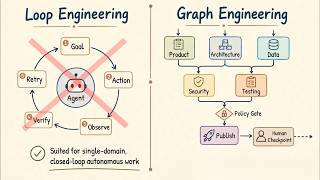
Graph engineering describes running a multi-agent system as an explicit graph of heterogeneous nodes - agents, deterministic functions, routers, joins, tools, and human checkpoints - connected by edges that carry a shared state object, with the topology itself treated as a programmable, versionable artifact [1]. The framing responds to a real ceiling: a single-agent 'loop,' where one model repeatedly acts until a task finishes, is where most builders start, but it fails in predictable ways as tasks grow - context gets polluted with irrelevant history, there is no way to run sub-tasks in parallel, and any failure forces a full restart from scratch rather than a targeted fix [2]. A related framework called 'directed agentic graphs' pushes this further by defining each node as a verifiable outcome rather than a fixed sequence of steps, letting a mix of agents, deterministic code, humans, or existing workflows fill in for any given node as long as the outcome is met [3].
The clearest evidence that decomposing a loop into a graph pays off in practice comes from Anthropic's own multi-agent research system, where a lead orchestrator agent delegates to specialized parallel subagents; on an internal research evaluation, that setup beat a single-agent Claude Opus 4 baseline by 90.2 percent - though at roughly 15 times the token cost of a standard chat interaction [4]. That tradeoff is central to how practitioners now frame the pattern: graph engineering is a genuine specialization gain, not a free upgrade, and its cost only pays for itself when a task actually needs parallel execution, isolated failure domains, or persistent memory that survives past any single node's context window.