Waymo launches Ojai robotaxi
TECH

Waymo launches Ojai robotaxi

33+
Signals

Strategic Overview

  • 01.
    On May 28, 2026, Waymo opened its new sixth-generation 'Ojai' robotaxi to select public riders in San Francisco, Los Angeles, and Phoenix, with free trips during an initial feedback period.
  • 02.
    The Ojai is built on a Zeekr (Geely-owned) battery-electric minivan platform manufactured in Ningbo, China, then shipped to Waymo's Mesa, Arizona factory where Waymo and Magna install the autonomous driving hardware.
  • 03.
    The vehicle carries the sixth-generation Waymo Driver with 13 cameras, 4 lidars, and 6 radars — a 42% reduction in total sensor count versus the prior Jaguar I-PACE fleet.
  • 04.
    Waymo plans to expand Ojai service to San Diego, Las Vegas, and Denver later in summer 2026, with the new Driver explicitly engineered to operate in snowier climates.

Deep Analysis

The number that actually matters: cost-per-vehicle, not 'first ride'

The headline is that select riders in San Francisco, Phoenix, and Los Angeles can now hail Ojai for free [1]. The real story is buried in the bill of materials. Morgan Stanley estimates each Ojai at around $125,000 per vehicle, versus roughly $200,000 for the Jaguar I-PACE robotaxi it replaces — about a $75,000 saving per car — and Waymo is targeting the 6th-gen sensor and compute kit alone at under $20,000, more than a 50% cut versus the 5th-gen kit [2][3]. That is the threshold at which a robotaxi business stops being an Alphabet science project and starts being a normal capital-intensive transportation company.

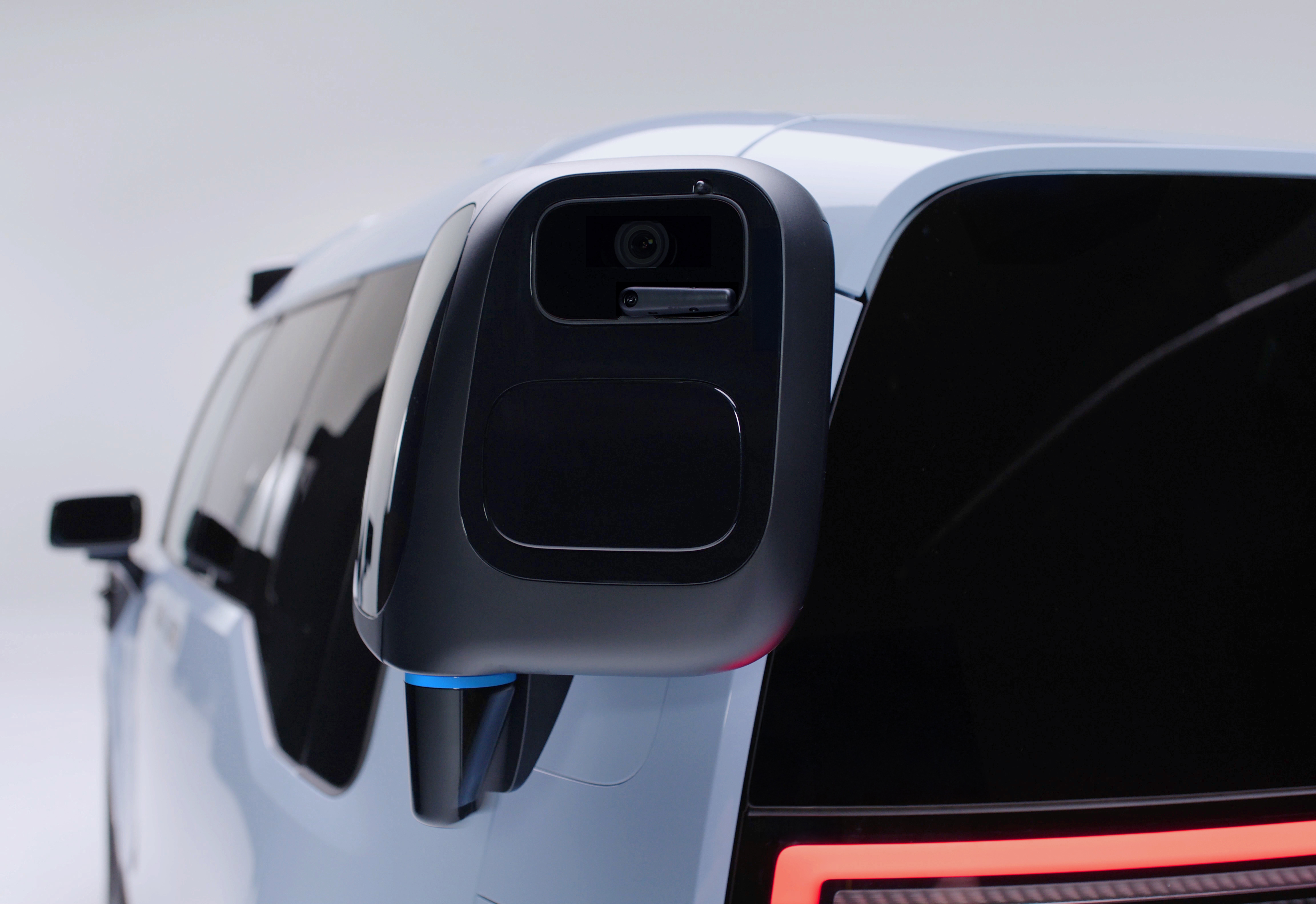
The mechanism behind that drop is concrete and engineering-led, not marketing. The 6th-gen Driver runs on 13 cameras, 4 lidars, and 6 radars — a 42% reduction in total sensor count versus the prior I-PACE generation, with one new ~17-megapixel camera that gives overlapping 360-degree coverage and can detect objects up to 500 m away in darkness [2][4]. Fewer parts on each vehicle means a shorter bill of materials, simpler calibration, fewer failure points to validate, and less inventory to warehouse — every one of which compounds when you multiply by the 'tens of thousands of units annually' Waymo wants to push through Mesa [5].
Why Waymo needed a Chinese minivan to hit 1 million rides a week

Waymo co-CEO Tekedra Mawakana has publicly committed to about 1 million paid rides per week by the end of 2026, roughly double the ~500,000/week the company runs across 11 cities today on a fleet of ~3,700–4,000 vehicles [2][6]. Math: even at perfect utilization, you can't double weekly trips without materially more cars, and you can't get materially more cars at $200K each without Alphabet treating Waymo as a moonshot in perpetuity. The Ojai is the answer — and the only way to land cost in the right zip code was a partner already shipping high-volume EVs.

That partner is Zeekr, the Geely-owned premium EV brand. The base 'glider' — chassis, body, 93 kWh 800V battery, 268 hp motor, four-seat B-pillar-less cabin with low step, flat floor, and elevator-style sliding doors — is built at Zeekr's Ningbo factory and shipped to Waymo's Mesa, Arizona plant, where Waymo and Magna install the autonomous driving hardware [4][7][8]. The initial U.S. deployment is small — roughly 100 vehicles to start [2]— but the Mesa factory's target is 'tens of thousands of units annually,' which is the actual scale the 1M-rides/week plan is pegged to [5].

The geopolitical fine print: a Chinese-made robotaxi on U.S. roads

Waymo's expansion plan now runs through Ningbo. TechCrunch's framing of the launch is blunt — 'Chinese-made, built to make money, and now accepting riders' [9]. The U.S.-final-assembly workaround at Mesa is presumably meant to address tariff exposure on Chinese EVs, but the underlying vehicle is still produced in Zhejiang province under a Chinese supply chain, leaving the program structurally sensitive to escalations in tariffs or new export controls on Chinese auto components [7][9]. That is a non-trivial bet for Alphabet to take with its highest-profile non-search product.

The naming choice quietly reflects how aware Waymo is of this. Spokesman Chris Bonelli says the company moved away from the Zeekr branding because 'most America consumers aren't familiar with the Zeekr name' [8]. Translated: the Chinese origin is fact, but the Chinese label is a UX liability in San Francisco, Phoenix, or — pointedly — Denver and Las Vegas, the next launch markets where local political climate around Chinese imports is harder to predict [2].

By the numbers: the sensor and cost compression that unlocks the rest

By the numbers: the sensor and cost compression that unlocks the rest
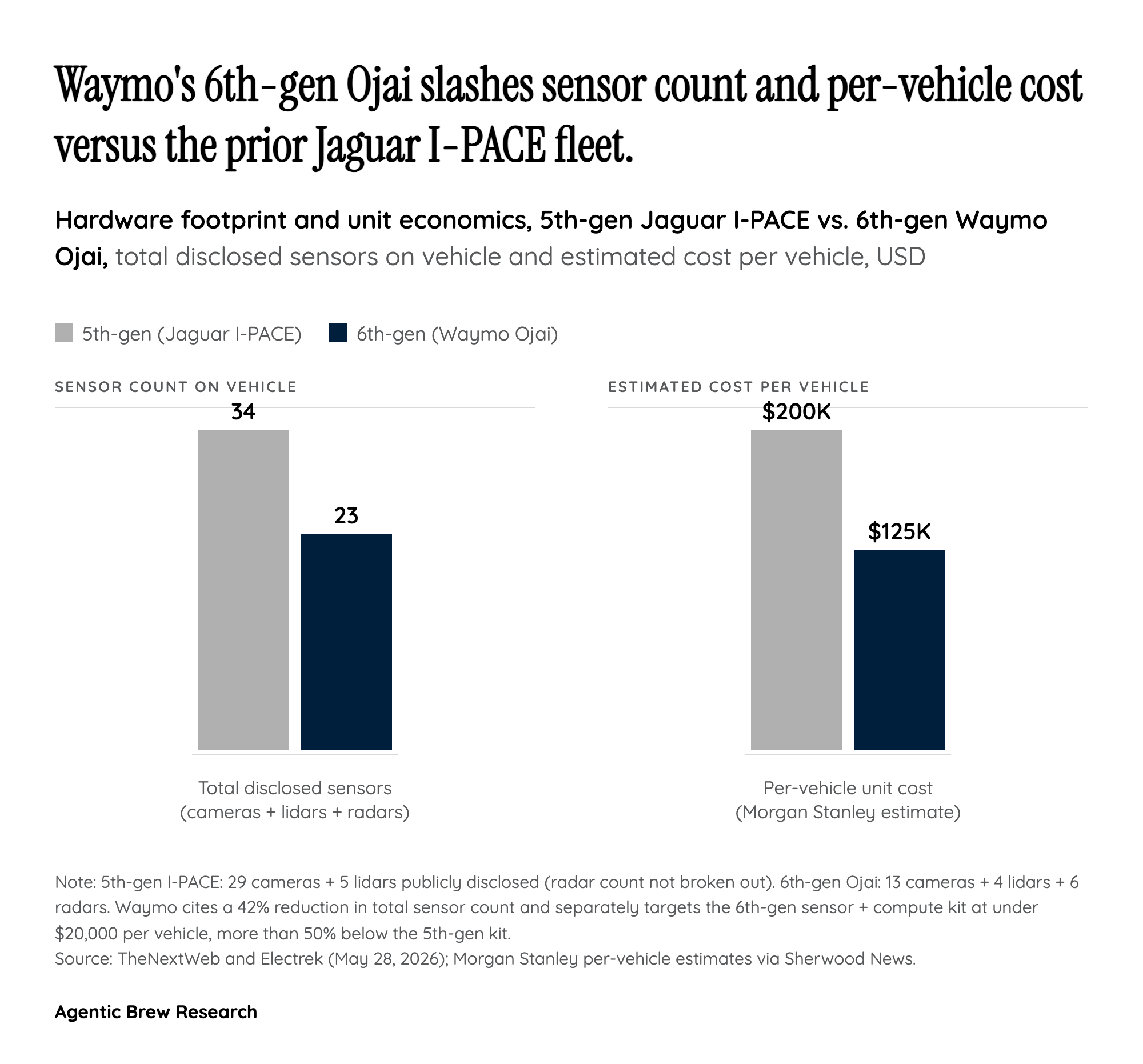
Sensor count and per-vehicle cost: 5th-gen Jaguar I-PACE vs. 6th-gen Waymo Ojai. Sources: TheNextWeb, Electrek, Morgan Stanley via Sherwood News.

Both the sensor cut and the cost cut are necessary; neither is sufficient on its own. The chart below pairs them so the engineering decision and its P&L consequence sit next to each other. Total disclosed sensors fall from 34 (29 cameras + 5 lidars) on the 5th-gen Jaguar I-PACE to 23 (13 cameras + 4 lidars + 6 radars) on the 6th-gen Ojai, with Waymo describing the swap as a 42% reduction in total sensor count [2][3]. Morgan Stanley's per-vehicle estimate falls from ~$200K to ~$125K over the same generational jump [2].

Those are platform-level numbers; the per-mile math sits a layer below. Morgan Stanley currently pegs Waymo's cost per mile at $1.43 — nearly double Tesla's — and projects it falling to $0.99 by 2028, with Waymo and Tesla collectively taking about 70% of U.S. autonomous miles by 2032 (Waymo ~38%, Tesla ~29%) [6]. The Ojai is the vehicle that has to bend that $1.43 curve.

What the skeptics keep flagging — and what the new Driver actually fixes

Two angles dominate community discussion. EV and autonomy enthusiasts on X read the launch as Waymo finally crossing the line from 'cool demo' to 'mainstream ride-hailing,' anchoring on the new sensor stack and the gradual rollout into LA, Phoenix, and SF. The contrarian camp, concentrated in r/SelfDrivingCars and r/waymo, is sharper: top threads return again and again to whether Ojai can handle snow, school-zone edge cases, and the steering-wheel-still-attached design (in contrast to Zoox's NHTSA exemption), and a hands-on review of the vehicle flagged a mid-ride software glitch on a test trip. Cabin-side, riders highlighted what the spec sheet describes as a four-seat, B-pillar-less minivan with a low step, flat floor, sliding doors, three large adaptive screens, and embedded braille — usefully roomy, but only one of the questions the skeptics actually care about [4].

The Driver itself is partly the answer. Waymo says the 6th-gen system 'enables fully autonomous operations in snowier cities' [2], which is the engineering case for the imminent Denver expansion. Safety credibility is more fragile: an Ojai under manual operation was involved in a multi-vehicle collision in LA's Echo Park in January 2026 [8], foreshadowing how every Ojai incident — even off-mode — will be litigated in public as the fleet grows from ~100 vehicles today toward the multi-thousand-unit footprint the 1M-rides/week target requires [9]. Mawakana has separately argued that scale doesn't eliminate humans from the loop — fleet maintenance, sensor calibration, and remote ops still need people [10]— meaning the labor effects will be a reshuffle, not a collapse, even if rider-facing seats go fully driverless.

Historical Context

2021-12
Waymo and Geely's Zeekr brand announce a partnership to co-develop a purpose-built robotaxi.
2022-11
Zeekr unveils the M-Vision concept (later the Ojai / Zeekr RT), with mass production targeted for 2024.
2023-03
Waymo retires its Chrysler Pacifica fleet, leaving the Jaguar I-PACE as the primary platform.
2024-08
Waymo officially announces the sixth-generation Driver hardware platform.
2024-12
Production of the base 'glider' vehicle begins at Zeekr's Ningbo factory.
2025-01
Vehicle officially unveiled at CES 2025 under the placeholder name 'Zeekr RT.'
2026-01-07
Waymo reveals the official production name 'Waymo Ojai.'
2026-01-28
An Ojai under manual operation collides with multiple vehicles in Los Angeles's Echo Park; no casualties.
2026-02
Ojai enters employee-only service in San Francisco and Los Angeles.
2026-05-28
Ojai opens to select public riders in San Francisco, Los Angeles, and Phoenix with free trips.

Power Map

Key Players
Subject

Waymo launches Ojai robotaxi

WA

Waymo (Alphabet)

Operator and integrator that owns the autonomy stack, runs the ride-hailing service, and is publicly targeting 1 million paid rides per week by the end of 2026.

ZE

Zeekr / Geely

Chinese EV maker supplying the SEA-M minivan 'glider' (chassis, body, battery, motors) from Ningbo — the manufacturing partner enabling Waymo's lower per-unit cost.

MA

Magna International

Final-assembly partner that, alongside Waymo, installs sensors, compute, and connectivity hardware on the imported gliders at the Mesa, Arizona factory.

TE

Tekedra Mawakana (Waymo co-CEO)

Public face of the scaling push, who has publicly committed Waymo to roughly 1 million weekly trips by end of 2026 and argues that scaling safely is 'imperative.'

TE

Tesla

Primary competitive benchmark — analysts contrast Waymo's multi-sensor stack and higher per-vehicle cost with Tesla's vision-only approach in modeling the 2032 robotaxi market.

Fact Check

10 cited
  1. [1] Alphabet's Waymo launches new robotaxi with free rides
  2. [2] Waymo opens up new Ojai electric robotaxi rides with 6th-gen Driver
  3. [3] Waymo's new Geely-built Ojai robotaxi could slash fleet costs
  4. [4] Waymo Launches Its New Ojai Robotaxi—With Chinese DNA
  5. [5] Waymo Launches Ojai Robotaxi for Public Rides in U.S. Cities
  6. [6] Where Morgan Stanley thinks autonomous taxis will be in 2032
  7. [7] Waymo to Deploy Robotaxi Built with Zeekr to Expand Public Rides
  8. [8] Waymo Ojai
  9. [9] Waymo's newest robotaxi is Chinese-made, built to make money, and now accepting riders
  10. [10] Waymo co-CEO Tekedra Mawakana on why robotaxis aren't eliminating human jobs

Source Articles

Top 3

THE SIGNAL.

Analysts

"Says scaling the robotaxi fleet is non-negotiable and has publicly committed to roughly 1 million trips per week by the end of 2026: 'By the end of 2026, you should expect us to be offering 1 million trips per week.'"

Tekedra Mawakana
Co-CEO, Waymo

"Argues Waymo's sensor-heavy stack still carries a higher per-mile cost than Tesla's vision-only approach but projects rapid convergence: 'Morgan Stanley believes cost per mile for Waymo, which is currently nearly double Tesla's cost, will drop from $1.43 to $0.99 by 2028.'"

Adam Jonas
Robotics research lead, Morgan Stanley

"Explained the rebrand away from the Zeekr name on grounds of U.S. recognition: 'most America consumers aren't familiar with the Zeekr name.'"

Chris Bonelli
Spokesman, Waymo

"Frames the Ojai's streamlined 6th-gen sensor suite as the cost lever required for nationwide expansion: 'This latest system serves as the primary engine for our next era of expansion, with a streamlined configuration that drives down costs while maintaining our uncompromising safety standards.'"

Waymo (corporate statement)
Company communication
The Crowd

"NEWS: Waymo has unveiled the official name of its new robotaxi van that will start offering rides to the public this year: Ojai. The vehicle uses Waymo's new 6th-gen hardware: • 13 cameras • 6 radars • 4 LiDARs • Heaters, wipers and sprayers for sensors to keep them clean"

@@SawyerMerritt2860

"Our fleet is expanding! ✨ Meet Ojai, powered by our sixth-gen Waymo Driver. Welcoming riders soon in LA, Phoenix, and San Francisco."

@@Waymo1006

"Waymo is launching public rides in its new Ojai robotaxi. Initially, select riders in San Francisco, Phoenix, and Los Angeles will have the option to take free rides in the Ojai, and will gradually open it up to more riders over the coming months, as well as expand to new"

@@SawyerMerritt666

"Waymo starts offering rides in new Ojai robotaxi with 6th-gen Driver"

@u/techno-phil-osoph88
Broadcast
Inside Waymo's New Robotaxi — The Ojai

Inside Waymo's New Robotaxi — The Ojai

Waymo's next-gen robotaxi - Ojai! Coming soon to 20+ cities including London!

Waymo's next-gen robotaxi - Ojai! Coming soon to 20+ cities including London!

Waymo begins public rides in Ojai as it shifts to lower-cost robotaxis

Waymo begins public rides in Ojai as it shifts to lower-cost robotaxis