OpenAI launches GPT-Live full-duplex voice for ChatGPT
TECH

OpenAI launches GPT-Live full-duplex voice for ChatGPT

45+
Signals

Strategic Overview

  • 01.
    OpenAI launched GPT-Live and GPT-Live-1 mini on July 8, 2026, a new generation of full-duplex voice models that can listen and speak at the same time to power a more natural ChatGPT Voice experience.
  • 02.
    GPT-Live replaces the existing Advanced Voice Mode in ChatGPT, with GPT-Live-1 mini as the default and paid Go, Plus, and Pro users getting the larger GPT-Live-1.
  • 03.
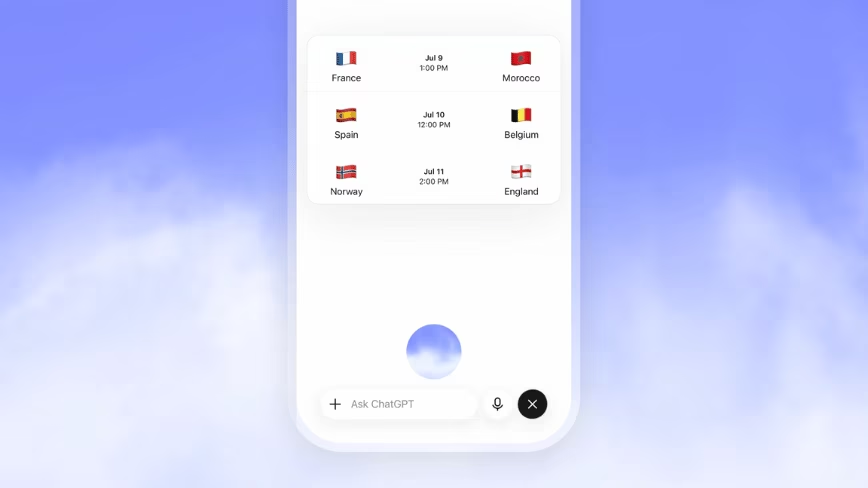
    For queries needing web search, deeper reasoning, or agentic work, GPT-Live delegates the task to a frontier model such as GPT-5.5 running in the background while keeping the conversation flowing.
  • 04.
    The models began rolling out globally across iOS, Android, and web with multilingual support, while API access for developers is not available at launch and is planned to come later.

Full-Duplex Is the Whole Point - and It Runs on a Model That Delegates

Every prior version of ChatGPT Voice was a walkie-talkie: you spoke, it waited for you to stop, then it answered. GPT-Live breaks that turn-based contract. It is a full-duplex model, meaning it can speak and listen at the same time [1]. Instead of one big decision per turn, it makes interaction decisions many times per second - whether to speak, keep listening, pause, interrupt, or invoke a tool [2]. That is why it can drop in short backchannel cues like 'mhmm' or 'yeah' while you are still talking, and why it can absorb an interruption without restarting its whole answer [2]. The constant timing awareness is also what unlocks live simultaneous translation: in press briefings the model spoke a running translation as the presenter talked, something the old turn-based system structurally could not do [3].

The design decision underneath the demo is delegation. GPT-Live is not trying to be the smartest model in the room; it is trying to be the fastest conversational surface. When a task needs web search, deeper reasoning, or agentic work, GPT-Live hands it off to a frontier model such as GPT-5.5 running in the background while it keeps the conversation flowing [2]. In OpenAI's flagship demo the voice model chatted naturally while concurrently correcting a historical date, checking transit delays, and pulling weather. This is a two-tier architecture - a low-latency talker in front, a heavyweight reasoner behind - and it is the same split OpenAI is drawing across its product line, where GPT-Live plays for voice the front-end role that its coding surfaces play for agentic work.


The Gap Between the Keynote and the Complaint

The launch messaging is unambiguous. Sam Altman said the model feels 'magical and real' and that he expects his own preference to shift from typing to talking, and the official rollout leans on that framing. In matched test conversations, GPT-Live-1 and its mini variant were strongly preferred over Advanced Voice Mode [2], and TechRadar billed it as ChatGPT's smartest voice model ever [6]. But the same feature that makes it feel alive is also the source of the loudest real-world gripe.

Across Reddit's OpenAI, ChatGPT, and singularity communities, reception has been positive-with-caveats: users call it the closest thing yet to the movie 'Her' and praise how it listens while speaking and runs tool calls in the background, but the single most-repeated complaint is that the model interrupts too eagerly, sprinkling filler backchannels like 'Awesome,' 'Mhmm,' and 'Wow' into the conversation. A contrarian minority argues it is not a real leap and still carries the same uncanny quality, and independent early-access reviewers were more skeptical than the polished official videos, confirming the duplex overlap works only 'sometimes.' The tension is instructive: backchanneling is a feature engineered to make the model sound human, and it is also the behavior users most want to turn down. That is not a bug report so much as a calibration problem baked into the full-duplex bet.

Shipped to Consumers, Not to Builders - and Why That Framing Matters

GPT-Live arrived globally on iOS, Android, and web, but developers cannot build on it yet: there is no day-one API, with access planned later via a signup form [2]. That is a deliberate ordering. OpenAI is putting voice in front of 150 million-plus people who already use ChatGPT's Voice and Dictation features [1]before it opens the model to third parties, and it frames voice as a potential primary interface to computing for managing increasingly complex long-running agentic work [1]. The consumer-first sequencing signals that OpenAI sees the strategic prize as the everyday interaction layer, not the API line item.

The cost of that ordering is competitive exposure. Google's Gemini Live already offers full-duplex conversation plus camera and screen sharing, capabilities GPT-Live lacks at launch [5], and a field of specialized vendors - ElevenLabs, Deepgram, Cartesia, InWorld AI - already ship developer-facing, low-latency voice products [5]. Because enterprises cannot yet wire GPT-Live into their own voice agents, that penetration is expected to lag rivals with existing developer products [5]. Latency is the battleground: OpenAI's rollout reportedly targets roughly 300ms for real-time voice [7], while competitors advertise aggressive numbers, with InWorld AI claiming sub-250ms P90 and Cartesia publishing time-to-first-byte around 40ms for a turbo voice model [5]. The translation demo also showed the polish gap: TechCrunch observed the Hindi output carried a heavy American accent and a slightly bookish tone [1].

From Three Models to One Voice: The Architecture Kept Collapsing

GPT-Live is the end of a multi-year compression story, and reading the arc explains why full-duplex feels inevitable in hindsight. The original ChatGPT Voice was a cascade of three separate systems: Whisper transcribed your speech to text, GPT-4 reasoned over the text, and a text-to-speech model spoke the answer back [1]. Each hop added latency and stripped away nuance, because the reasoning model never actually heard your voice. In May 2024, GPT-4o collapsed that stack into a single model trained end-to-end across text, vision, and audio [2], and the Advanced Voice Mode rollout that followed put one natively-audio model in users' hands, first on mobile in mid-2024 and then on the web later that year [3].

Even that unified model, though, still operated in discrete turns - it had to wait for you to stop speaking, which produced stiff back-and-forth and mistimed interruptions [5]. The 2025 gpt-realtime release pushed speech-to-speech into production voice agents via the Realtime API [4], and GPT-Live is the next step: it removes the turn boundary itself. So the trajectory reads cleanly - three models to one model, then one model that spoke in turns to one model that listens and speaks continuously. Notably, the reasoning did not necessarily get smarter at the voice layer; skeptics point out core reasoning is unchanged and the model can still miscount letters. What changed is the interface, which is exactly what OpenAI is betting matters most.

Historical Context

2023
Original ChatGPT Voice used a cascaded pipeline: Whisper for speech-to-text, GPT-4 for text, then a separate text-to-speech model.
2024-05-13
OpenAI released GPT-4o, a single model trained end-to-end across text, vision, and audio.
2024-07
Advanced Voice Mode began a limited rollout to ChatGPT Plus users, collapsing the three-model pipeline into one model processing audio natively.
2024-11
Advanced Voice Mode launched on the web, extending it beyond mobile.
2025
OpenAI released gpt-realtime, its most advanced speech-to-speech model for production voice agents via the Realtime API.
2026-07-08
OpenAI launched GPT-Live and GPT-Live-1 mini, full-duplex voice models replacing Advanced Voice Mode, ahead of a broader GPT-5.6 release.

Power Map

Key Players
Subject

OpenAI launches GPT-Live full-duplex voice for ChatGPT

OP

OpenAI

Vendor releasing GPT-Live and GPT-Live-1 mini; it replaces its own Advanced Voice Mode and routes complex work to GPT-5.5, positioning voice as a shared front end onto its agentic core.

CH

ChatGPT paid users (Go, Plus, Pro)

Get GPT-Live-1 as the default voice model - the more capable of the two variants.

CH

ChatGPT free users

Get the scaled-down GPT-Live-1 mini as the default voice model.

EN

Enterprise and voice-agent developers

Blocked at launch by the absence of a day-one API, slowing commercial adoption relative to rivals that already ship developer-facing voice products.

GO

Google (Gemini Live)

Competitor whose Gemini Live already supports full-duplex conversation plus camera and screen sharing, capabilities GPT-Live lacks at launch.

EL

ElevenLabs, Deepgram, Cartesia, InWorld AI

Specialized voice-AI vendors with developer-facing, low-latency products already competing in the real-time voice space.

Fact Check

7 cited
  1. [1] OpenAI releases new voice models for more natural, live conversations
  2. [2] OpenAI Releases GPT-Live and GPT-Live-1 mini, Full-Duplex Voice Models That Delegate Deeper Reasoning to GPT-5.5
  3. [3] OpenAI's GPT-Live brings full-duplex voice to ChatGPT
  4. [4] Introducing gpt-realtime
  5. [5] OpenAI GPT-Live: full-duplex voice and how it compares to rivals
  6. [6] ChatGPT's new GPT-Live voice model is here and it can speak and listen at the same time
  7. [7] OpenAI rolls out GPT-Live, targeting 300ms latency for real-time voice

Source Articles

Top 5

THE SIGNAL.

Analysts

"Frames GPT-Live-1 as ChatGPT's smartest voice model ever, enabling more natural conversations without interruptions as it rolls out to everyone."

TechRadar
AI platforms coverage, TechRadar

"Noted a rough edge in the live translation demo, observing that the Hindi output had a heavy American accent and a slightly bookish, unnatural tone."

TechCrunch
Reporting, TechCrunch

"Highlights that GPT-Live-1 and GPT-Live-1 mini were strongly preferred over Advanced Voice Mode in matched test conversations, with the larger model also stronger on expert-level science reasoning."

MarkTechPost
Technical coverage, MarkTechPost
The Crowd

"Introducing GPT-Live, a new generation of voice models for natural human-AI interaction. Rolling out in ChatGPT starting today. You’ll want to turn the sound on for this one."

@@OpenAI16272

"GPT-live (next-generation voice) launches today in ChatGPT. it feels magical and 'real'. i have always preferred typing to talking to an AI, now i think that's going to shift."

@@sama8156

"BREAKING: OpenAI launched GPT Live 1, a new full duplex voice model for ChatGPT! It comes in 2 versions: GPT-Live-1 and GPT-Live-1 mini, and is rolling out to everyone in the coming days. API support is coming soon too. GPT-Live is built on a full-duplex architecture."

@@testingcatalog379

"Introducing GPT-Live"

@u/Just_Lingonberry_352326
Broadcast
This is the new ChatGPT Voice, powered by GPT-Live

This is the new ChatGPT Voice, powered by GPT-Live

Listening & Speaking with GPT-Live

Listening & Speaking with GPT-Live

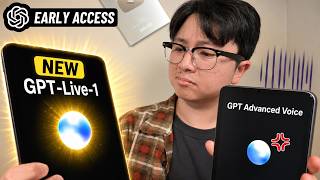
OpenAI gave ME early access to the new ChatGPT voice model (GPT-Live-1)

OpenAI gave ME early access to the new ChatGPT voice model (GPT-Live-1)