Hyperscaler AI revenue growth and capex divergence in Q2 2026
TECH

Hyperscaler AI revenue growth and capex divergence in Q2 2026

32+
Signals

Strategic Overview

  • 01.
    Amazon's stock market capitalization surpassed $3 trillion for the first time, joining Apple, Microsoft, Alphabet, and Nvidia in the $3 trillion club, powered by AWS revenue growth of 37% year-over-year - the fastest pace in 18 quarters.
  • 02.
    Microsoft's Azure crossed $100 billion in annual revenue for the first time, with Azure and cloud services growth accelerating to 43% year-over-year, up from 40% in the prior quarter.
  • 03.
    Google Cloud revenue surged 82% to $24.8 billion, far exceeding analyst forecasts of 64% growth, helping drive a 24% overall revenue increase for Alphabet in Q2 2026.
  • 04.
    Meta's revenue grew 28% to $60.8 billion, but shares fell roughly 9-10% after-hours as AI spending guidance rose to $130-145 billion for the year and free cash flow dropped to $784 million.

Deep Analysis

The $3 Trillion Verdict: How AWS Finally Proved the AI Capex Bet

On August 3, 2026, Amazon's stock jumped more than 5%, pushing its market capitalization above $3 trillion for the first time and putting the company alongside Apple, Microsoft, Alphabet, and Nvidia in cloud computing's most exclusive valuation tier [1]. The catalyst wasn't a new product announcement - it was earnings math finally sinking in.

AWS posted $42.2 billion in Q2 2026 revenue, up 37% year-over-year and its fastest growth rate in 18 quarters (more than four years), beating Street expectations of $40.54 billion while holding a 39% operating margin [2]. More telling than the quarterly number is the backlog: AWS's contracted cloud revenue backlog jumped from $364 billion to $496 billion in a single quarter [3]- meaning customers are locking in years of future AI compute spend today, not just buying it as needed.

CEO Andy Jassy used the earnings call to justify raising 2026 capex guidance from $200 billion to $220 billion, arguing the company is now capacity-constrained rather than demand-constrained: 'Even at that amount, we will still not have enough capacity to meet all the demand we have in 2026, and I believe this dynamic will also be true in 2027, too. In fact, the demand we already have for 2028 is striking.' [4]For a stock that had spent much of the AI buildout era being questioned over runaway spending, this is the first quarter where the market visibly decided the bet was paying off.

Landlords vs. Speculators: Why the Same AI Boom Is Punishing Meta

Put Amazon, Microsoft, and Alphabet's cloud results side by side and a pattern emerges. Microsoft's Azure crossed $100 billion in annual revenue for the first time, with growth accelerating to 43% year-over-year, up from 40% the prior quarter [5]. CFO Amy Hood pointed to that momentum as the driver of the quarter: 'We delivered a strong quarter to close out the fiscal year, highlighted by Microsoft Cloud revenue of $59.3 billion.' [6]Google Cloud did even better, growing 82% to $24.8 billion against an analyst consensus of just 64% [7], while cloud operating income roughly tripled to $8.8 billion from $2.8 billion a year earlier [8].

What AWS, Azure, and Google Cloud share is a business model: they rent AI infrastructure to outside customers under contracts that show up as backlog, so every capex dollar has a visible, trackable revenue counterpart. Meta doesn't have that. Its Q2 revenue grew a strong 28% to $60.8 billion [9], but shares fell roughly 9-10% after-hours anyway, because most of its AI capital spending (guided up to $130-145 billion for the full year, more than double the prior year's pace) funds internal systems like ad-ranking and recommendation models rather than a product it sells directly [10]. There's no backlog absorbing that spend - just compressed free cash flow, which dropped to $784 million for the quarter.

Even Alphabet, despite its outsized cloud beat, wasn't immune to this scrutiny: its stock fell after-hours purely because it raised its 2026 capex outlook to $195-205 billion from a prior $180-190 billion range [8], a reminder that even 'landlord' businesses get penalized once the market starts questioning payoff timelines.

The Capex Arms Race, By the Numbers

The Capex Arms Race, By the Numbers
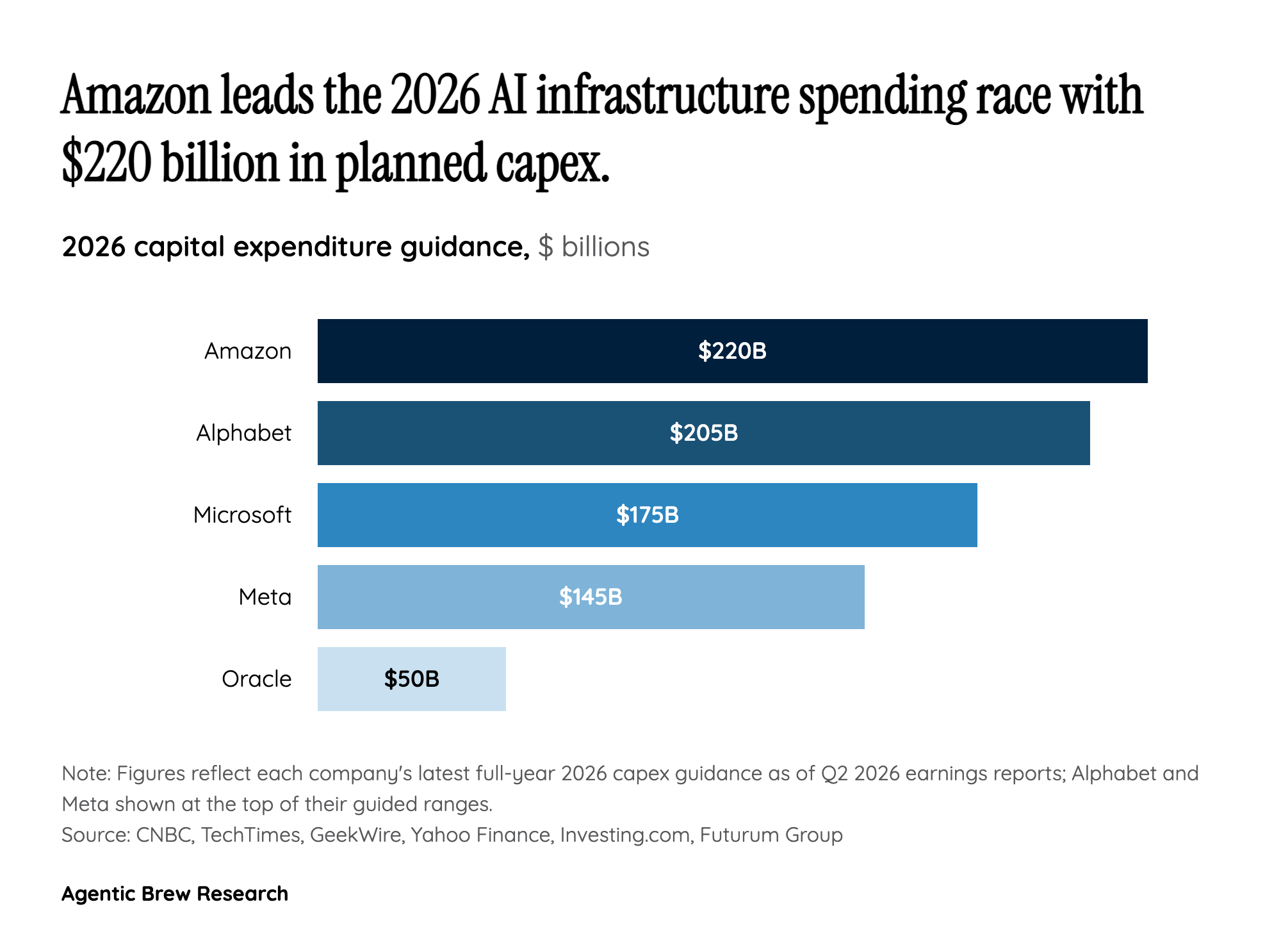
Amazon leads 2026 AI capex guidance at $220B, followed by Alphabet ($205B), Microsoft ($175B), Meta ($145B), and Oracle ($50B).

Every major cloud provider raised its AI infrastructure spending guidance this earnings season. Amazon lifted 2026 capex from $200 billion to $220 billion, citing rising memory and chip costs [3]. Alphabet raised its outlook to as much as $205 billion, up from $180-190 billion three months earlier [8]. Meta guided to $130-145 billion for the year, more than double its prior pace [10]. Oracle, despite being a fraction of the other companies' size, raised its own FY2026 capex guidance to roughly $50 billion [11].

Add it up across the group and Wall Street's 2026 capex consensus has climbed to $527 billion, up from $465 billion at the start of the third-quarter earnings season alone [12]- a jump of more than $60 billion in a matter of weeks, driven almost entirely by companies raising guidance rather than new entrants joining the spending race. The consistent explanation across earnings calls is the same: every hyperscaler describes itself as supply-constrained, not demand-constrained, with contracted backlogs (AWS's $496 billion, Oracle's $523 billion in remaining performance obligations [11]) growing faster than data center capacity can be built.

Oracle's Leveraged Bet

Oracle's cloud numbers look as strong as anyone's: Cloud Infrastructure (IaaS) revenue grew 68% year-over-year to $4.1 billion, GPU revenue was up 177%, and the company added 50% more GPU capacity than the prior quarter [11]. Its remaining performance obligations - future contracted revenue - grew 15% sequentially to $523 billion.

The difference is how Oracle is paying for its build-out. Amazon, Microsoft, Alphabet, and Meta are funding their capex primarily out of enormous operating cash flow. Oracle, a much smaller company trying to compete for the same AI training and inference contracts, has taken on substantial debt to keep pace - its total notes payable and borrowings have reached $108.1 billion [13]. That's a fundamentally different risk profile: if AI demand growth decelerates even briefly, Oracle carries balance-sheet exposure that its cash-rich rivals simply don't have, which is why analysts have flagged its leverage as a distinct concern even as its growth rate outpaces the rest of the field [13].

The Open Question Behind Every Earnings Beat

Underneath the record numbers sits a question none of these companies have fully answered yet: how long can revenue growth outrun the capex required to produce it? Goldman Sachs Research notes that tech equipment and software investment as a share of GDP is approaching dotcom-era peaks, and that AI infrastructure depreciates quickly enough (roughly 20% per year) that annual depreciation expense could soon exceed the hyperscalers' combined 2025 profits [12].

That tension is showing up in how investors are talking about these results. Reddit's investing communities circulated a framing that treated AWS and Azure as 'landlords' collecting contracted rent on AI compute while Google and Meta effectively 'consume their own' - though that framing drew real pushback, since Google Cloud's growth and backlog are themselves externally monetized and arguably undercut the analogy entirely. YouTube coverage of the earnings season made a similar point about Microsoft specifically: despite beating headline revenue estimates, its stock fell because the market wanted proof AI demand was converting into durable, profitable growth right now, not a promise that heavy investment would eventually pay off. None of this means the AI infrastructure boom is overbuilt - contracted backlogs at every major provider are still growing faster than capacity - but it does mean the market has stopped grading hyperscalers on revenue growth alone.

Historical Context

2026-07-22
Alphabet reported Q2 2026 earnings showing Google Cloud revenue growth accelerating to 82%, well above analyst forecasts of 64%.
2026-07-29
Microsoft reported fiscal Q4 2026 results in which Azure revenue crossed $100 billion annually for the first time, with growth accelerating to 43% from 40% the prior quarter.
2026-07-30
Amazon reported Q2 2026 earnings with AWS revenue up 37% year-over-year, its fastest growth rate in 18 quarters, and raised 2026 capex guidance to $220 billion.
2026-08-03
Amazon shares rallied further post-earnings, pushing the company's market capitalization above $3 trillion for the first time, joining Apple, Microsoft, Alphabet, and Nvidia in that valuation tier.

Power Map

Key Players
Subject

Hyperscaler AI revenue growth and capex divergence in Q2 2026

AM

Amazon (AWS)

Cloud market leader whose 37% AWS growth (fastest in 18 quarters) and $496 billion contracted backlog drove Amazon's stock past $3 trillion market cap; raised 2026 capex to $220 billion while warning of capacity shortfalls through 2028.

MI

Microsoft (Azure)

Azure crossed $100 billion annual revenue with growth accelerating to 43%; Microsoft Cloud revenue reached $59.3 billion, the strongest driver of a fiscal-year-closing quarter even as AI capex weighed on cash flow.

AL

Alphabet (Google Cloud)

Google Cloud revenue surged 82% to $24.8 billion, exceeding analyst forecasts of 64%, yet Alphabet's stock fell after-hours purely because it raised its 2026 capex outlook to as much as $205 billion.

ME

Meta

Ad revenue grew 27% to $59.4 billion, but AI capex guidance of $130-145 billion for 2026 pressured margins and free cash flow, sending shares down roughly 9-10% after-hours despite the revenue beat.

OR

Oracle

Cloud Infrastructure (IaaS) revenue grew 68% year-over-year, but the company is financing its AI data center buildout via heavy debt ($108.1 billion in notes payable and borrowings), raising leverage-risk concerns among analysts.

WA

Wall Street analysts / Goldman Sachs Research

Set and track the hyperscaler capex consensus, which jumped to $527 billion for 2026 from $465 billion at the start of the earnings season, and are increasingly differentiating companies with a clear capex-to-revenue link from debt-funded infrastructure bets.

Fact Check

13 cited
  1. [1] Amazon (AMZN) stock jumps, market cap tops $3 trillion after earnings
  2. [2] Amazon (AMZN) Q2 2026 earnings report
  3. [3] AWS Backlog Hits $496B, Amazon Raises AI Spend to $220B as Capacity Runs Short
  4. [4] Andy Jassy Defends Amazon's AWS Capex Decision
  5. [5] Microsoft Azure Tops $100B in Annual Revenue as Record AI Spending Cuts Into Cash Flow
  6. [6] Microsoft Cloud and AI Strength Fuels Fourth Quarter Results
  7. [7] Alphabet (GOOGL) Reports 24% Revenue Growth in Q2 2026 as Cloud Accelerates
  8. [8] Alphabet Q2 2026 Earnings
  9. [9] Meta Q2 2026: Revenue Surges 28% as AI Spending Pressures Margins
  10. [10] Meta Beats Earnings 2026 on AI
  11. [11] Oracle Q2 FY2026: Cloud Grows, Capex Rises for AI Buildout
  12. [12] Why AI Companies May Invest More Than $500 Billion in 2026
  13. [13] AI Cloud Business Grows at an Alarming Rate While Oracle's Heavy Debt Burden Raises Concerns

Source Articles

Top 5

THE SIGNAL.

Analysts

Defended AWS's raised capex by arguing demand for AI and cloud capacity already outstrips what Amazon can build, with customers reserving capacity years in advance.

Andy Jassy
CEO, Amazon

Framed Microsoft's AI infrastructure investment as improving unit economics for customers running AI workloads on Azure, saying the company is 'advancing the frontier on the cost-to-outcome curve, ensuring every customer can turn tokens into business results.'

Satya Nadella
CEO, Microsoft

Highlighted Microsoft Cloud's quarterly strength as the driver of overall results, even as AI capex weighed on free cash flow: 'We delivered a strong quarter to close out the fiscal year, highlighted by Microsoft Cloud revenue of $59.3 billion.'

Amy Hood
CFO, Microsoft

Sees investor sentiment bifurcating: companies that show a demonstrable link between capex and revenue growth are rewarded, while debt-funded infrastructure buildouts without matching revenue face rotation away from investors amid bubble-risk concerns.

Ryan Hammond
Analyst, Goldman Sachs Research
The Crowd

Amazon is spending $220B. Is 37% AWS growth enough to justify it?

@u/FailOk1528147

Meta printed the worst quarter of the four hyperscalers this week. It might also be the only one holding a free option.

@u/Aya_Research44

Google has more cash on balance sheet & their cloud business is growing faster than Azure. So why did GOOG not moon like MSFT after earnings?

@u/mojolakota62
Broadcast
Azure Softness + AI Capex = The Public Cloud's New Problem

Azure Softness + AI Capex = The Public Cloud's New Problem

Big Tech earnings recap: Meta, Amazon, Apple, Microsoft, and Alphabet

Big Tech earnings recap: Meta, Amazon, Apple, Microsoft, and Alphabet

$570 Billion in One Year: How Google, AWS & Microsoft Are Betting Big on AI

$570 Billion in One Year: How Google, AWS & Microsoft Are Betting Big on AI

Hyperscaler AI revenue growth and capex divergence in Q2 2026 — AI News | Agentic Brew