Carney warns on US Anthropic export ban
TECH

Carney warns on US Anthropic export ban

28+
Signals

Strategic Overview

  • 01.
    On June 12, 2026, the US Commerce Department ordered Anthropic to suspend all foreign-national access to its two most powerful models, Fable 5 and Mythos 5, and the company disabled both globally within hours.
  • 02.
    Canadian Prime Minister Mark Carney warned that the ban exposes the systemic danger of over-relying on a handful of US-controlled AI models, drawing an explicit comparison to the 'model risk' that fed the 2008 financial crisis.
  • 03.
    Carney urged Canada to diversify its technology and trade relationships, framing the episode as a reason to reduce dependence on US-controlled systems ahead of the G7 summit.
  • 04.
    Access to Anthropic's other models, including Claude Opus 4.8, was unaffected; the directive targeted only Fable 5 and Mythos 5.

Deep Analysis

The Overnight Off-Switch

What makes this episode unsettling is not that a government restricted an AI model, but the speed and totality with which it happened. At 5:21pm ET on June 12, 2026, Anthropic received a US Commerce Department directive citing national-security authorities and ordering it to suspend access to Fable 5 and Mythos 5 for any foreign national [1]. Because Anthropic could not reliably separate foreign users from domestic ones in real time, compliance meant the blunt option: take both models offline for everyone, worldwide, within hours [2].

The trigger, according to Anthropic, was a 'narrow potential jailbreak' — a technique to bypass the models' safeguards — that the company says is also present in rival systems such as OpenAI's GPT-5.5, which faces no comparable restriction [1]. The directive reportedly stemmed in part from suspicions that a China-linked group had accessed the model [3]. The mechanism here is the real story: a single letter to one CEO removed two of the most capable models on the market from global circulation in an afternoon, with no transition period and no appeal. That is concentration risk made concrete, not theoretical.

Why a Central Banker Saw 2008

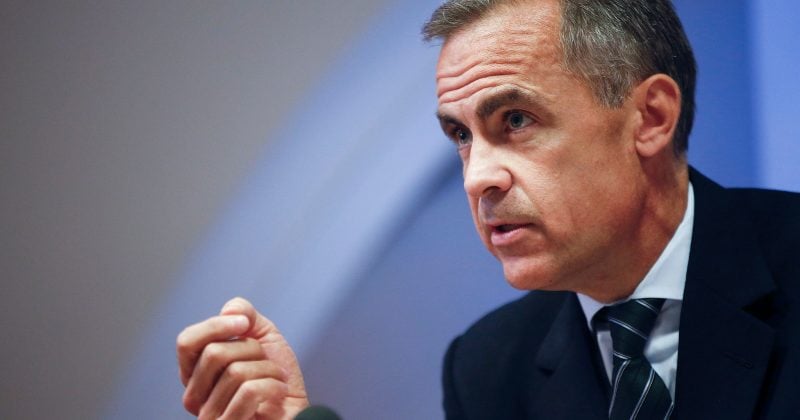
Carney's reaction stood out because of who he is. Before politics he ran the Bank of Canada through the 2008 financial crisis and later the Bank of England, and he reached instinctively for the vocabulary of systemic finance, warning that over-reliance on a few dominant AI systems creates the same kind of 'model risk' that propagated through the financial system in 2008 [4]. In banking, 'model risk' describes what happens when many institutions lean on the same flawed assumptions or the same handful of tools — a local failure becomes a system-wide one because everyone is wired into the same node.

Applied to AI, the analogy is pointed: if governments, enterprises, and public services all build on a small set of US-controlled frontier models, then a policy decision in Washington becomes a dependency for everyone downstream. 'Nobody's done anything wrong in this situation,' Carney argued, 'but we will have done something wrong if we just accept this, don't take the lesson, don't build out and diversify' [4]. His framing converts a one-off export action into a structural argument about who controls critical infrastructure — and Bloomberg's reporting underscored that this was a deliberate warning about depending on big AI models, not an offhand remark [5].

The Sovereignty Scramble

The second-order effect is a scramble among US allies to figure out whether they are next, and what leverage they actually hold. Carney paired his warning with a concrete agenda — diversifying Canada's technology and trade relationships and leaning on the 2.3 billion dollar 'AI for All' strategy launched just ten days earlier [4]. He is not alone: across allied developer and policy communities the dominant thread treats this as a sovereign-capacity wake-up call, animated by the fear that a foreign government could effectively switch off a dependent economy without domestic AI and compute of its own.

The uncomfortable counterpoint, surfaced sharply in those same communities, is that escaping US control is structurally hard. As the discussion goes, Anthropic itself cannot simply relocate: it runs on US cloud infrastructure and US semiconductors that are themselves export-controlled, it is incorporated in Delaware, and the bulk of its revenue is American — and the very export-control regime that just cut off foreign users would also constrain any attempt to leave. So the sovereignty conversation splits in two: nation-states talking about building domestic compute and energy capacity, and the blunt reality that today's frontier labs are deeply, perhaps inextricably, tied to the US stack.

What the Skeptics See

Not everyone reads this as principled national-security policy, and the criticism is worth taking seriously precisely because it comes from across the spectrum. Dean Ball, an AI policy expert who served in the Trump administration, called the order 'cartoonish' and said he couldn't tell whether it was targeted lawfare against Anthropic or extreme hawkishness [2]. The inconsistency he points to is real: if the cited jailbreak also exists in competing models, singling out one company looks less like security and more like selective enforcement.

A second critique targets enforceability. Gating a model by 'foreign national' status is, as one engineer put it, simply not workable in practice — the category is porous and hard to police [3]. And a third strand argues Anthropic partly brought this on itself: by marketing its frontier models in the language of dangerous capability, it handed regulators a rationale to treat them as munitions [2]. The throughline is that even sympathetic observers see an action whose costs — talent flight, eroded trust in US labs, and a precedent for instant global shutoffs — may outweigh whatever narrow risk it was meant to contain [3].

Historical Context

2008
Carney governed the Bank of Canada through the 2008 financial crisis and later led the Bank of England, giving his AI 'model risk' analogy direct grounding in systemic financial-risk experience.
2026-06-04
Canada launched its 2.3 billion dollar 'AI for All' national strategy, ten days before the Anthropic ban gave Carney a live example of dependency risk.
2026-06-12
Anthropic received the export-control directive at 5:21pm ET and disabled Fable 5 and Mythos 5 globally within hours.
2026-06-14
Carney delivered his warning to reporters during a visit to Ireland ahead of the G7 summit.

Power Map

Key Players
Subject

Carney warns on US Anthropic export ban

MA

Mark Carney

Canadian Prime Minister and former central banker who reframed the ban as a systemic AI 'model risk' warning and used it to justify diversifying Canada's technology and trade away from the US.

AN

Anthropic

Target of the directive; complied by disabling Fable 5 and Mythos 5 worldwide while publicly disputing the order, arguing the cited jailbreak was narrow and exists in rival models too.

US

US Commerce Department (Sec. Howard Lutnick)

Issued the export-control directive to Anthropic citing national-security authorities, holding the legal leverage to force a global model shutdown.

TR

Trump administration / David Sacks

Provided the national-security justification; AI adviser David Sacks said Anthropic was warned Fable 5 could be jailbroken and failed to act.

FO

Foreign nationals and allied governments

The parties cut off — non-citizen Anthropic employees, foreign nationals inside and outside the US, and global firms relying on the models — who lost access overnight, with critics questioning whether the gate is even enforceable.

Fact Check

5 cited
  1. [1] An update on Fable 5 and Mythos 5 access
  2. [2] Anthropic disables Fable and Mythos models after US export controls cite national security threat
  3. [3] US asks Anthropic to block global access to top AI models: Why it matters
  4. [4] Carney warns Anthropic ban shows the risk of AI model over-reliance ahead of G7
  5. [5] Carney Says Anthropic Ban Shows Risk of Relying on Big AI Models

Source Articles

Top 3

THE SIGNAL.

Analysts

"Called the order incoherent: 'I can't tell if this is lawfare against Anthropic in particular or extreme national-security hawkery. Regardless, it is simply cartoonish.'"

Dean Ball
AI policy expert, former Trump administration

"Argued Anthropic's own threat framing invited the action: 'If you describe your product as a munition in every press release, eventually a government takes you at your word.'"

Peter Girnus
Cybersecurity researcher

"Called the gating criterion unworkable: 'Using "foreign national" as the criteria to gate the model is just not very smart. It's clearly not enforceable in practice.'"

Kun Chen
Engineer, Meta/Microsoft

"Warned the foreign-national ban would likely convince Chinese-born AI researchers to return to China, undermining US AI talent and investment safety."

Gary Marcus
AI researcher and industry critic

"Read the episode as proof that technology now sits at the center of statecraft: 'National sovereignty, national security, all of it is now about technology.'"

Sridhar Vembu
Co-founder, Zoho
The Crowd

"Starmer seeks British carve-out from Trump's Anthropic AI ban"

@u/PartyFriend84

"Maybe the company should move to Canada"

@u/anon063069

"Can Mark Carney get Canadians to trust AI? - The Liberal government sees AI as a big opportunity. There's just one problem"

@u/CanadianErk17
Broadcast
Latest Claude AI models suspended after orders from Trump administration • FRANCE 24 English

Latest Claude AI models suspended after orders from Trump administration • FRANCE 24 English

Anthropic disables top AI models after US foreign access order

Anthropic disables top AI models after US foreign access order

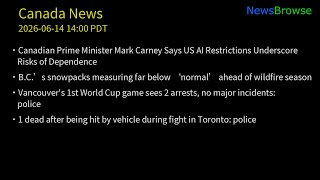
Canadian Prime Minister Mark Carney Says US AI Restrictions Underscore Risks of Dependence

Canadian Prime Minister Mark Carney Says US AI Restrictions Underscore Risks of Dependence