Graph Engineering for AI Agents
TECH

Graph Engineering for AI Agents

37+
Signals

Strategic Overview

  • 01.
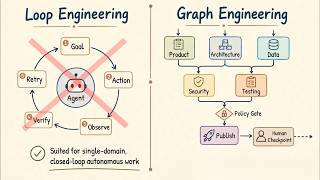
    Graph engineering treats an AI application as an executable graph of nodes - agents, tools, evaluators, human checkpoints - connected by edges that define permitted transitions, making multi-agent organization structure explicit instead of leaving it to a freeform manager agent.
  • 02.
    Explainx.ai's framing of the shift distinguishes a stable, permanent 'org graph' of roles and memory from an ephemeral 'work graph' that executes a single task, summarized as loops making agent behavior programmable while graphs make agent organizations programmable.
  • 03.
    The engineering-layer progression - prompt engineering to context engineering to harness engineering to loop engineering to graph engineering - is commonly described as additive, with each new layer wrapping rather than replacing the one before it.
  • 04.
    Anthropic's Claude Cookbook published a guide to building persistent knowledge graphs for multi-agent systems, using an extract-resolve-assemble-query pipeline that turns unstructured documents into entities and typed relations so multi-hop questions become graph traversal instead of retrieval.
  • 05.
    Andrew Ng and DeepLearning.AI released a free course, 'Agentic Knowledge Graph Construction,' co-taught with Neo4j's Andreas Kollegger, covering how a team of agents extracts and connects a knowledge graph to improve RAG using Google's Agent Development Kit.
  • 06.
    Anthropic published research on recursive self-improvement showing AI already materially accelerates its own AI development, and joined the 'Pacing the Frontier' letter published July 28-29, 2026, asking for international coordination to deliberately pace automated AI R&D.

The Stack Above Loops: What Graph Engineering Actually Adds

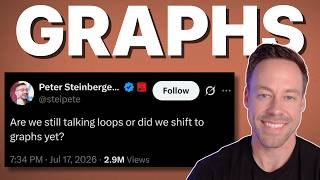
Loop engineering gave a single agent an act-evaluate-continue cycle; graph engineering does the same thing for multi-agent organizations, wiring nodes - agents, tools, evaluators, human checkpoints - together with edges that define permitted transitions and shared state[1]. Explainx.ai's framing splits this into a stable 'org graph', the permanent roles and memory of the system, and an ephemeral 'work graph' that executes a single task - echoing the same distinction production frameworks like LangGraph operationalize as explicit state, reducers, guard conditions, and checkpoints rather than leaving coordination to a freeform manager agent[2]. The tradeoff is that context does not propagate automatically between nodes: an edge a developer forgets to design starves a downstream agent of information it needs - a failure mode specific to graph-engineered systems rather than single-agent loops[3].
Memory That Outlives the Context Window

An LLM agent's working memory dies with its context window, which is why teams are building external knowledge graphs that persist facts and relationships across sessions and agents. Anthropic's Claude Cookbook describes the process as extract, resolve, assemble, query: pull entities and typed relations out of unstructured documents, merge duplicate entities that traditional string-matching misses (its own example - 'Edwin Aldrin' and 'Buzz Aldrin' share zero character overlap but refer to the same person), then assemble the result into a graph that turns multi-hop questions into graph traversal instead of retrieval[4]. In a worked example processing six Apollo-program documents, 36 raw entities resolved down to 22 canonical nodes connected by 34 edges in a single connected component - a small-scale demonstration of a pipeline meant to generalize to production multi-agent memory[4].

Old Wine, New Label? The Skeptic's Case

Not everyone is convinced 'graph engineering' names anything new. One widely-watched YouTube explainer argues the label mostly repackages patterns Anthropic already documented in its 2024 'Building Effective Agents' post - chaining, routing, parallelization, orchestrator-workers, evaluator-optimizer - and that the new term just makes those existing patterns easier to talk about and implement with today's coding harnesses. On Reddit, one builder who bootstrapped a company selling AI research tooling argued that full graph databases like Neo4j are overkill for most production use, describing instead running entities and edges as ordinary records inside a regular database plus a search index, under a small fixed ontology, with edges represented as co-occurrence counts rather than typed relations. A commenter pushed back directly: removing typed edges, path reasoning, and global summaries might be a reasonable tradeoff, but 'isn't really the same thing anymore' as a knowledge graph. Elsewhere in the same community discussions the dismissal was blunter - 'yet another bullshit term' was one reaction - even as other commenters swapped notes on real multi-agent orchestration projects they had built using the pattern.

Racing Ahead, Then Asking to Slow Down

Racing Ahead, Then Asking to Slow Down
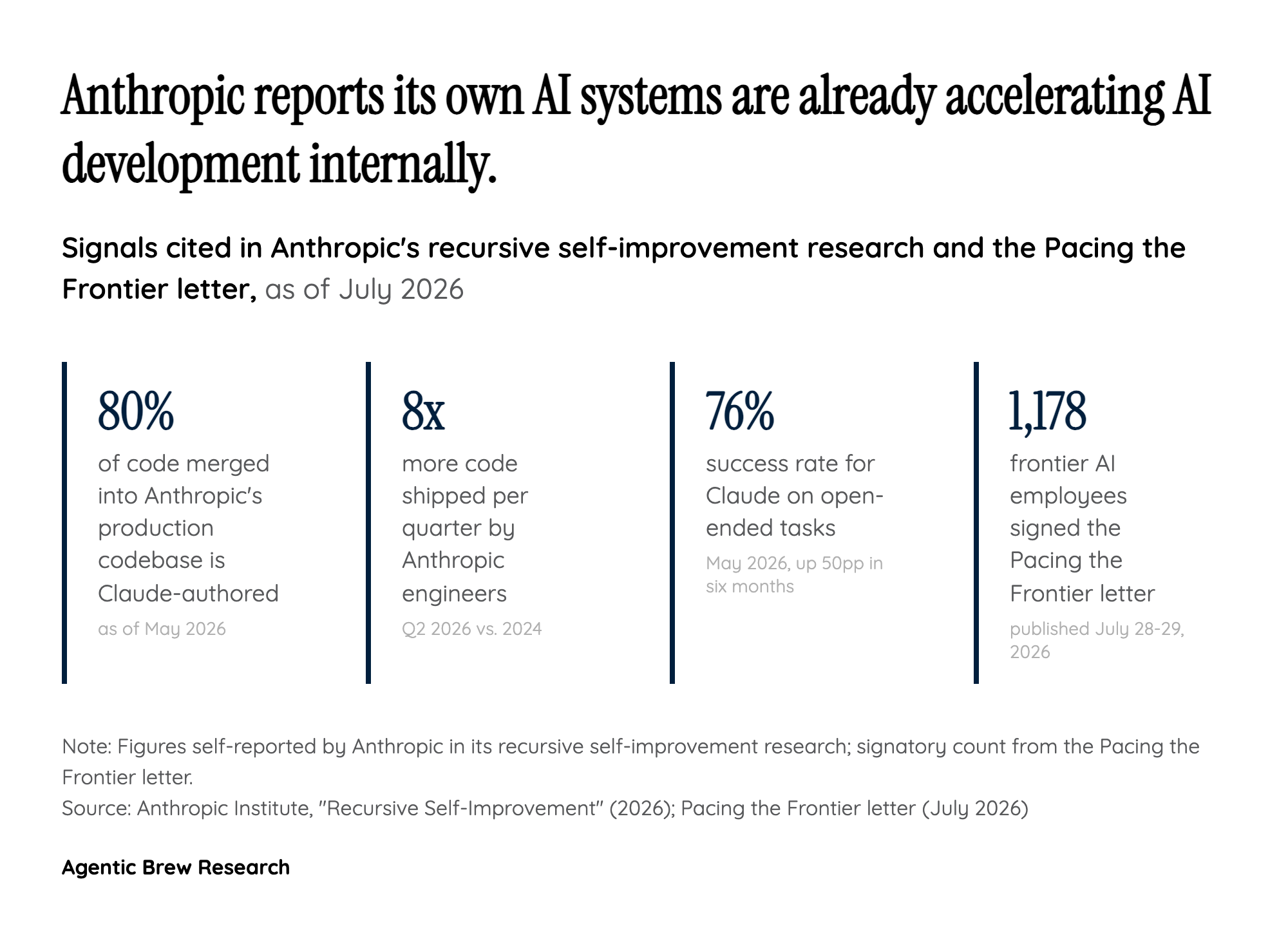
Anthropic-reported acceleration signals cited alongside the Pacing the Frontier letter.

The same infrastructure that lets agents coordinate as graphs is also the evidence Anthropic cites for why AI development may need deliberate pacing: more than 80% of code merged into its own production codebase is now Claude-authored, engineers are shipping roughly 8x more code per quarter than in 2024, and Claude's success rate on open-ended tasks rose to 76% in May 2026, up 50 percentage points in six months[5]. Full recursive self-improvement, Anthropic argues, could bring major scientific benefit but also raises the risk that humans lose control of AI systems if governance doesn't keep pace - while a unilateral slowdown could simply let less-cautious actors catch up[5]. That tension sits behind the 'Pacing the Frontier' letter, signed by 1,178 employees across frontier AI labs including OpenAI's chief scientist and Anthropic's own leadership, asking governments to build international tools for pacing automated AI R&D rather than calling for an immediate halt[6][7].

Historical Context

2025-01-01
Agentic systems moved to loop engineering - the design of autonomous act-evaluate-continue cycles for a single agent - described as the phase preceding graph engineering, running roughly 2025 into early 2026.
2026-07-18
Published the article widely cited as the naming and synthesis event that popularized 'graph engineering' as the term for the multi-agent-organization layer above loop engineering.
2026-07-28
1,178 employees from frontier AI companies, including OpenAI and Anthropic leadership, published the 'Pacing the Frontier' letter asking governments to support internationally coordinated pacing of automated AI R&D.

Power Map

Key Players
Subject

Graph Engineering for AI Agents

AN

Anthropic

Publishes both the technical building block (a Claude Cookbook guide to knowledge-graph memory for multi-agent systems) and the risk framing (recursive self-improvement research), and co-leads the Pacing the Frontier letter, citing its own majority-Claude-authored codebase as evidence of acceleration.

OP

OpenAI

Formally backs the Pacing the Frontier letter alongside Anthropic, with Chief Scientist Jakub Pachocki and CRO Mark Chen among the signatories.

GO

Google (Agent Development Kit)

ADK is the multi-agent framework used in DeepLearning.AI's agentic knowledge-graph construction course.

NE

Neo4j

Graph database vendor positioning knowledge graphs as AI agent memory and co-producing Andrew Ng's agentic knowledge-graph course via developer evangelist Andreas Kollegger.

DE

DeepLearning.AI / Andrew Ng

Distributes the free 'Agentic Knowledge Graph Construction' course teaching multi-agent extraction and connection of knowledge graphs to improve RAG.

LA

LangGraph (LangChain)

Cited as the representative production framework operationalizing graph engineering - treating agent execution as graph traversal with explicit state persistence, checkpoints, and controlled cycles.

Fact Check

9 cited
  1. [1] Graph Engineering: How AI Agents Become Organizations
  2. [2] What is Graph Engineering?
  3. [3] Graph Engineering: An Enterprise Guide
  4. [4] Knowledge Graph Construction with Claude
  5. [5] Recursive Self-Improvement
  6. [6] Pacing the Frontier: AI Employees Letter
  7. [7] OpenAI, Anthropic Formally Back Plan To Slow AI That Writes Its Own Code
  8. [8] Agentic Knowledge Graph Construction
  9. [9] Andrew Ng Unveils Free Course on Knowledge Graphs for RAG with Neo4j

Source Articles

Top 5

THE SIGNAL.

Analysts

Argues graphs make agent organizations, not just individual agent behavior, programmable, and that graphs force explicit modeling of dependencies that loop-based systems could leave implicit: 'Loops are subroutines. Graphs are programs.'

Yash Thakker
Author, explainx.ai

Frames prompt, context, harness, loop, and graph engineering as cumulative layers rather than replacements, each defined by what a single unit of work looks like at that layer: 'the list keeps growing, and every new term gets treated as a replacement for the last one... each layer wraps the one before it.'

Akshay Pachaar
AI commentator on X

Positions graph engineering as the concrete implementation discipline behind LangGraph-style systems: 'Graph engineering is the design of nodes, dependencies, state transitions, execution routes, validation gates, recovery paths, and control boundaries inside an agentic system.'

Harsh Mishra
Author, Analytics Vidhya
The Crowd

From prompt → context → harness → loop → graph engineering: The list keeps growing, and every new term gets treated as a replacement for the last one. In reality, however, each layer wraps the one before it, and the cleanest way to tell them apart is to ask what a single...

@@_avichawla495

context engineering vs graph engineering. every few months the list gets a new word and everyone treats it as a replacement for the last one. these two are not on the same list. one decides what the model sees this turn, the other decides what exists at all. the cleanest way...

@@hanakoxbt173

a free course just quietly ended the RAG debate. 1 hour and 43 minutes. almost no one's watched it. built on Google's ADK - the full pipeline for a knowledge graph your agent walks instead of searches: • 00:00 - what an AI agent actually is • 08:09 - how you split work across...

@@kingwilliam_26

I built a knowledge graph 1000x cheaper than GraphRAG that you can query with an agent

@u/TheRedfather41
Broadcast
Move Over Loop Engineering, Graph Engineering Is Now Here

Move Over Loop Engineering, Graph Engineering Is Now Here

Graph Engineering, Without the Hype

Graph Engineering, Without the Hype

FORGET Loop Engineering. Graph Engineering is about THIS

FORGET Loop Engineering. Graph Engineering is about THIS