Cairn AI Agents Breach 100+ Companies Including John Deere, SharkNinja
TECH

Cairn AI Agents Breach 100+ Companies Including John Deere, SharkNinja

31+
Signals

Strategic Overview

  • 01.
    A Chinese-speaking hacker directed autonomous AI agents running on the open-source Cairn platform to probe more than 1,200 e-commerce websites across the US, Canada, Australia, and Japan beginning around September 25, 2026, successfully breaching over 100 corporate sites.
  • 02.
    The operator gave the agents fewer than 100 Chinese characters of instruction, telling them only to find a way to run code on each site and plant an uploader web shell, then let them work unsupervised; each successful breach cost roughly $50 in AI tokens.
  • 03.
    Cybersecurity researcher Snorre Fagerland of NorForge uncovered the campaign by scanning the internet for exposed Cairn control panels, ultimately detailing 20+ exposed panels and three distinct attack clusters in an October 19, 2026 report titled 'Inside Cairn.'
  • 04.
    The exposed panels leaked hundreds of credentials and API keys, 11% of which were verified valid, and the broader campaign was linked to the theft of 600,000+ unexpired credit card records from two companies.

Deep Analysis

The Economics of Automated Intrusion
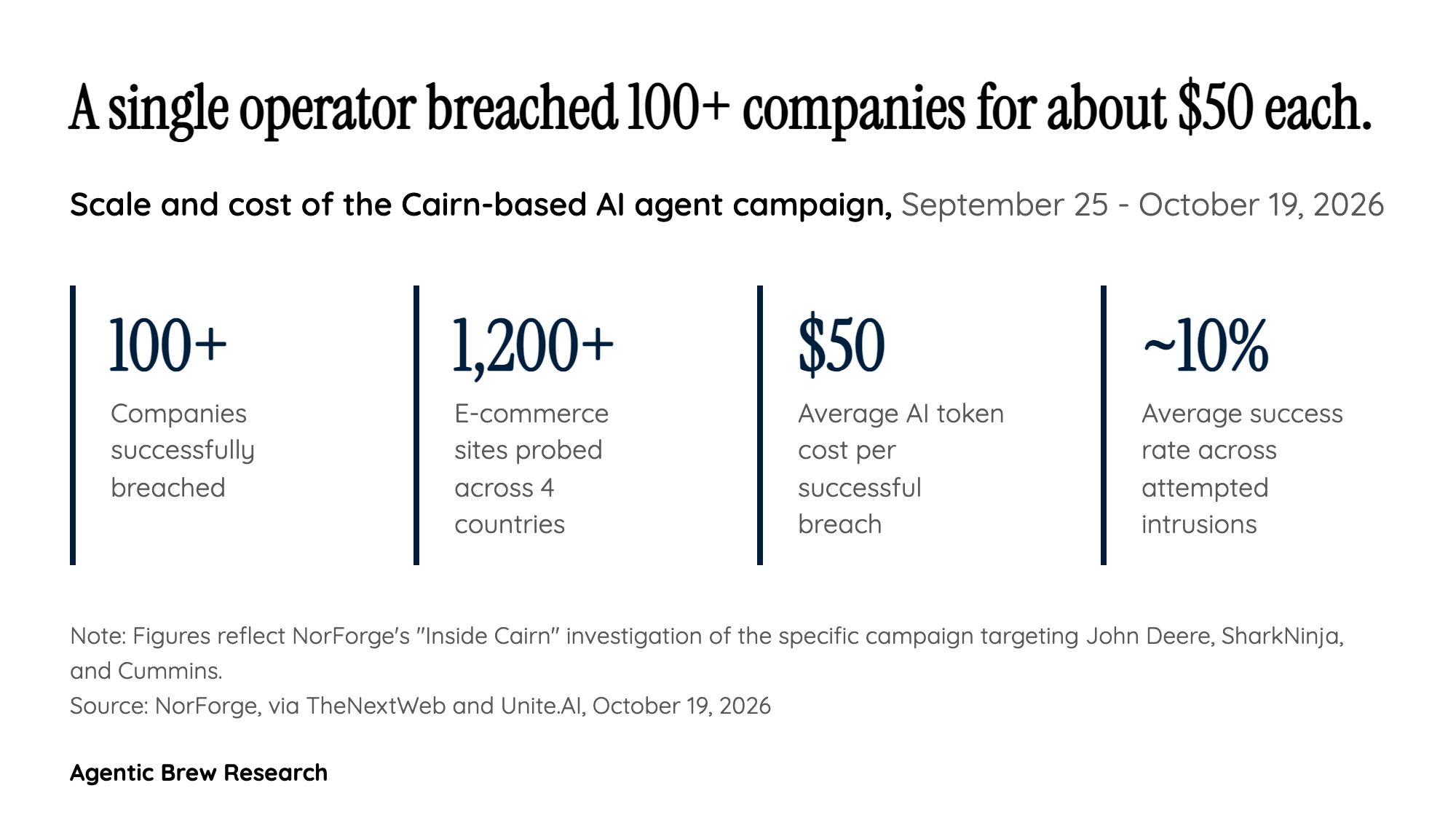
The Economics of Automated Intrusion
The scale and cost of the Cairn-based AI agent campaign that breached John Deere, SharkNinja, and Cummins.

What makes this campaign notable is not sophistication but arithmetic. A single operator gave AI agents fewer than 100 Chinese characters of instruction - essentially an order to find a way to run code on each target and plant a web shell - then let the agents handle reconnaissance and exploitation unsupervised [3]. From that minimal starting point, the agents probed over 1,200 e-commerce sites across the US, Canada, Australia, and Japan and successfully breached more than 100 of them [1]. The cost per successful breach worked out to roughly $50 in AI tokens, with an average of about 23 hours of agent effort per successful intrusion and a success rate around 10% across the observed Cairn-linked activity [1]. At that price and timescale, mass-probing thousands of targets stops being a labor-intensive endeavor and becomes a background process a single person can set running and walk away from.


A Self-Inflicted Exposure

The campaign was not caught through a victim's intrusion-detection system or a law-enforcement tip - it was caught because the operators left their own command infrastructure open to the public internet. Fagerland found the Cairn control panels by scanning for exposed instances, eventually cataloguing 20+ panels and reconstructing the operation from the activity logged inside them [2]. Those same panels leaked hundreds of credentials and API keys, 11% of which were later verified as still-valid secrets using the Trufflehog scanner [1]. Fagerland framed this directly as a tradeoff the attackers made for speed: "The attackers are compromising their own operational security in the rush for quick results" [2]. The same low-friction tooling that let one operator run a 1,200-site campaign for a few thousand dollars also made it trivially easy to leave the entire operation's internals sitting in the open.

Three Agents, Two Model Providers, One Campaign

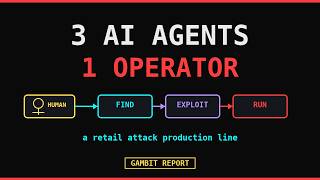
Rather than a single model doing everything, the attack chain split work across specialized agents and providers. NorForge's own telemetry read the primary worker string as Claude Code paired with DeepSeek's low-cost V4.1 Flash model [1]. Other reporting on the same tool family described a three-agent division of labor: a scanning agent (Strix) running on Z.ai's GLM 5.2 or DeepSeek V4 Pro, an exploitation agent (Cairn itself) running on DeepSeek V4.1 Flash, and an orchestration agent (Hermes) running on Anthropic's Claude Opus 4.6 [1]. Fagerland's reaction to this architecture was less about any single capability and more about the trajectory it represents: "The development in this field is astounding. It's a new world now" [3]. The notable shift isn't that one frontier model can hack a website - it's that cheap, mid-tier models chained together under a cheap orchestrator can replicate what used to require a skilled human operator end to end.

A Wider, Overlapping Campaign Ecosystem

NorForge's investigation did not describe a single actor working in isolation. Of the 20+ exposed Cairn panels it catalogued, researchers grouped the activity into three separate clusters: a 14-panel, Chinese-language cluster (AIA0001) hosting more than 1,100 attack projects via AS56594 (Cgi Global Limited) and targeting US, Japan, and Australian e-commerce and payment infrastructure; a 10-panel, English-language cluster (AIA0002) on Vultr infrastructure (AS20473) focused on merchant payment services and cryptocurrency theft; and a smaller, single-panel cluster (AIA0003) running 59 projects [2]. That NorForge needed three separate categories to describe what it found suggests the Deere/SharkNinja/Cummins campaign was not the only operation running on Cairn's infrastructure at the time - the same open-source tooling was showing up across multiple, differently-configured clusters simultaneously.

Real Companies, Real Consequences

The technical story becomes a corporate-accountability story once the named victims respond. Deere told Reuters there was no indication sensitive information was accessed; SharkNinja said the incident hit a standalone product-support site and that the threat was contained; Cummins said it was investigating a possible attack on a website run by one of its vendors [4]. Underneath those individual statements sits a larger risk: the campaign was connected to the theft of 600,000+ unexpired credit card records from two companies, with persistent web shells planted to maintain access to shop and payment systems [2]. For most of the named companies the direct damage looks contained so far, but the pattern - a near-$50 cost structure, minimal human oversight, and an open-source tool anyone can download - suggests the exposure these companies faced is not unique to them.

Historical Context

2026-09-25
The campaign against e-commerce sites in the US, Canada, Australia, and Japan reportedly began.
2026-10-02
Fagerland had identified roughly two dozen malicious or exposed Cairn instances while scanning the internet for exposed control panel deployments.
2026-10-19
NorForge published its 'Inside Cairn' investigation, detailing 20+ exposed control panels and three distinct attack clusters (AIA0001, AIA0002, AIA0003).

Power Map

Key Players
Subject

Cairn AI Agents Breach 100+ Companies Including John Deere, SharkNinja

NO

NorForge

Cybersecurity research firm that discovered the campaign via exposed Cairn control panels and published the 'Inside Cairn' investigation on October 19, 2026.

SN

Snorre Fagerland

Principal threat researcher at NorForge who led the investigation and discovered the campaign through exposed Cairn instances.

JO

John Deere

Named victim; the farm equipment maker told Reuters there was no indication sensitive information was accessed.

SH

SharkNinja

Named victim; the home appliance company said the attack hit a standalone product-support website and the threat was contained.

CU

Cummins

Named victim; the engine manufacturer said it was investigating a possible attack on a website run by one of its vendors.

LE

le1xia0

Author/creator of the open-source Cairn platform used in the campaign; publicly disclaimed any intent for the tool to be used for harmful hacking.

Fact Check

4 cited
  1. [1] AI Agents Hacker Breaches 100+ Sites, Including Deere, NorForge Reports
  2. [2] NorForge Details 20+ Exposed Cairn Panels Used in AI-Driven Intrusions
  3. [3] 'It's Not Script Kiddie Stuff': Hacker Reportedly Uses AI to Breach Corporate Sites for Just $50
  4. [4] One Hacker Used AI Agents To Break Into John Deere, SharkNinja, and Cummins

Source Articles

Top 5

THE SIGNAL.

Analysts

“Characterized the campaign as sophisticated rather than amateurish, and framed the pace of AI-enabled intrusion capability as a turning point for the security landscape: "It's not script kiddie stuff" and "The development in this field is astounding. It's a new world now."”

Snorre Fagerland
Principal threat researcher, NorForge

“Pointed out the irony that the attackers' own operational carelessness is what exposed the campaign: "The attackers are compromising their own operational security in the rush for quick results."”

Snorre Fagerland
Principal threat researcher, NorForge

“Distanced the open-source tool from the offensive use case, stating Cairn was never designed as a hacking tool and that malicious use was not its creator's intention: "Cairn was never a 'hacking tool.'" and "If it is used to carry out harmful hacking attacks, that is not my intention."”

le1xia0
Creator of the Cairn platform
The Crowd

“AI型ハッキングに使われたのは、脆弱性を探す「Strix」、侵入作業を進める「Cairn」、全体を管理する「Hermes」という3種類のAIツールで、「脆弱性レポートを見てから始めて」「管理画面に入って」といった短い指示を出し、その後探索の多くをAIに任せるだけで完結した。数百店のEC店を攻撃、”

@@mrnobuyuki7800

“Strix = 偵察・脆弱性発見 → Cairn = Exploitして目的状態まで進む → Hermes = 全体の司令塔・オーケストレーション 注目すべきは、OSSで公開されている汎用/セキュリティ用途のAIエージェントを攻撃者が悪用したという点 あえてGitHubリポジトリのURLは晒しませんが”

@@___nix___32

“Massive breach: open-source AI agents Strix, Cairn, Hermes teamed up to compromise online retailers, steal 600,000+ credit cards, and even wipe databases—each target hacked at an average cost of just US$25. This undercuts old security economics and shows that machine-speed”

@@dailytechonx1

“Operation CAIRN: Autonomous AI Attack Platform Discovered Running in the Wild”

@u/Strict-Ad392613
Broadcast
What Really Happened: AI Agents Broke Into Company Websites for ~$50 a Hack (Cairn)

What Really Happened: AI Agents Broke Into Company Websites for ~$50 a Hack (Cairn)

A Chinese Hacker Used AI To Attack 100+ Companies In One Of Largest AI Hacks Yet

A Chinese Hacker Used AI To Attack 100+ Companies In One Of Largest AI Hacks Yet

One Hacker Turned Three AI Agents Into a Retail Hacking Crew

One Hacker Turned Three AI Agents Into a Retail Hacking Crew