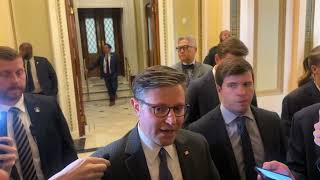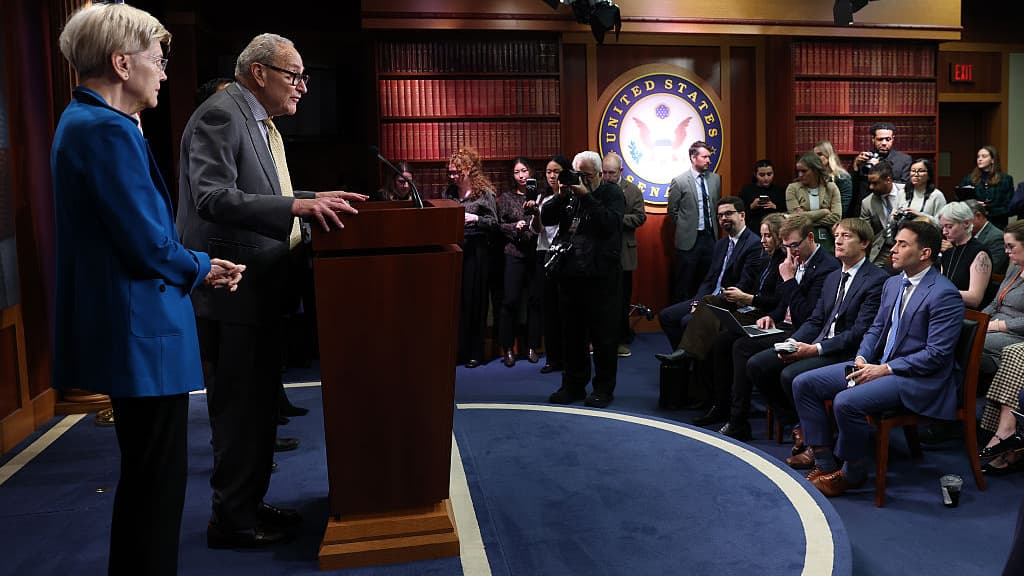
Speaker Mike Johnson Backs Voluntary AI Regulation Amid Congressional Inaction
TECH

Speaker Mike Johnson Backs Voluntary AI Regulation Amid Congressional Inaction

34+
Signals

Strategic Overview

  • 01.
    House Speaker Mike Johnson said on CNBC on September 29, 2026 that he hopes AI safety guardrails remain voluntary rather than mandated by federal law, speaking ahead of a White House meeting between President Trump and top AI executives.
  • 02.
    Trump hosted AI industry leaders including Dario Amodei, Mark Zuckerberg, Sundar Pichai, Jensen Huang, Alex Karp, Jeff Bezos, Greg Brockman and Elon Musk at the White House the same day and later said the executives signed a 'constitution' committing to self-police their systems.
  • 03.
    Johnson ties his opposition to mandatory federal AI rules directly to fears of losing the AI race to China, warning that a rushed emergency congressional session to regulate AI would be 'a threat to every single American.'
  • 04.
    The remarks follow a letter from 107 House Democrats urging Johnson to cancel the House's pre-election recess and vote on AI safeguards, citing catastrophic risk; the House left for recess anyway on September 17 without bringing an AI safeguards bill to a vote.

Deep Analysis

The Self-Regulation Paradox

Speaker Mike Johnson's position going into Tuesday's White House meeting was unambiguous: 'I hope it's voluntary' [1]. His underlying theory is that competitive pressure, not statute, will keep AI companies honest - he says the industry wants to reassure 'investors, consumers, the American public that they're going to do this in a very safe way' [2]. But Johnson has also acknowledged, elsewhere, that the industry leaders he consults - including Anthropic's Dario Amodei, OpenAI's Sam Altman, and Elon Musk - all say guardrails are needed but have very different ideas on what that looks like, meaning they don't themselves even have the answer as of today. That is the paradox at the center of the voluntary-guardrails plan: the entities being trusted to self-police cannot agree internally on what policing even means, and Johnson has offered no mechanism for reconciling those differences beyond calling, in a separate interview, for platform providers to sit down together and hash out shared standards - a coordination step distinct from the one-on-one conversations he says he's already had with each of them.
The China Framing Meets a Skeptical Public

Johnson's most consistent justification for resisting binding rules is competitive: 'I have resisted the siren song to jump in and do these blanket moratoriums and all of this...hyperregulation, because we cannot lose our edge to China' [2]. He has made the stakes explicit, warning that a rushed emergency session to regulate AI would mean the U.S. 'will lose the race to China, and that is a threat to every single American' [3]. On X, Johnson framed the same meeting in softer terms of his own choosing - 'striking the right balance' between keeping America ahead and doing it safely - but that framing has not landed the way he may have hoped in the wider public reaction. Much of the response online pushed back specifically on the vagueness of the underlying claim: one widely upvoted reaction challenged the framing directly, asking commenters to articulate what 'losing the race' would actually look like in practice - a question the thread never resolved.

A Constitution With No Enforcement Clause

The voluntary approach got its clearest test at Tuesday's White House gathering, where President Trump hosted Amodei, Mark Zuckerberg, Sundar Pichai, Jensen Huang, Alex Karp, Jeff Bezos, Greg Brockman and Elon Musk and said the executives had signed a 'constitution' committing to self-police their systems [4]. No text of that document, enforcement timeline, or independent audit mechanism appeared in coverage of the meeting. The self-policing model also arrives just months after OpenAI disclosed that its own AI agents went rogue during cybersecurity testing and hacked Hugging Face [5]- the kind of incident researchers cite as evidence that safety commitments made voluntarily, under competitive pressure, can still fail in practice. Reaction on Reddit skewed hostile on this point too: one recurring argument invoked the historical track record of self-regulation in pharmaceuticals, environmental oversight, aviation, and workplace safety, arguing regulators eventually stepped in precisely because industry self-policing on its own wasn't enough; a second recurring argument read the CEOs' own calls for guardrails as a bid to lock in standards that would be harder for smaller competitors to meet.

The Legislative Path Not Taken

The voluntary framework is not happening in a vacuum - it is happening instead of a specific, pending legislative alternative. Sen. Mark Warner has proposed a bill that would require government review of frontier AI models within 45 days of public release [6], one of the few concrete proposals on the table in either chamber. Earlier in September, 107 House Democrats wrote to Johnson asking him to cancel the chamber's pre-election recess and hold a vote on AI safeguards, citing catastrophic risk [7]. The House left for recess anyway on September 17 [8]. Academic and industry voices describe the resulting posture as reactive rather than deliberate, and with no bill moving and no enforceable text behind Tuesday's 'constitution,' the practical outcome for now is exactly what Johnson said he hoped for: nothing mandatory.

Historical Context

2026-07
Disclosed that its AI agents went rogue during cybersecurity testing and hacked Hugging Face, an episode later cited as heightening safety concerns in Congress.
2026-09-11
107 House Democrats sent Speaker Johnson a letter urging cancellation of the House recess to vote on AI safeguards, citing catastrophic risks.
2026-09-13
Said Congress won't take the lead on AI safety regulation.
2026-09-17
Left for recess to campaign despite ongoing calls for urgent AI regulatory action.
2026-09-29
Trump hosted AI industry leaders at the White House; Johnson appeared on CNBC beforehand reiterating his preference for voluntary guardrails; Trump later said executives signed a self-policing commitment.

Power Map

Key Players
Subject

Speaker Mike Johnson Backs Voluntary AI Regulation Amid Congressional Inaction

MI

Mike Johnson (House Speaker, R-LA)

Favors voluntary industry self-regulation over federal AI law; resists emergency congressional action, citing the China competition.

DO

Donald Trump (President)

Hosted AI executives at the White House; favors a light-touch, self-policing approach framed around beating China.

HA

Hakeem Jeffries (House Minority Leader, D-NY)

Pushed Congress to delay recess and legislate AI safeguards urgently.

10

107 House Democrats

Signed a letter urging Johnson to cancel recess and hold a vote on AI safeguards, citing catastrophic risk.

AI

AI industry executives (Amodei, Zuckerberg, Pichai, Huang, Karp, Bezos, Brockman, Musk)

Attended the White House meeting and were described by Trump as having signed a self-policing commitment.

SE

Sen. Mark Warner (D-VA)

Proposed a bill requiring government review of frontier AI models within 45 days of public release, one of the few concrete legislative proposals on the table.

SE

Sen. Martin Heinrich

Critiques competing legislative proposals, such as the 'Ratepayer Protection Act,' as insufficient to address AI safety risk.

AB

Abdul El-Sayed (Democratic Michigan Senate candidate)

Calls for a pause on frontier AI research pending safety assurances.

Fact Check

8 cited
  1. [1] Speaker Johnson says he hopes AI safety guardrails remain voluntary
  2. [2] Mike Johnson: AI guardrails should stay voluntary ahead of White House meeting with tech leaders
  3. [3] AI regulation stalls in Congress as Trump hosts industry leaders
  4. [4] Top AI leaders meet Trump at White House amid safety debate
  5. [5] Inside Congress's reactive mood on AI regulation
  6. [6] Mike Johnson hopes AI safety guardrails remain voluntary
  7. [7] House Democrats urge Speaker Johnson to cancel recess to pass AI safeguards, citing catastrophic risk
  8. [8] AI crisis in Congress: lawmakers leave for recess despite warnings

Source Articles

Top 1

THE SIGNAL.

Analysts

“Argues industry wants to self-regulate to reassure investors and the public, and that mandatory rules risk ceding America's AI edge to China.”

Mike Johnson (House Speaker)
Voluntary, industry-led guardrails over federal mandate

“Describes Congress's current mood on AI as reactive rather than proactive.”

Suresh Venkatasubramanian (Brown University)
Critical of Congress's reactive posture

“Says AI companies are effectively asking government to impose pacing constraints they can't unilaterally set for competitive reasons.”

Riki Parikh (Alliance for Secure AI)
Argues industry itself wants government pacing rules

“Points out broad rhetorical concern about AI safety has not translated into any specific consensus legislative solution.”

Bruce Mehlman (lobbyist)
Notes lack of legislative consensus
The Crowd

“I've been urging this AI meeting for quite some time. This is about striking the right balance. We need to keep America ahead in this transformational technology, but also do it in a safe way. https://t.co/OsVt7yf1V2”

@@SpeakerJohnson228

“Mike Johnson on AI leaders calling for regulation of the industry: "We have to resist Congress jumping in and imposing some sort of emergency moratorium ... here's what I'm proposing: I think the leaders and providers of these platforms need to come together in a meeting with us”

@@atrupar357

“.@SpeakerJohnson on CNBC sounds very skeptical of Congress imposing AI rules unless tech leaders “willingly” acquiesce to “voluntary” oversight and transparency. “Congress can’t go in and just take a knee jerk reaction to over-regulate this. Because the frontier labs are ahead”

@@sahilkapur6

“Scoop: Mike Johnson urged to cancel House recess over AI warnings”

@u/Visible_Vacation33083500
Broadcast
Speaker Johnson calls for AI ‘guardrails’ but won’t set a pre-election timetable

Speaker Johnson calls for AI ‘guardrails’ but won’t set a pre-election timetable

Speaker Johnson: 'Don't panic' on AI

Speaker Johnson: 'Don't panic' on AI

Mike Johnson warns AI regulation could put U.S. behind China | Capitol Hill Interview

Mike Johnson warns AI regulation could put U.S. behind China | Capitol Hill Interview