OpenAI Revenue Shortfall Sparks AI Stock Selloff
TECH

OpenAI Revenue Shortfall Sparks AI Stock Selloff

44+
Signals

Strategic Overview

  • 01.
    OpenAI told investors its annualized revenue is approaching $50 billion as of the end of September 2026, roughly $20 billion below a $70 billion figure that had been circulating among investors.
  • 02.
    OpenAI still expects to reach or exceed $70 billion in annualized revenue by the end of 2026, driven largely by enterprise business growth.
  • 03.
    Multiple outlets reported the gap is a measurement difference, not evidence of a demand shortfall: Anthropic reports gross revenue including cloud-partner sales, while OpenAI records only its own net share of such sales.
  • 04.
    The disclosure, first reported by the Financial Times, triggered a broad selloff across AI infrastructure stocks including Nvidia, Oracle, CoreWeave, Micron, Broadcom, AMD, and Intel.

Deep Analysis

The Accounting Mechanism Behind the 'Missing' $20 Billion

The headline $20 billion gap did not come from a sales miss - it came from two companies measuring revenue differently. Anthropic reports gross revenue, including the full value of sales routed through cloud partners, even though it pays those partners roughly 16% of every dollar earned through them - a channel that accounted for about half of Anthropic's revenue [1]. OpenAI, by contrast, records only its own net share of partner-channel sales, excluding the partner's cut [1]. The $70 billion figure that circulated among investors was effectively an attempt to make OpenAI's number directly comparable to Anthropic's cloud-inclusive accounting [1], compounded by some investors extrapolating OpenAI's reported 70%-plus growth since July onto the wrong baseline [5]. Multiple outlets, including Yahoo Finance, framed the gap as a measurement difference rather than a demand shortfall [6].
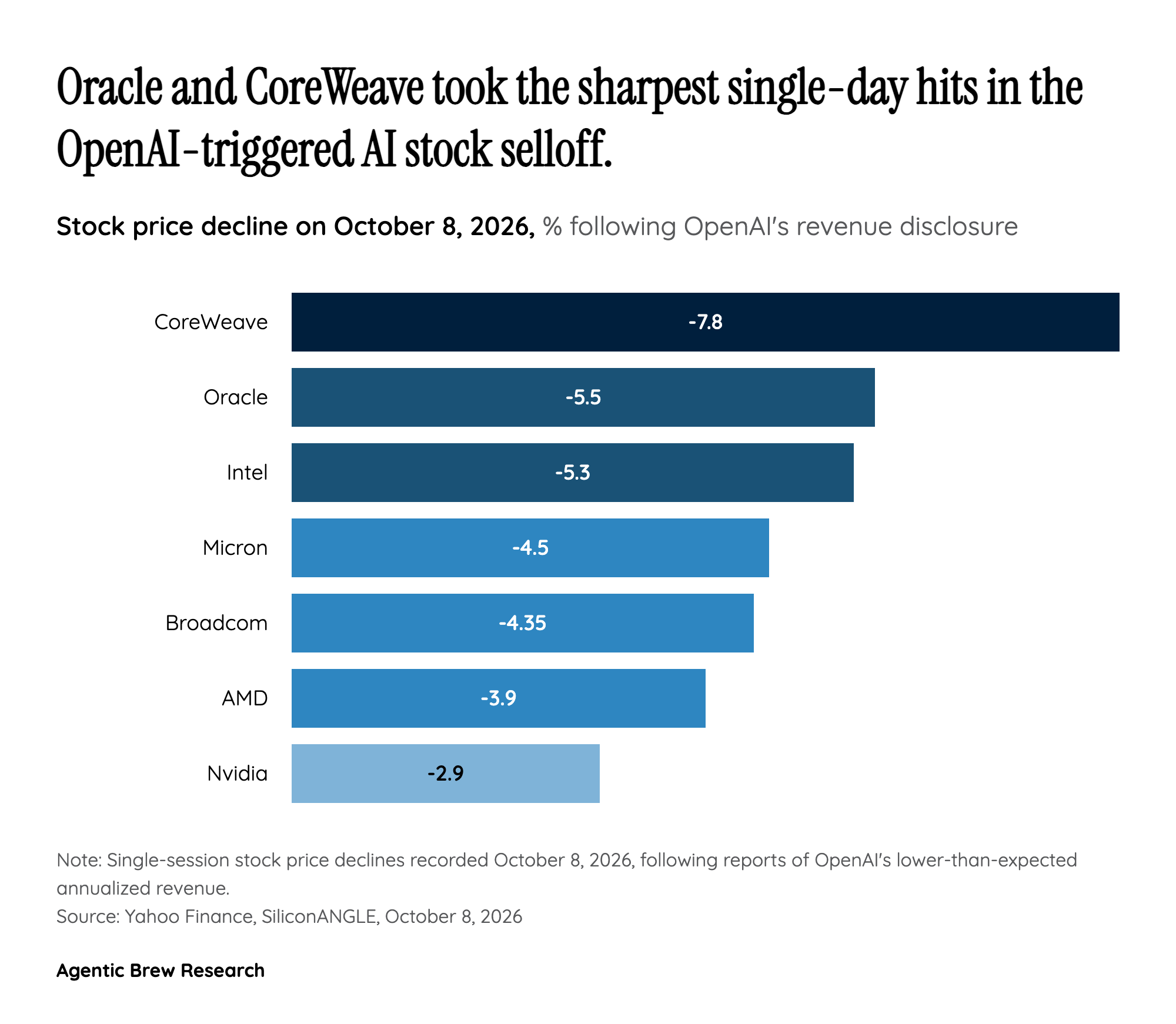

Oracle's Concentration Risk Shows Who Actually Bears the Downside

Oracle's Concentration Risk Shows Who Actually Bears the Downside
Single-day stock price declines on October 8, 2026, following OpenAI's revenue disclosure. Source: Yahoo Finance, SiliconANGLE.

The selloff's severity tracked exposure, not just sentiment. Oracle, which signed a roughly $300 billion cloud computing agreement with OpenAI that represents about 45% of its contracted revenue backlog, fell about 5.5% - a sharper decline than Nvidia's - because Oracle is already running $28.5 billion in capex against negative $5.4 billion in free cash flow, and is reportedly seeking additional financing for AI chips [3]. CoreWeave, with $22.4 billion in cloud contracts tied to AI demand, fell 7.8-8%, even as CEO Michael Intrator publicly dismissed related circular-financing concerns [3][4]. Nvidia's roughly 2.9% decline wiped out about $169 billion in market value [2], underscoring that the market was repricing the entire AI capital-spending chain, not just OpenAI's own numbers. On X, The Kobeissi Letter flagged Oracle's slide in real time, while Bloomberg Surveillance co-host Lisa Abramowicz went further, framing it as evidence of how leveraged the broader tech sector - from Nvidia to AMD to Microsoft - has become to OpenAI and Anthropic's self-reported revenue figures.

A Credibility Problem, Not Necessarily a Demand Problem

The sharpest critique wasn't about the math itself but about disclosure timing. Big Technology's Alex Kantrowitz argued the episode reflected 'some sloppiness' on OpenAI's part [7]- the company did not proactively correct the inflated $70 billion figure before the Financial Times report forced the real number into the open, despite OpenAI's outsized influence on how markets price the entire AI trade. D.A. Davidson's Gil Luria pushed back from the other direction, arguing the market reaction itself was 'unnecessary concern' because the original $70 billion figure may never have accurately reflected OpenAI's actual standing in the first place [5]. Separately, a CNBC panel debated whether the shortfall could partly reflect OpenAI losing enterprise or coding market share to Anthropic's Claude, though that framing remained speculative and company-specific rather than a signal of a broader AI-trade inflection point.

The ARR Metric Itself Is Now Under Fire

Beyond the OpenAI-Anthropic comparison, the episode reopened a more fundamental question about annualized run rate (ARR) as a metric. On Reddit's r/BetterOffline, the dominant critique was that ARR for both companies is calculated by taking a single best day and multiplying it out to a full year, making headline figures structurally unreliable regardless of accounting method. That skepticism sat alongside a counter-argument on r/technology that annualized reporting, while abuse-prone, is a legitimate way for fast-growing companies to represent trajectory. A related thread on r/business pushed back from a different angle, noting that the widely cited $70 billion figure was never OpenAI's own guidance but rather an investor and media extrapolation, making the 'revenue miss' framing itself questionable. The tension is notable because OpenAI's own disclosed growth - annualized revenue up more than 70% from roughly $30 billion in July to near $50 billion by September [5]- was cited by outlets as evidence that underlying demand remains strong, even as the reporting methodology used to communicate that growth is what investors no longer fully trust.

Historical Context

2025-09-01
Oracle signed a roughly $300 billion cloud computing agreement with OpenAI, which came to represent about 45% of Oracle's contracted future revenue backlog.
2026-07-01
OpenAI's annualized revenue baseline was reported around $30 billion before 70%+ growth through September pushed it toward $50 billion.
2026-07-01
Anthropic's annualized revenue reportedly crossed $65 billion, becoming the comparison point investors used to produce the inflated $70 billion OpenAI estimate.
2026-10-08
A Financial Times report disclosing OpenAI's actual ~$50 billion annualized revenue figure triggered the broad AI infrastructure stock selloff.

Power Map

Key Players
Subject

OpenAI Revenue Shortfall Sparks AI Stock Selloff

OP

OpenAI

Subject of the revenue disclosure; told investors annualized revenue is near $50 billion versus a previously circulated $70 billion figure, while maintaining it expects to hit $70 billion by year-end on enterprise growth.

AN

Anthropic

Rival whose gross, cloud-partner-inclusive revenue accounting was used as the comparison basis that produced the inflated $70 billion estimate for OpenAI; itself reported an annualized run rate in the $65-68 billion range.

OR

Oracle

AI infrastructure partner with a $300 billion cloud computing agreement with OpenAI, roughly 45% of its contracted revenue backlog; among the hardest-hit stocks given heavy reliance on future OpenAI-linked revenue and current negative free cash flow.

NV

Nvidia

AI chip supplier tied to the broader AI infrastructure buildout; lost roughly $169 billion in market value as shares fell about 2.9-3% on the news.

CO

CoreWeave

GPU cloud provider with $22.4 billion in cloud contracts tied to OpenAI/AI demand; stock fell roughly 7.8-8% on the selloff, though CEO Michael Intrator publicly dismissed related circular-financing concerns.

MI

Micron, Broadcom, AMD, Intel, Super Micro, SoftBank

Other AI-infrastructure-linked companies whose shares also declined on the news, reflecting broader concern about AI supply-chain and capex sustainability.

Fact Check

7 cited
  1. [1] OpenAI tells investors revenue run rate is $20bn below earlier indication
  2. [2] OpenAI revenue reportedly $20 billion below expectations
  3. [3] Oracle stock crashes on OpenAI revenue shortfall report
  4. [4] CoreWeave CEO rebuts circular-financing concerns amid stock slide
  5. [5] Why OpenAI's Annualized Revenue Is $20 Billion Below Expectations
  6. [6] OpenAI revenue appears $20 billion short of expectations
  7. [7] OpenAI's Revenue Gap: Some Sloppiness, Not a Demand Problem

Source Articles

Top 5

THE SIGNAL.

Analysts

“Investors are growing skeptical about how long massive AI infrastructure spending can continue.”

Matt Maley
Analyst, Miller Tabak

“Uncertainty remains about how much total funding AI companies will ultimately require.”

Holger Mueller
Analyst, Constellation Research

“The market reaction overstated the issue, since the original $70 billion figure itself may not have accurately reflected OpenAI's actual standing.”

Gil Luria
Analyst, D.A. Davidson

“The revised figure is primarily a clarification of revenue reporting methods, not evidence of weakening underlying demand.”

Evan Schlossman
Neostellar

“Characterized the discrepancy as reflecting some sloppiness on OpenAI's part rather than a demand problem, and argued OpenAI should be more proactive about disclosure given its market-moving influence.”

Alex Kantrowitz
Big Technology
The Crowd

“BREAKING: Oracle stock, $ORCL, falls over -5% after OpenAI tells investors that its annualized revenue is $20 billion less than expected.”

@@KobeissiLetter3962

“Evidence of how leveraged the entire tech sector is to OpenAI & Anthropic: an FT story about OpenAI's revenue's being less than initially reported is spurring a more than 5% drop in Oracle shares, exacerbating losses from Nvidia and AMD to Microsoft.”

@@lisaabramowicz11474

“OPENAI'S ANNUALIZED REVENUE NEARS $50B, BELOW EARLIER $70B REPORTS: FT OpenAI recently told investors its annualized revenue was approaching $50B at the end of September, roughly $20B below the figure widely reported last month. The discrepancy reportedly stems from differences”

@@wallstengine1117

“OpenAI Annualised Revenue 20bn less then previously stated”

@u/Pseudanonymius595
Broadcast
Reaction to OpenAI's revenue miss: How to trade it

Reaction to OpenAI's revenue miss: How to trade it

Big Technology's Kantrowitz on OpenAI revenue report: Some sloppiness on company's part

Big Technology's Kantrowitz on OpenAI revenue report: Some sloppiness on company's part

OpenAI Revenue Shocks AI Plays | Chipotle Jumps on Takeover Rumors

OpenAI Revenue Shocks AI Plays | Chipotle Jumps on Takeover Rumors

OpenAI Revenue Shortfall Sparks AI Stock Selloff — AI News | Agentic Brew