US probes whether China obtained an ASML EUV chip-making machine, ASML denies
TECH

US probes whether China obtained an ASML EUV chip-making machine, ASML denies

32+
Signals

Strategic Overview

  • 01.
    US Commerce Secretary Howard Lutnick told ASML's senior leadership in a series of recent meetings that he is concerned one of the company's most advanced EUV lithography machines may have reached China in violation of US-led export controls, a dispute Bloomberg made public on June 19, 2026.
  • 02.
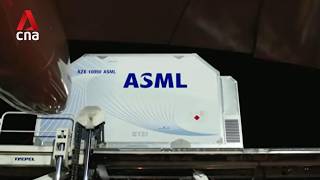
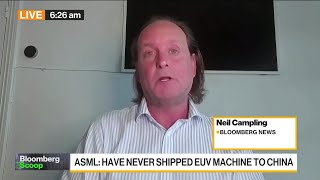
    ASML flatly denies the claim, stating it has never shipped an EUV machine to China nor any component, module or equipment specially designed for use in an EUV machine, and characterizes the reports as rumors that are inaccurate and damaging to its reputation.
  • 03.
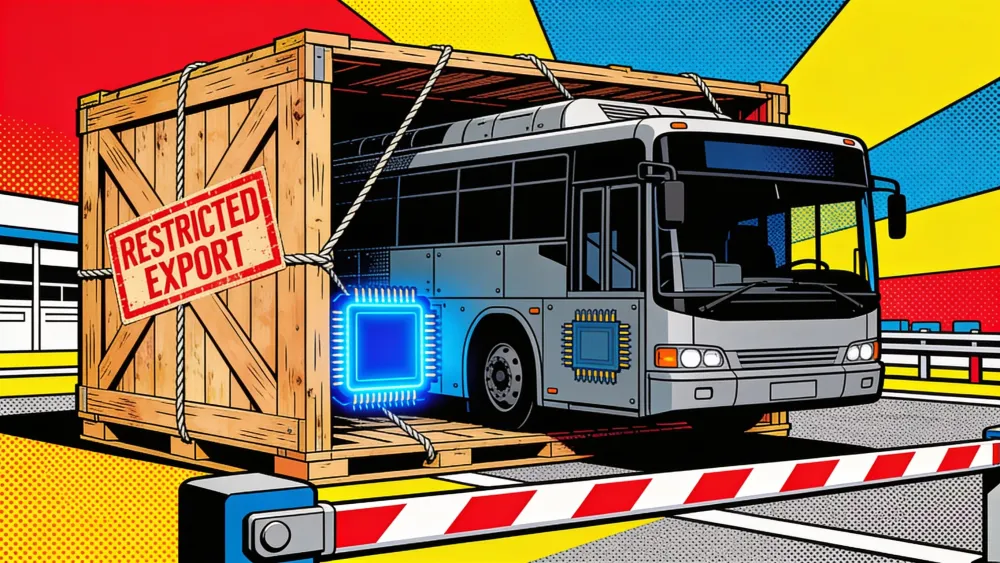
    Senior administration officials told Bloomberg they have evidence ASML is not acting in good faith, including exports to China of specialty gear used to transport EUV machines, but declined repeatedly to produce it, and the Commerce Department did not answer whether it has evidence of an actual EUV system on Chinese soil.

Deep Analysis

The One Chokepoint That Can't Be Routed Around

Extreme ultraviolet (EUV) lithography is the process of using extremely short-wavelength ultraviolet light to etch the finest features onto a silicon wafer, and ASML is the only company on Earth that builds the machines that do it. That single-supplier reality is why this story matters more than a typical export-control spat: there is no second vendor, no gray-market clone, and no domestic substitute that lets China leapfrog to cutting-edge chips. ASML's CEO has previously estimated the US EUV export ban sets China's chipmaking back 10 to 15 years [1], and the lack of EUV access is described as the single toughest constraint facing Huawei, with SMIC forced to lean on multi-patterning DUV (the older, longer-wavelength deep-ultraviolet tools) to approximate a 7nm process [2].

That context reframes the accusation. If even one EUV system reached China, Bloomberg notes it would rank among the biggest known violations of US-led curbs designed to limit Beijing's access to AI that could benefit its military [2]. The stakes are not one machine's worth of output; they are whether the central pillar of the entire containment strategy still holds. That is precisely why the Commerce Department is willing to confront the West's most strategically important hardware company directly.
An Evidence-Free Standoff

The defining feature of this dispute is what is missing: proof. Commerce Secretary Howard Lutnick told ASML's leadership across a series of meetings that he is concerned one of its most advanced machines may have reached China in violation of export controls [3]. Senior administration officials went further, telling Bloomberg they have evidence ASML is not acting in good faith, including exports to China of specialty gear used to transport EUV machines and other components usable in EUV systems, but they declined repeatedly to produce that evidence, citing its sensitivity [4]. The Commerce Department also did not respond to Bloomberg's questions about whether it has evidence of an actual EUV system on Chinese soil [4].

ASML's rebuttal is categorical. The company says it has never shipped an EUV machine to China, nor any component, module or equipment specially designed for use in an EUV machine [5], and CEO Christophe Fouquet says ASML tracks every machine it has ever shipped, each either in active use with monitored customers or dismantled and returned [4]. Around an April 2026 meeting with Lutnick, ASML circulated a Washington document titled 'No indication of any ASML EUV System in China' [6], and publicly called the reports rumors that are inaccurate and damaging to its reputation [6]. The result is a clean claim-versus-denial: one side asserts a violation it won't substantiate, the other asserts an airtight chain of custody. Note the careful hedge in the US framing, which slides between a full machine and merely transport gear or usable components, a much lower and harder-to-disprove bar.

By The Numbers: Why a Hidden EUV Machine Is Physically Implausible

By The Numbers: Why a Hidden EUV Machine Is Physically Implausible
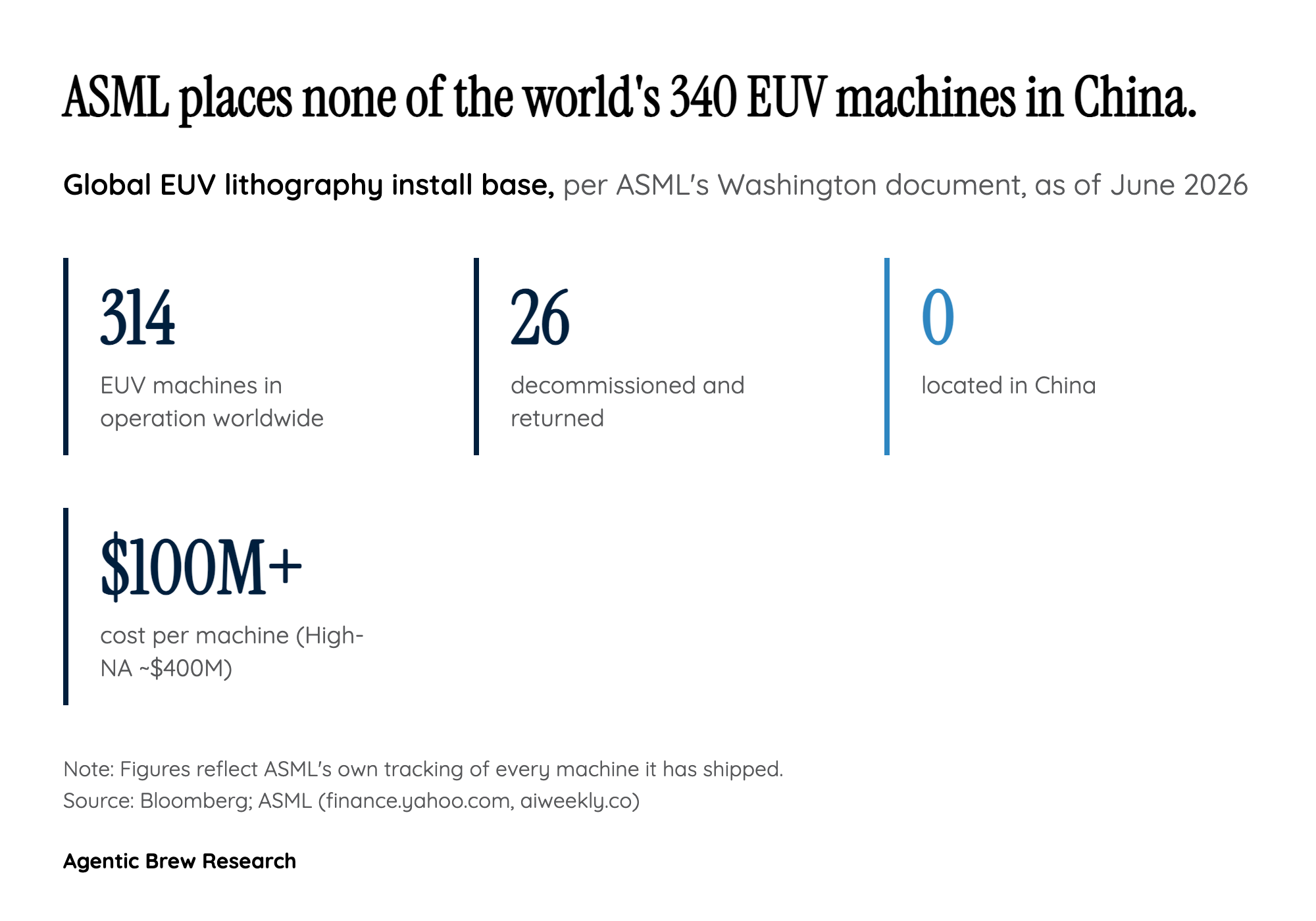
ASML's records place none of the world's 314 operating EUV machines in China.

The physics and logistics are where ASML's denial draws its strength. Per the company's Washington document, there are 314 EUV machines in operation worldwide, 26 decommissioned, and none in China [2]. Each machine weighs roughly 180 metric tons, described as the size of a school bus, which makes a covert physical shipment implausible on its face [2]. The economics reinforce the point: a single EUV system costs over $100 million, with newer High-NA versions closer to $400 million [2]. These are not units that move quietly. Installation and servicing happen only through ASML, and the Netherlands has prohibited EUV exports to China since 2019, a period in which ASML confirms zero EUV machines were shipped to Chinese clients [7].

The counter-effort runs on a separate budget. China is pursuing a domestic build: Shenzhen recruits working on an EUV prototype were reportedly offered signing bonuses of roughly $420,000 to $700,000, and China targets EUV-made chips by 2028, though experts say 2030 is more likely [8]. Set against ASML's previous estimate that the export ban already cost China a 10-to-15-year lag [1], the figures sketch the real contest: not a single smuggled tool, but whether money and talent can rebuild a $100M+, 180-ton machine from scratch faster than the controls can hold.

The Real Long Game Is China's Domestic EUV Push

Whether or not a machine was diverted, the more durable threat to the export-control regime is China's parallel effort to build its own. In December 2025, Reuters reported that a Shenzhen team of former ASML engineers completed an EUV prototype, reverse-engineered from older ASML parts and now undergoing testing [8]. That detail matters because it explains the timing of Washington's scrutiny: the question is no longer purely whether a finished machine slipped across a border, but whether ASML's know-how, components, and transport infrastructure are leaking into an indigenous program.

This is also why the US framing leans on 'components and transport gear' rather than a complete system. A controls regime built to stop one irreplaceable machine is poorly suited to policing the diffusion of expertise and sub-assemblies that a domestic prototype actually needs. The historical arc supports the concern: Dutch controls have steadily tightened, from the 2019 EUV license freeze to the 2024 addition of metrology and software to the restricted list [7]. Skeptics rightly note that a tested prototype is still a long way from high-yield mass production, and that this allegation is about a knowing diversion rather than an accident. But the strategic takeaway holds regardless of how the smuggling claim resolves: the contest has shifted from blocking a single shipment to slowing an entire homegrown supply chain, and that is a far harder line to defend.

Historical Context

2019-01-01
After 2018-2019 meetings in Washington, the first Trump administration convinced the Dutch government not to renew EUV export licenses to China before any EUV machine was shipped there.
2024-12-31
Updated Dutch export controls took effect, adding metrology and software to the restricted list.
2025-12-01
Reuters reported a Shenzhen team of former ASML engineers completed an EUV prototype, reverse-engineered from older ASML parts, now undergoing testing.
2026-04-01
Around an April 2026 meeting with Lutnick, ASML created its response document titled 'No indication of any ASML EUV System in China'.
2026-06-19
Bloomberg reported the US concerns and ASML's denial, making the dispute public.

Power Map

Key Players
Subject

US probes whether China obtained an ASML EUV chip-making machine, ASML denies

AS

ASML

Dutch company holding a monopoly on EUV lithography systems and the subject of the allegation; denies any EUV machine or specially-designed component reached China and says inaccurate rumors are damaging its reputation.

HO

Howard Lutnick

US Commerce Secretary who raised the concerns directly with ASML leadership across a series of meetings, pressing the company over a possible EUV transfer to China.

CH

Christophe Fouquet

ASML CEO who states no EUV system exists or has ever existed in China and that ASML tracks every machine it ships.

CH

China / Huawei / SMIC

Target of EUV export controls; lack of EUV access is described as the toughest constraint facing Huawei, while SMIC relies on multi-patterning DUV to approximate 7nm.

NE

Netherlands government

Has prohibited EUV exports to China since 2019 and extended controls to DUV immersion tools under US pressure; expected to keep facing US pressure on ASML exports.

Fact Check

8 cited
  1. [1] ASML CEO Christophe Fouquet: U.S. EUV export ban causes China's chip-making to lag by 10-15 years
  2. [2] US Tells ASML It's Concerned China May Have Top Chip Tool
  3. [3] US presses ASML over an EUV machine it says may have reached China
  4. [4] The US says ASML's top chip tool may be in China. ASML says it isn't
  5. [5] ASML denies US government report that its EUV chipmaking tool was shipped to China, says rumors are inaccurate and damaging to our reputation
  6. [6] No indication of any ASML EUV System in China
  7. [7] The Export Control Loophole Fueling China's Chip Production
  8. [8] China reportedly has a prototype EUV machine built by ex-ASML employees

Source Articles

Top 5

THE SIGNAL.

Analysts

"Insists no EUV system exists or has ever existed in China and that every machine is tracked, while previously estimating the US EUV export ban sets China's chipmaking back 10-15 years."

Christophe Fouquet
CEO, ASML

"If an EUV system did reach China, it would rank among the biggest known violations of US-led curbs designed to limit Beijing's access to AI that could benefit its military."

Bloomberg analysis
Bloomberg News reporting
The Crowd

"‼️U.S. Commerce Secretary Lutnick is concerned one of ASML's lithography chipmaking machines may have ended up in China. ASML's extreme ultraviolet lithography machines cost around $370 million and take multiple 747s to transport. ASML denies the allegation, saying it has never shipped one."

@@IntCyberDigest521

"The US has outlined concerns to ASML that one of its top chip machines may have made its way into China, violating export curbs"

@@business257

"🇺🇸🇨🇳 US TELLS ASML IT'S WORRIED CHINA MAY HAVE ITS MOST FORBIDDEN MACHINE. Washington thinks an EUV machine may be running in China. The one tool that prints the world's best chips. Banned from China since 2019. ASML says no. Never shipped one. None in the country."

@@cryptogoos142

"The US says ASML's top chip tool may be in China | TechCrunch"

@u/Pipepoi1400
Broadcast
US Tells ASML It's Concerned China May Have Top Chip Tool

US Tells ASML It's Concerned China May Have Top Chip Tool

ASML denies allegations it breached export controls concerning China

ASML denies allegations it breached export controls concerning China

China Tests Advanced EUV Chip Machine Prototype | Former ASML Engineers Involved | WION

China Tests Advanced EUV Chip Machine Prototype | Former ASML Engineers Involved | WION