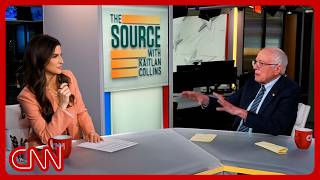
Bernie Sanders' American AI Sovereign Wealth Fund proposal
TECH

Bernie Sanders' American AI Sovereign Wealth Fund proposal

29+
Signals

Strategic Overview

  • 01.
    Sen. Bernie Sanders (I-Vt.) introduced the American AI Sovereign Wealth Fund Act on June 18, 2026, a one-time 50% tax paid in stock that would hand the public a 50% ownership stake in the largest AI companies.
  • 02.
    The tax applies to AI companies with $200 million or more in annual AI gross receipts, and mixed companies must separate their AI from non-AI divisions to isolate the public stake.
  • 03.
    The contributed stock would seed a sovereign wealth fund estimated at roughly $7 trillion, paying an initial 5% annual dividend projected at $1,000-plus per American.
  • 04.
    A 7-member Independent Commission for Democratic AI would manage the fund and use its voting shares to block harmful corporate decisions; the bill targets firms including OpenAI, Anthropic, and xAI.

Deep Analysis

The Real Novelty Is Tax-Paid-in-Stock, Not Cash

What separates Sanders' proposal from a conventional windfall tax is the payment instrument. Rather than collecting cash, the bill imposes a one-time 50% tax that AI companies satisfy by handing over shares, depositing that equity directly into a public sovereign wealth fund [1]. The mechanism sidesteps the obvious objection that frontier labs are cash-poor: OpenAI and Anthropic remain unprofitable, so a cash levy would be hard to pay [2]. Paying in stock instead converts paper valuations into public ownership without touching operating cash.

It also reshapes the relationship from taxpayer-and-treasury to shareholder-and-company: the fund's 7-member Independent Commission for Democratic AI would wield voting shares to block harmful corporate decisions, and mixed companies would have to carve their AI divisions away from non-AI businesses so the public stake attaches only to AI operations [1]. That is governance leverage, not just revenue.

Strange Bedfellows: The Left and the MAGA Right Are Circling the Same Equity Idea

The most surprising feature of this debate is who agrees. Sanders frames the bill as a check on Big Tech oligarchs, but the idea of government taking AI equity already has traction on the right. The Trump administration has been pursuing voluntary, passive stakes in AI firms and is in active talks with OpenAI about one [5], Commerce Secretary Lutnick favors a sovereign wealth fund approach, and Treasury Secretary Bessent wants AI equity to seed Trump Accounts [2]. Steve Bannon went further, arguing the government should force AI firms to give up 50% of their equity [5].

The online reaction underscored the crossover: a prominent right-leaning tech figure, while professing no love for socialism or arbitrary confiscations of wealth, publicly conceded he could see why Sanders' proposal resonates, including with many on the right. The convergence is real but not identical: the Trump-side version is voluntary and passive (no board seats, no voting rights), while Sanders' is mandatory and explicitly activist. The Cato Institute's Tad DeHaven even argues Trump's February 2025 executive order opened the door Sanders is now walking through [3].

By The Numbers: Anatomy of a $7 Trillion Fund

By The Numbers: Anatomy of a $7 Trillion Fund
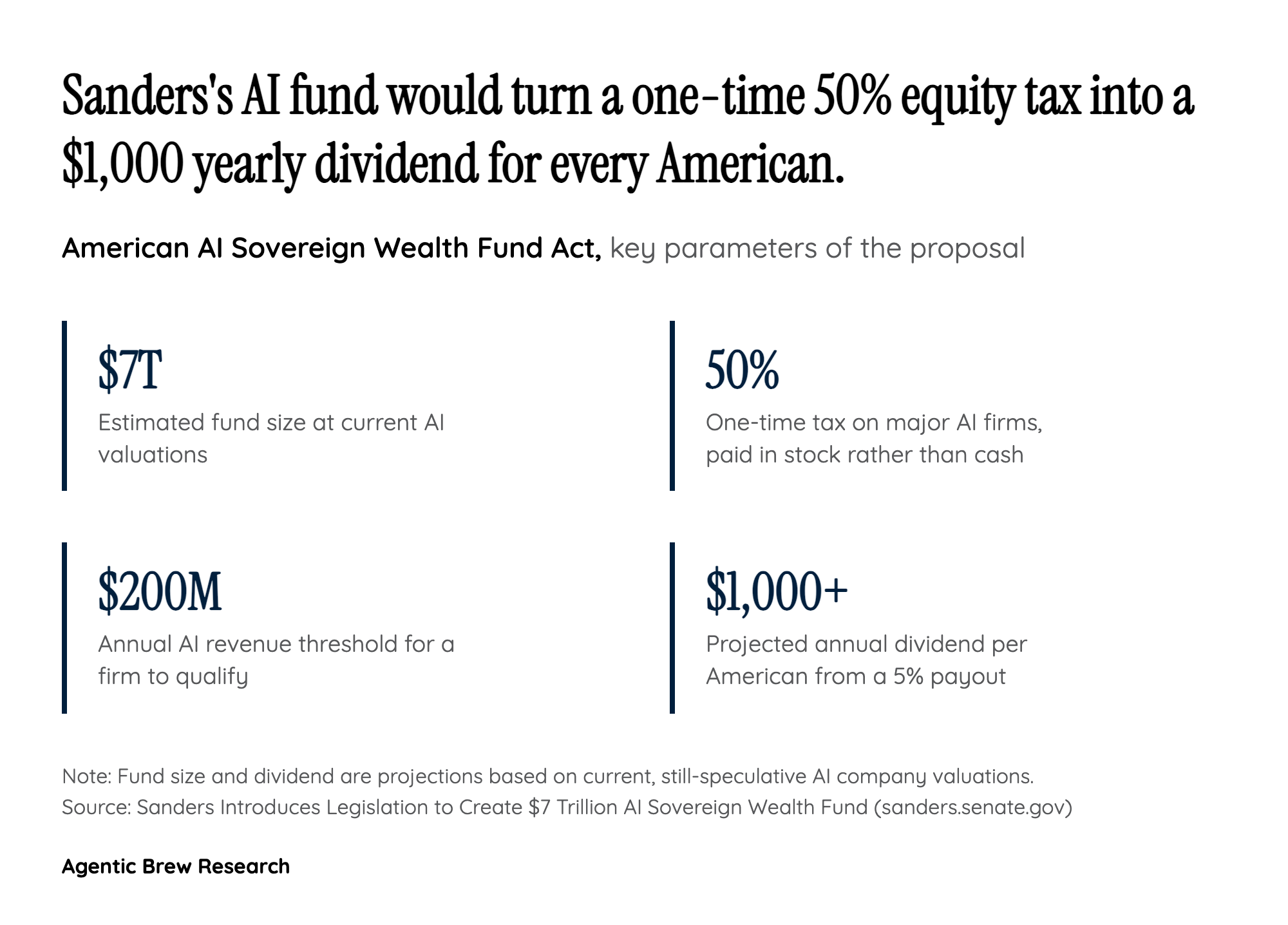
Key parameters of the American AI Sovereign Wealth Fund Act: a $7 trillion fund seeded by a one-time 50% equity tax, projected to pay every American $1,000+ a year.

The proposal's scale is what makes it arresting. The headline figure is a roughly $7 trillion fund at current valuations, seeded by a one-time 50% tax paid in stock and triggered for any AI company with $200 million or more in annual AI gross receipts [1]. From that base the bill projects a 5% initial annual dividend, which Sanders' office translates into more than $1,000 per American per year [1]. The governance layer is a single 7-member Independent Commission for Democratic AI [1].

The math, however, leans on valuations that are still speculative: OpenAI alone is valued above $850 billion and reportedly eyeing an IPO as early as September 2026 [6], while the same firms underpinning the dividend math are not yet profitable [2].

Can It Actually Work? Cash-Poor Firms, Conflicts, and Takings

The objections cluster into three families. First, feasibility: the $1,000 dividend rests on shares of companies that are not yet profitable, so converting equity into a reliable income stream is far from guaranteed [2]. Second, conflict of interest: Cato's Tad DeHaven warns that a government holding equity in firms it also regulates, taxes, and investigates undermines impartial oversight, comparing it to referees in the NBA Finals having a financial stake in the teams on the court [3]. He and the World Socialist Web Site both attack Sanders' Norway analogy from opposite directions, with WSWS noting Norway's fund is invested entirely abroad while its population owns and controls none of it [7].

Third, constitutionality: community debate on Reddit repeatedly raised Fifth Amendment takings concerns about confiscating private equity, a thread that ran alongside arguments over whether the plan amounts to nationalizing frontier labs. Reason's Tosin Akintola adds the innovation objection, arguing AI already benefits ordinary Americans and government control would slow breakthroughs [4].

Historical Context

2025-01
Altman first pitched the equity-donation concept to the Trump administration.
2025-02
Signed an executive order calling for the federal government to establish a U.S. sovereign wealth fund.
2026-04-06
Published a 13-page policy paper, Industrial Policy for the Intelligence Age, proposing a voluntary Public Wealth Fund seeded by AI-company equity donations.
2026-06-18
Introduced the American AI Sovereign Wealth Fund Act in the Senate.

Power Map

Key Players
Subject

Bernie Sanders' American AI Sovereign Wealth Fund proposal

SE

Sen. Bernie Sanders (I-Vt.)

Bill sponsor; frames AI as built on collective human knowledge and seeks public control to counter Big Tech oligarchs.

SA

Sam Altman / OpenAI

Met with Sanders in early June; agrees the public should hold equity in AI companies but cannot support a 50% stake. OpenAI separately published an April 2026 policy paper proposing a voluntary Public Wealth Fund.

TR

Trump administration

Separately pursuing voluntary, passive government equity stakes in AI firms (no board seats or voting rights) and in active talks with OpenAI about a stake.

HO

Howard Lutnick / Scott Bessent

Commerce Sec. Lutnick supports a sovereign wealth fund approach; Treasury Sec. Bessent favors using AI equity to fund Trump Accounts.

ST

Steve Bannon

Tech critic and Trump's former chief strategist; argued the government should force AI firms to give up 50% of their equity for citizens.

Fact Check

7 cited
  1. [1] Sanders Introduces Legislation to Create $7 Trillion AI Sovereign Wealth Fund
  2. [2] Bernie Sanders wants to tax AI companies to pay every American $1,000 a year
  3. [3] Trump Opened the Door to Sanders's Sovereign Wealth Fund
  4. [4] Bernie Sanders' AI Wealth Fund Bill Shows That He Doesn't Understand AI or Wealth
  5. [5] Trump's AI Stake in OpenAI
  6. [6] Trump Administration Negotiates Direct Government Equity Stake in OpenAI
  7. [7] Bernie Sanders proposes AI sovereign wealth fund

Source Articles

Top 5

THE SIGNAL.

Analysts

"Government ownership creates a regulatory conflict of interest; the Norway and Alaska funds are false precedents because they drew on government-owned resources, not confiscated private equity."

Tad DeHaven
Cato Institute

"Argues Sanders misunderstands AI and wealth; AI already benefits ordinary Americans, not just the ultrarich, and government control would slow innovation."

Tosin Akintola
Assistant Editor, Reason

"Contends Sanders' Norway comparison misrepresents that fund, which is invested entirely abroad with the population owning and controlling none of it."

World Socialist Web Site
WSWS analysis
The Crowd

"I will soon be introducing a bill to give the public a 50% ownership stake in the largest AI companies in America. This would guarantee that the trillions created by AI are used to improve the lives of all of us — and block oligarch decisions that harm the American people."

@@BernieSanders29070

"While I'm no fan of socialism or arbitrary confiscations of wealth, I can see why Bernie Sanders' proposal (for the government to take a 50% stake in AI companies) resonates, including with many on the right. The CEOs of the leading AI labs have told us repeatedly that they will..."

@@DavidSacks6387

"AI is built on humanity's collective knowledge. The wealth it generates must benefit humanity — not just Elon Musk, Sam Altman and other AI oligarchs. That's why I'll be introducing the American AI Sovereign Wealth Fund Act — to give the public a direct ownership stake."

@@SenSanders5386

"Bernie finally figured it out! Proposing an AI sovereign wealth fund"

@u/GuidedVessel271
Broadcast
Introducing the American AI Sovereign Wealth Fund Act

Introducing the American AI Sovereign Wealth Fund Act

Why Bernie Sanders wants to force AI companies to share their wealth

Why Bernie Sanders wants to force AI companies to share their wealth

Bernie Sanders Announces Bill To 'Give The Public A Direct Ownership Stake' In US AI Companies

Bernie Sanders Announces Bill To 'Give The Public A Direct Ownership Stake' In US AI Companies