Skepticism of Elon Musk's orbital AI data center vision
TECH

Skepticism of Elon Musk's orbital AI data center vision

23+
Signals

Strategic Overview

  • 01.
    SoftBank founder Masayoshi Son publicly dismissed Elon Musk's plan for orbital AI data centers, arguing the AI race will be won by compute on Earth within the next few years and that electricity is only about 7% of what it costs to run a data center.
  • 02.
    SpaceX filed an FCC application on January 30, 2026 for a constellation of up to one million orbital data center satellites and unveiled the AI1 satellite, with a 120 kW average compute payload and a roughly 70-meter solar wingspan.
  • 03.
    Son is not the only skeptic - OpenAI's Sam Altman has also dismissed the orbital idea, and TechCrunch noted that a constellation needing regular replacement guarantees recurring launch business for SpaceX.
  • 04.
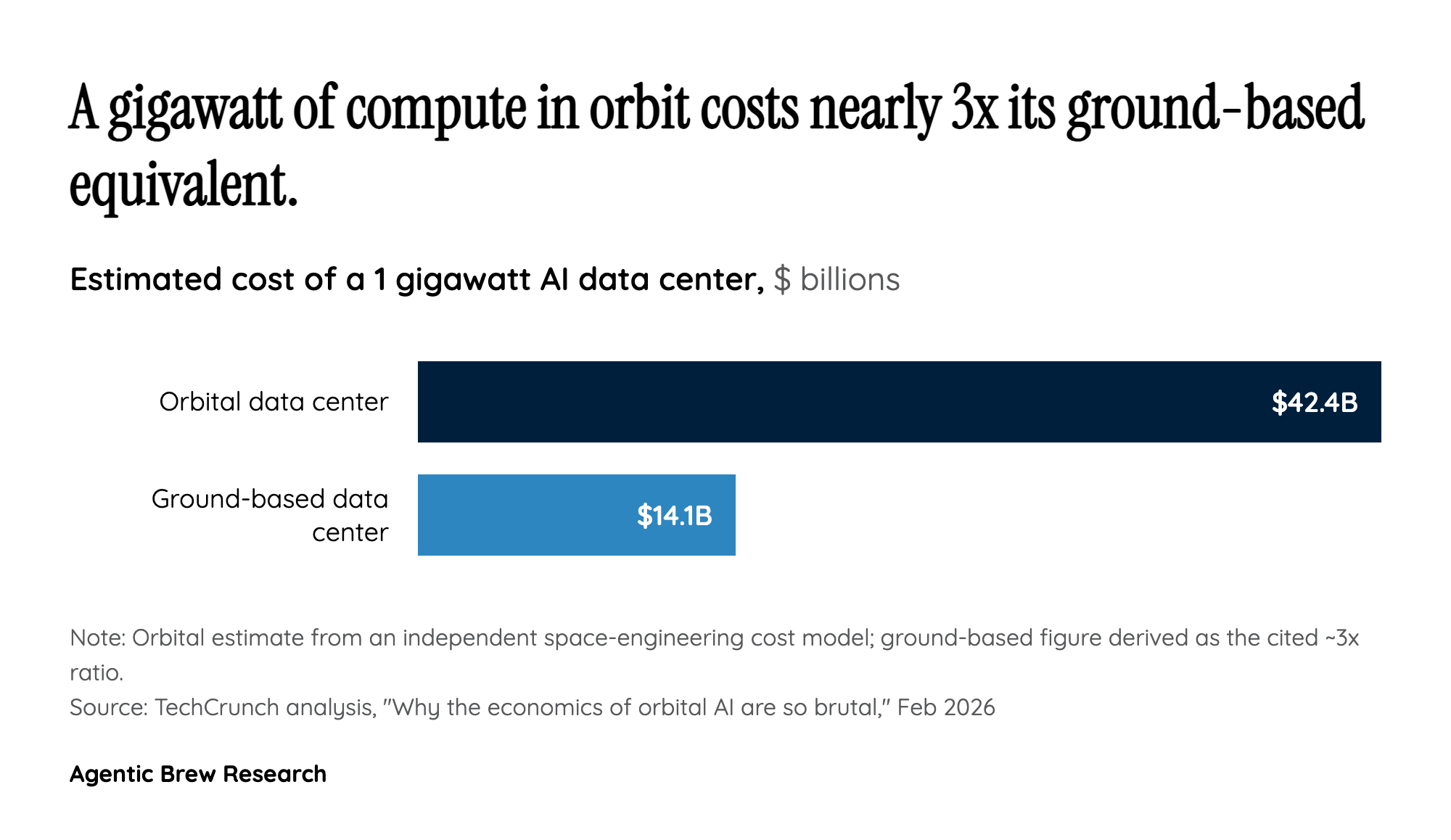
    Independent cost analysis estimated a 1 gigawatt orbital data center at roughly $42.4 billion, nearly three times its ground-based equivalent.

Deep Analysis

The 7% That Sinks the Pitch

Masayoshi Son's objection to orbital data centers is not really about rockets - it is about a spreadsheet. He argues that electricity accounts for only about 7% of what it costs to run an AI data center, with chips, servers, and supporting hardware swallowing the rest [2]. That single number is the whole argument, because orbital data centers sell exactly one core advantage: near-constant solar power harvested off the grid. SpaceX's own FCC filing leans on it directly, framing the satellites as harnessing near-constant solar power with little operating or maintenance cost to achieve transformative cost and energy efficiency [5].

Son's retort reframes the entire debate from "can we build it?" to "why bother?" If power is a thin slice of the bill, then engineering an extraordinary solution to make that slice cheaper is solving the wrong problem - especially when the launch, cooling, and hardware-replacement costs of operating in space dwarf any electricity savings [2]. The pitch's headline benefit, in other words, attacks the smallest line item on the invoice.
Follow the Launches, Not the Logic

A recurring theme among critics is that the orbital vision is suspiciously well-aligned with SpaceX's commercial interests. A constellation whose satellites must be replaced every few years guarantees a steady stream of launch business, and SpaceX has already begun renting compute capacity to companies like Google and Anthropic as an interim revenue stream [1]. As TechCrunch's Anthony Ha put it, there are no objective, impartial observers here - it is all people with baggage and tremendous amounts of money at stake [1].

That cuts both ways, and it is worth saying plainly: Son and Sam Altman are not neutral either. Both are pouring capital into terrestrial AI infrastructure, which gives them their own reasons to talk down a space-based rival [1]. SoftBank has publicly committed to building formidable ground capacity even as its CEO shoots down the orbital plan [6]. On X, the conversation split along exactly these lines: reporting on Son's reservations anchored the skeptic side, while Musk-aligned accounts amplified terawatt-scale projections and the orbital-solar promise far more loudly by engagement - a reminder that the debate is being waged as much on vibes and incentives as on physics.

The Physics Bill Comes Due

The Physics Bill Comes Due
A 1 gigawatt data center in orbit is estimated to cost nearly three times its ground-based equivalent.

Strip away the motives and the engineering numbers are sobering on their own. Independent analysis pegs a 1 gigawatt orbital data center at roughly $42.4 billion, nearly three times its ground-based equivalent, with power costing on the order of $14,700 per kilowatt-year in orbit versus a few hundred to a few thousand dollars on the ground [3]. For the model to pencil out at all, launch costs would have to fall roughly eighteen-fold, from about $3,600 per kilogram today toward $200 per kilogram, a milestone expected only in the 2030s [3].

Then there is heat. In a vacuum there is no air to carry warmth away, so every watt of waste heat must be radiated - and Brookings estimates that properly cooling a single orbital data center could require about 2.15 million square feet of radiators [4]. Radiation degrades solar panels to roughly a five-year service life, and the fastest off-the-shelf inter-satellite laser links top out near 100 gigabits per second, far below what frontier training across thousands of GPUs demands [3]. This is where the technical community is most pointed: on Reddit, the loudest skeptics are people who actually build satellites and data centers, and the central fight is heat rejection in vacuum - though a thoughtful minority insists the cooling challenge is a matter of economics and engineering, not a law-of-physics impossibility.

Why 'Win It On Earth' Is The Sharper Argument

Son's most durable point may be about timing, not cost. He frames the next few years as more decisive than anything a decade out - in his telling, he who strikes first wins the AI race [2]. Even granting that orbital data centers eventually become viable, they take years to design, launch, and scale, which makes them useless for the compute crunch happening right now [1], and their economics only start to close in the 2030s [3]. By then, on Son's logic, the contest is already decided on the ground.

That leaves the orbital vision looking less like a near-term data-center strategy and more like a long-horizon flywheel - one that conveniently keeps SpaceX's launch cadence full and gives investors a galaxy-brained story to buy into. Musk has only widened the gap between pitch and present, extending the roadmap to a lunar mass driver that would fling AI satellites into deep space [7]. Brookings, meanwhile, warns the bigger near-term risk is not technical failure but governance: a regulatory coordination gap, market concentration around a single vertically integrated launch provider, and the prospect of a million satellites cluttering the night sky and crowding orbit [4].

Historical Context

2026-01-30
SpaceX filed an FCC application for up to one million orbital data center satellites, which the Space Bureau accepted for review five days later.
2026-02-11
TechCrunch published an analysis arguing the economics of orbital AI are brutal, citing a roughly $42.4 billion cost for a 1 gigawatt orbital data center.
2026-06
Son dismissed Musk's orbital data center idea, arguing the AI race will be decided on Earth within a few years.
2026-06-27
TechCrunch reported that Son was not alone in questioning the orbital hype, noting Sam Altman's skepticism and the conflicts of interest among all parties.

Power Map

Key Players
Subject

Skepticism of Elon Musk's orbital AI data center vision

MA

Masayoshi Son (SoftBank)

SoftBank's founder and CEO; publicly rejected the orbital plan while committing SoftBank to large terrestrial AI capacity and billions invested in OpenAI, giving him a competing earthbound stake in how the AI buildout plays out.

EL

Elon Musk (SpaceX / xAI)

The orbital data center proponent; a constellation that must be replaced every few years would funnel recurring launch revenue to SpaceX, an incentive critics repeatedly flag.

SA

Sam Altman (OpenAI)

Has publicly dismissed the orbital data center idea while pursuing massive earthbound AI infrastructure, aligning him with Son's terrestrial-first stance.

GO

Google

Reported to be in talks with SpaceX about orbital data centers and a major compute customer; a terrestrial-compute incumbent whose participation would lend the orbital pitch credibility.

Fact Check

7 cited
  1. [1] SoftBank's CEO isn't the only one with questions about Elon Musk's orbital data center hype
  2. [2] SoftBank's Son Says Musk's Orbital Data Centers Miss the Point: Power Is Only 7% of the Cost
  3. [3] Why the economics of orbital AI are so brutal
  4. [4] Orbital data centers' feasibility gap is a governance risk
  5. [5] SpaceX files plans for million-satellite orbital data center constellation
  6. [6] SoftBank CEO Shoots Down Musk's Plan for Orbital Data Centers as SpaceX Stock Falls Back to Earth
  7. [7] SpaceX details its AI1 compute satellite

Source Articles

Top 4

THE SIGNAL.

Analysts

"Argues that even if the technology and costs eventually work, orbital data centers take years to build and so cannot meet immediate AI compute demand, and that none of the loud voices in the debate are impartial."

Anthony Ha
Writer, TechCrunch

"Estimated that a 1 gigawatt orbital data center would cost about $42.4 billion, nearly three times its ground-bound equivalent."

Andrew McCalip
Space engineer

"Warns that orbital data centers face a feasibility gap that is also a governance risk - cooling a single facility could demand about 2.15 million square feet of radiators, and a million-satellite constellation raises greenwashing, night-sky, and space-junk concerns."

Brookings Institution
Public policy research organization
The Crowd

"SoftBank’s Masayoshi Son thinks the math doesn’t support space-based data centers."

@@WSJ113

"Even SoftBank’s Masayoshi Son—no shrinking violet when it comes to wild ideas—has reservations about data centers in outer space, @timkhiggins writes"

@@WSJ80

"ELON MUSK PUT A DEADLINE ON EARTH: “30–36 MONTHS. MARK MY WORDS.” On a podcast, Elon Musk didn’t speculate. He timestamped the future. He said AI cannot scale on Earth the way it can in space. Period. Solar power in orbit is ~5x more effective and radically cheaper."

@@Vivek4real_1205

"Why Orbital Data Centers Are Harder Than Silicon Valley Thinks"

@u/IEEESpectrum1582
Broadcast
Space Data Centers, Musk's Latest Scam

Space Data Centers, Musk's Latest Scam

Why does Elon Musk want to put data centres in space? | The Economist

Why does Elon Musk want to put data centres in space? | The Economist

Elon Musk's Latest Promise Makes No Sense

Elon Musk's Latest Promise Makes No Sense