Anthropic launches Claude Tag, an agentic AI teammate in Slack
TECH

Anthropic launches Claude Tag, an agentic AI teammate in Slack

39+
Signals

Strategic Overview

  • 01.
    Anthropic launched Claude Tag, a Slack-native AI teammate summoned by typing @Claude, in beta for Claude Team and Enterprise customers.
  • 02.
    One shared Claude per channel builds persistent memory from channel history, uses admin-granted tools, and can work asynchronously over hours or days; an optional ambient mode lets it act proactively.
  • 03.
    Claude Tag runs on the Opus 4.8 model, is framed as the multiplayer evolution of Claude Code, and replaces the legacy Claude in Slack app on August 3, 2026.
  • 04.
    Anthropic says 65% of its product team's code is now written by its internal version of Claude Tag, including most of the code that built Claude Tag itself.

Anthropic Just Made Its AI Multiplayer

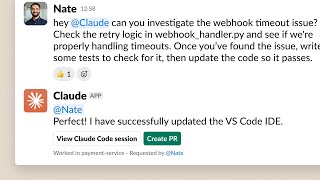
Claude Tag's central move is turning a private assistant into a shared coworker. Where Claude Code, Cowork, and the chat app are single-player by design, one human in one session, Claude Tag puts a single Claude inside a Slack channel that everyone can see and steer [1]. You tag @Claude with a request in plain terms; it breaks the task into stages, works through them using whatever tools the channel grants it, and replies in the thread with what it produced while you focus elsewhere [1].

The design choice that makes this more than a chatbot in a sidebar is that there is one shared Claude per channel rather than a separate session per person. A teammate can pick up a task someone else started without re-explaining the context, and the whole channel can watch and redirect the work in the open. Over time Claude builds persistent memory from the channel's history, so it needs less repeated briefing. And when admins switch on an ambient mode, it stops waiting to be asked, proactively surfacing relevant information from across the org and following up on forgotten threads. Anthropic positions all of this as the multiplayer evolution of Claude Code, running on its Opus 4.8 model [1].
The 65% Number Is the Whole Pitch

The statistic Anthropic keeps repeating is that 65% of its product team's code is now written by the internal version of Claude Tag, including most of the code that built Claude Tag itself [1]. That recursive detail, the tool largely wrote the tool, is doing deliberate work: it converts an abstract capability claim into a proof-by-dogfooding that an enterprise buyer can weigh.

Anthropic's own product lead leans into that reframing. Cat Wu argues the underlying abilities were mostly already there, and that what changed is the interface: 'A lot of the capabilities did exist, but actually the form factor of being able to tag it the same way that you would a coworker is really powerful' [2]. Read that way, Claude Tag is less a new model than a new packaging of an existing one, and the 65% figure is the evidence Anthropic offers that the packaging matters. For buyers wary of training gaps, unclear ROI, and the gap between demo and daily use, 'we shipped most of our own product this way' is a sharper argument than any benchmark.

An Agent With a Service Account, and a Bill

Underneath the coworker metaphor is enterprise plumbing. Claude Tag runs under an organization-level agent identity that admins govern: they decide which channels it joins and which tools, data, and codebases it can use in each one, set token spend limits at the org and channel level, and read audit logs of everything it does, with usage billed to the organization [1].

Those same controls are also the privacy mechanism. For sensitive material, Anthropic's guidance is to DM Claude Tag directly so the information never enters a shared channel where other members could see it [2]. The scoped identities are meant to keep one team's tools, memory, and data from leaking into another's. None of this is glamorous, but it is the part that determines whether a regulated enterprise can actually deploy an always-on agent, and it is why the launch ships with administrative controls rather than just a model. The legacy Claude in Slack app, by contrast, is being retired into this new experience on August 3, 2026 [3].

The Part Reddit Won't Stop Poking At

An always-on agent that reads and remembers messages across a company's channels, and potentially its connected tools, is also a new and concentrated attack surface: persistent cross-channel memory means a compromised instance has far more accumulated context to leak [4]. That is roughly where community skepticism landed. The most-upvoted Reddit thread on the launch was not about productivity at all but about what it means to feed an outside model your company's entire written history, with commenters making the second-order argument that once an AI has absorbed how a company works, the people who taught it become easier to replace.

TechCrunch caught the same unease in its framing that Claude Tag is learning your company one Slack message at a time [5]. On X, by contrast, the reaction skewed the other way: Anthropic's own team and a range of outside builders greeted Claude Tag as a genuinely new form factor for agents rather than an incremental release, with much of the enthusiasm pointed at the same dogfooding story. The tension between those two audiences, builders who see a new way to work and a wider public that sees surveillance, is the real debate the launch opened. Anthropic's answer is scoped identities, DM isolation, and audit logs; the skeptics' rejoinder is that if an agent can absorb a company by reading its channels, the company's moat was never really the code.

Why Now: The Fight for the Channel

Claude Tag is also a land grab for the Slack channel itself, increasingly treated as the contested layer of enterprise AI. Salesforce, which acquired Slack for $27.7 billion, has been positioning it as an agentic operating system, and Claude Tag has to coexist with, and compete against, Salesforce's own Slackbot as well as other workspace agents [6]. By planting a persistent agent identity in the place where work already happens, Anthropic is trying to own the surface rather than be a tab users visit.

The competitive read is reinforced by adoption momentum: Anthropic reportedly edged OpenAI in business uptake, 34.4% versus 32.3% of firms in Ramp's May 2026 index [2]. Whether Claude Tag widens that lead depends less on raw model quality, which rivals can match, than on becoming the default teammate inside the channel before anyone else does. That is why the form factor, not the benchmark, is the strategy.

Historical Context

2021
Salesforce acquired Slack for $27.7 billion, later positioning it as an agentic operating system that Claude Tag now plugs into and competes within.
2026-06-23
Anthropic launched Claude Tag in beta for Claude Team and Enterprise customers, framed as the multiplayer evolution of Claude Code and built on Opus 4.8.
2026-08-03
The legacy Claude in Slack app is scheduled to be retired and switched over to the Claude Tag experience.

Power Map

Key Players
Subject

Anthropic launches Claude Tag, an agentic AI teammate in Slack

AN

Anthropic

Vendor and heaviest internal user of Claude Tag; uses its own 65%-of-code dogfooding as the central adoption argument as it pushes into the enterprise AI collaboration market.

SA

Salesforce / Slack

Platform host and competitor; Salesforce owns Slack and positions it as an agentic operating system, so Claude Tag both rides on Slack and competes with Salesforce's own Slackbot. Slack GM Rob Seaman publicly endorsed the multiplayer framing.

EN

Enterprise and Team admins

Govern which channels Claude joins and which tools, data, and codebases it can use; set token spend limits and read audit logs, bearing data-governance and billing responsibility for an agent that reads and remembers cross-channel messages.

CO

Competing AI assistants (Salesforce Slackbot, OpenAI, and the startup Viktor)

Incumbents and rivals for the in-Slack agent slot; Claude Tag is framed as potentially displacing the traditional Slackbot role and challenging other workspace agents.

Fact Check

6 cited
  1. [1] Introducing Claude Tag
  2. [2] Anthropic launches Claude Tag, a virtual employee tool for Slack
  3. [3] Anthropic announces Claude Tag for Slack
  4. [4] Anthropic Claude Tag Brings AI Teammate Into Slack
  5. [5] Anthropic's Claude Tag is learning your company, one Slack message at a time
  6. [6] Anthropic launches Claude Tag, an agentic AI coworker for Slack

Source Articles

Top 5

THE SIGNAL.

Analysts

"Frames Claude Tag as the multiplayer evolution of single-player Claude Code, and argues the breakthrough is the form factor: 'A lot of the capabilities did exist, but actually the form factor of being able to tag it the same way that you would a coworker is really powerful.'"

Cat Wu
Head of Product for Claude Code and Cowork, Anthropic

"Describes the launch as 'making AI multiplayer. Instead of a private back-and-forth, Claude Tag shows up in the open.'"

Rob Seaman
General Manager, Slack
The Crowd

"Introducing Claude Tag, a new way for teams to work with Claude. In Slack, Claude joins as a team member with access to the channels and tools you choose. Tag Claude in and delegate tasks to it while you focus on other work."

@@claudeai15096

"The Claude Code team has been shipping with Claude Tag internally all year. It now writes 65% of our product team's code, including most of what built Claude Tag itself. Here are a few ways we use it every day:"

@@ClaudeDevs3434

"Claude Tag is an incredible new form factor for agents, so I think it's going to take some time to figure out the best practices, but these are some of my favorites"

@@trq2121379

"Anthropic's Claude Tag is learning your company, one Slack message at a time"

@u/DonkeyFuel34
Broadcast
Tag Claude in, right where you already work

Tag Claude in, right where you already work

Claude Code in Slack

Claude Code in Slack

Claude Code in Slack changes how teams SHIP

Claude Code in Slack changes how teams SHIP