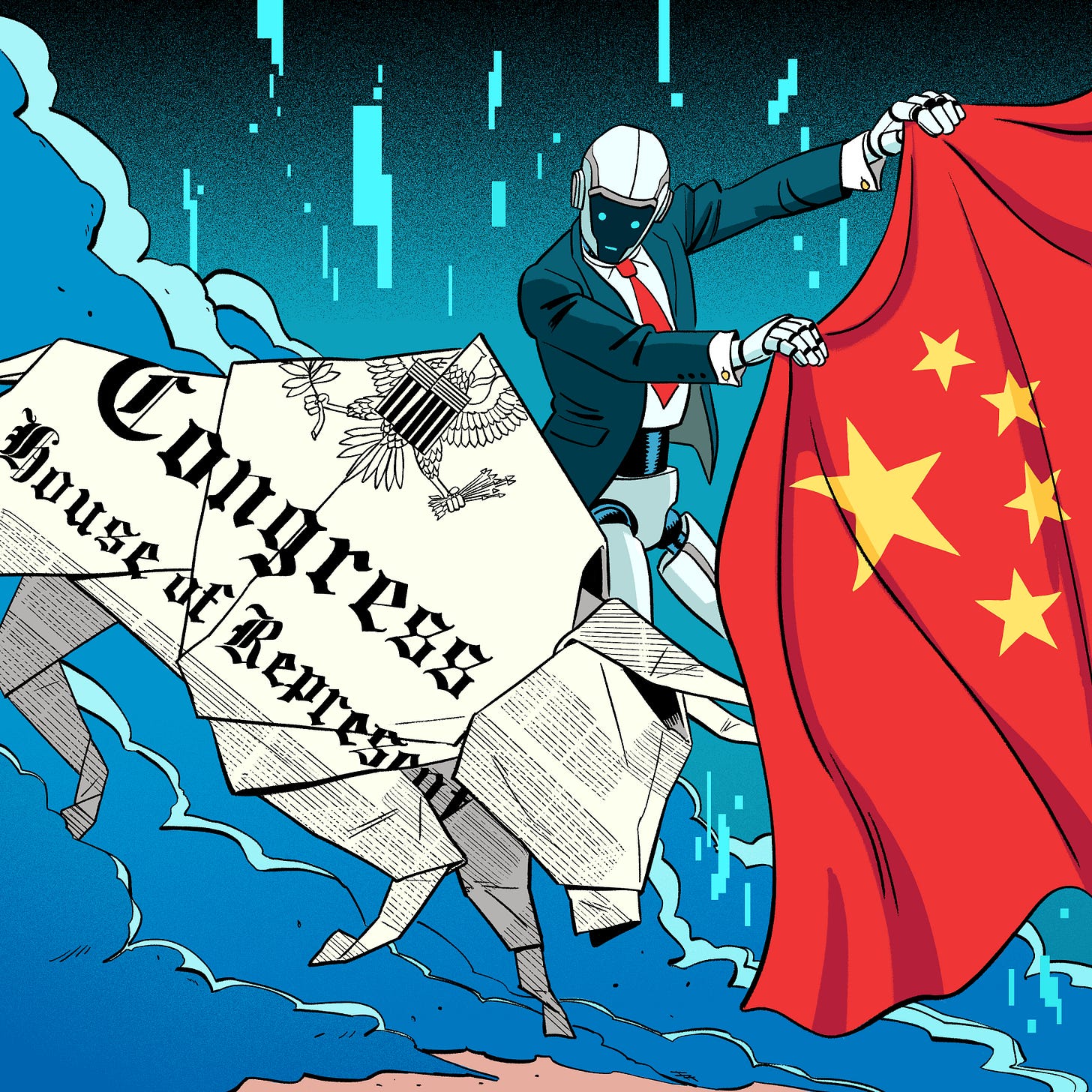
The US-China AI Race Narrative Debate
TECH

The US-China AI Race Narrative Debate

27+
Signals

Strategic Overview

  • 01.
    Moonshot AI released Kimi K3, a 2.8-trillion-parameter open-weight model, on July 16, 2026, timed near the World AI Conference in Shanghai where Xi Jinping spoke about China's open-source AI strategy.
  • 02.
    Transformer News argues Kimi K3 is not at the frontier and doesn't warrant 'losing the AI race' alarm, noting China faces the same incentive as the US to restrict future advanced open-weight models once they pose national-security risks.
  • 03.
    Chinese authorities - the Ministry of Commerce and the National Development and Reform Commission - met with Alibaba, ByteDance, and Z.ai to discuss restricting overseas access to China's advanced AI models and possibly criminalizing AI technology leaks.
  • 04.
    A former Tencent Hunyuan AI lead, now running his own startup, argues China trails the US in large language models but could still win the broader AI race, pointing to a lack of paradigm-shifting innovation as the industry's core weakness.

Deep Analysis

The Race Narrative Is Also a Lobbying Tool

Transformer News' investigation into how the 'China AI race' framing gets used in Washington traces the anxiety back to 2017, when China's State Council set a goal of AI world leadership by 2030 [1]. Since then, American AI companies have found it useful to keep the alarm ringing: invoking China's progress is one of the fastest ways to secure a government contract or wave off a proposed regulation. Marc Andreessen has framed Chinese AI dominance as the single greatest risk facing the West [1], a framing that conveniently doubles as an argument against slowing US AI development with oversight.

The mechanism played out in real time this week. When Kimi K3 landed, the widely-followed X account @DavidSacks called it 'concerning,' arguing the model was scoring near the frontier on coding benchmarks - and used that same post to criticize US regulators and data-center permitting as the bigger threat to American competitiveness. That pairing mirrors exactly the pattern Transformer's reporting describes: cite China's progress first, pivot to a domestic deregulatory ask second. It doesn't make the concern about Kimi K3 insincere. It means the 'race' framing has a second job, as a lobbying instrument, that rarely gets mentioned alongside the benchmark scores.
Beijing Is Building Its Own Iron Curtain - While Still Renting the Bricks

Even as American companies invoke Chinese AI progress to argue against domestic regulation, Beijing has been quietly building its own version of the same wall. Chinese authorities - the Ministry of Commerce and the National Development and Reform Commission - have met with Alibaba, ByteDance, and Z.ai to discuss restricting overseas access to China's advanced AI models, including unreleased ones, and reportedly considered criminalizing AI technology leaks under national security law [2]. Gizmodo has described the emerging posture as a 'Silicon Curtain': not yet fully closed, but increasingly visible in both capitals at once [3].

The contradiction is hard to miss. China's AI rise has depended in part on American systems and training techniques, even as regulators now move to restrict foreign access to what Chinese labs build in return. State support for the underlying hardware has grown alongside the political rhetoric - Beijing's backing for major domestic chip companies rose to roughly $2.8 billion in 2023, up 35% year-over-year [4]- a sign the self-reliance push predates and outlasts any single model release. China isn't just responding to how Kimi K3 was received abroad; it has been building toward tighter control over its own AI exports for a while.

Redefining 'Winning' When the Frontier Model Isn't the Point

Set against that backdrop, the loudest 'China is winning' claims run into a simple problem: even Transformer News, no China skeptic, calls Kimi K3 not at the frontier - full stop, without staking out any claim about how dangerous the model's actual capabilities are [6]. Reddit's reaction split along a similar fault line, with one heavily upvoted thread debating whether Kimi K3 is genuinely competitive with frontier US models or simply cheaper without matching their capability - a distinction that matters more than the headlines suggest, since pricing power, not benchmark leadership, is what much of the US AI industry's valuation actually rests on.

That's close to the argument a former head of Tencent's Hunyuan AI team makes from the other side. Liu Wei, now running his own startup, agrees China trails the US in large language models specifically, but says the benchmark gap is the wrong thing to worry about. His diagnosis is blunter: 'Chinese companies are either copying DeepSeek or US companies at the core technical level' [5]. The real deficit, in his telling, is the absence of paradigm-shifting ('fanshi') innovation - not a scoreboard problem, but a creativity problem. That reframing cuts against both the panic and the reassurance: China may not be losing the race so much as running a different one, on cost and deployment rather than raw capability, while still lacking the kind of original breakthrough that would let it set the pace outright.

Why This Debate Ignited This Week

None of this happened in a vacuum. Moonshot AI released Kimi K3 on July 16, timed to land alongside Xi Jinping's keynote at the World AI Conference in Shanghai, where he doubled down on open-source AI as a pillar of Chinese strategy [6]. Axios also covered the release [7], and Fortune described the launch as sending a jolt through markets already primed to relive the DeepSeek moment [8]. Analyst Patrick Moorhead put it plainly: the reaction looked like an overreaction, structurally similar to the DeepSeek panic, before the dust had even settled [6].

The timing is what turns three separate stories - a lobbying-driven race narrative, Beijing's own export anxieties, and a genuine debate about what 'winning' even measures - into one. Kimi K3 didn't create any of these tensions. It just landed in the one week when all three were already primed to collide: a US industry incentivized to sound alarmed, a Chinese government simultaneously championing openness and restricting it, and a technical debate about whether frontier benchmarks were ever the right yardstick to begin with.

The View From Outside the Op-Eds: Traffic, Chips, and Robots

Outside the op-ed back-and-forth, a Coin Bureau analysis on YouTube points to a harder number: OpenRouter, a real-time aggregator of LLM API traffic, shows Chinese open-weight models now pulling more than half of all routed traffic, up from under 20% a year ago when American models held roughly 72% - a crossover the video dates to February 2026. Its argument is that US export controls backfired, pushing Chinese labs like DeepSeek, Qwen, Kimi/Moonshot, and GLM to optimize hard for cost efficiency instead of chasing frontier benchmarks: DeepSeek's V4 Flash, the video notes, runs at roughly $0.14 per million input tokens versus about $5 for GPT-5.5, a gap of some 36x. It cites real companies, including Coinbase and Pinterest, shifting production traffic to Chinese open-weight models to capture close to 90% cost cuts.

A BBC News panel - Gregory Allen, a former Pentagon AI strategy lead now running Decision Tree Research, and Harvard's Rana Mitter - raises two harder-edged data points in the same debate: a Malaysia customs seizure of roughly $13 million in AI chips allegedly smuggled toward China, and Anthropic's own accusation that Alibaba ran a 25,000-fake-account 'distillation attack' aimed at extracting Claude's capabilities into its own models. A third video, from AI Edge, pushes back on the 'US wins' framing itself, calling it a 'fake scoreboard' that ignores the physical layer underneath AI - electricity, minerals, industrial robots - and pointing to China installing roughly five times as many industrial robots as the US.

None of these data points settle the 'who's winning' question so much as move it: from benchmark scores to infrastructure, chip supply chains, and the unglamorous economics of who actually pays for inference.

Historical Context

2017
Released the 'New Generation AI Development Plan' setting a goal of Chinese AI world leadership by 2030 - the origin point Transformer News cites for American fears of an AI race.
2026-05-08
Published an investigation into how American AI companies promote the 'race with China' narrative to secure contracts and resist regulatory oversight.
2026-05-22
Published Liu Wei's argument that China trails in the LLM race but can still win the broader AI competition.
2026-07-07
Analyzed Beijing's growing 'Silicon Curtain' strategy and its underlying dependence on American chips and training techniques.
2026-07-12
Met with Alibaba, ByteDance, and Z.ai to discuss restricting overseas access to advanced Chinese AI models.
2026-07-16
Released the 2.8-trillion-parameter Kimi K3 model, coinciding with Xi Jinping's World AI Conference speech on open-source strategy.
2026-07-17
Published 'Kimi K3 Is No Reason for China Panic,' pushing back on the alarmist reaction to the release.

Power Map

Key Players
Subject

The US-China AI Race Narrative Debate

MO

Moonshot AI

Chinese lab whose release of the 2.8-trillion-parameter Kimi K3 model reignited the 'losing the AI race' narrative, echoing the earlier DeepSeek shock.

CH

Chinese Ministry of Commerce and National Development and Reform Commission

Met with Alibaba, ByteDance, and Z.ai to weigh restricting overseas access to advanced Chinese AI models, signaling a shift toward treating AI as a controlled national asset.

LI

Liu Wei (CEO, Video Rebirth; former head of Tencent's Hunyuan AI team)

A voice arguing China's LLM gap with the US is real but not decisive, reframing what 'winning' the AI race actually requires.

US

US AI industry lobby (e.g. Marc Andreessen, Alexandr Wang)

Promotes the 'China AI dominance' framing in Washington to secure government contracts and resist regulatory oversight, per Transformer News' investigation.

XI

Xi Jinping

Used the World AI Conference in Shanghai to double down on China's open-source AI strategy, positioning Beijing as a collaborative global AI partner even as regulators moved toward restricting model exports.

Fact Check

8 cited
  1. [1] The US-China AI Race Narrative: How Lobbying Shaped Policy from Biden to Trump
  2. [2] China weighs curbs on advanced AI model exports amid national security push
  3. [3] China Built Cheap AI. Now It's Building a Great Wall Around It.
  4. [4] China's Drive Toward Self-Reliance in Artificial Intelligence Chips and Large Language Models
  5. [5] China is losing the LLM race, but it can still win AI, ex-Tencent AI lead says
  6. [6] Kimi K3 Is No Reason for China Panic
  7. [7] Axios coverage of Kimi K3's open-source release
  8. [8] Moonshot's Kimi K3 sends a jolt through China AI markets

Source Articles

Top 3

THE SIGNAL.

Analysts

"Kimi K3's release doesn't warrant China panic because the model isn't at the frontier, and China will face the same national-security pressure to restrict advanced open-weight models that the US does: 'once capabilities threaten national security, even the most deregulatory governments suddenly change their tune.'"

Shakeel Hashim, Veronica Irwin, and Celia Ford
Transformer News

"China's LLM gap with the US is real, but the deeper weakness is the absence of original, paradigm-shifting ('fanshi') breakthroughs, not raw benchmark scores: 'Chinese companies are either copying DeepSeek or US companies at the core technical level.'"

Liu Wei
Founder/CEO, Video Rebirth; former head of Tencent's Hunyuan AI team

"The 'China AI race' framing is deployed instrumentally in Washington to fast-track policy initiatives: 'There's an open secret in DC: attach the word China to anything and you can get it done.'"

Samm Sacks
Fellow, New America

"Promoted the framing that Chinese global AI dominance is 'the single greatest risk of AI,' a claim Transformer News cites as evidence of self-interested narrative-building by tech executives."

Marc Andreessen
Venture capitalist / AI industry figure

"Frames Beijing's push for AI self-reliance alongside new restrictions on foreign access to its own models as an emerging 'Silicon Curtain,' even though China's AI progress still leans on American-derived chips and techniques."

Webb Wright
Gizmodo
The Crowd

"This is concerning. For the first time, a Chinese model Kimi K3 has taken #1 on the Frontend Code Arena and is scoring at or near the frontier on other benchmarks. Meanwhile America is tying itself in knots: politicians and bureaucrats are banning new data centers, piling on..."

@@DavidSacks13404

"China just torched the U.S. AI lead in a single afternoon. Moonshot AI, a little-known Beijing startup, dropped Kimi K3 on Thursday and it instantly kicked into the top tier of global models. It beat Anthropic's Fable 5 and OpenAI's GPT-5.6 Sol on coding tests, then edged..."

@@MarioNawfal1096

"US hyperscalers will spend close to a trillion dollars on AI infrastructure by 2027. China's four biggest players will spend about an eighth of that. Nobody serious thinks China is losing the AI race because of it. The market keeps pricing capex as if spending more is the moat."

@@ansujeet0

"China just erased America's AI lead | Axios"

@u/Nunki08386
Broadcast
Can China cheat its way to AI supremacy? | BBC News

Can China cheat its way to AI supremacy? | BBC News

China Is Quietly Winning The AI Race (U.S. Is F*cked)

China Is Quietly Winning The AI Race (U.S. Is F*cked)

China Is Quietly Winning the AI Race

China Is Quietly Winning the AI Race