SpaceX unveils AI1, its first orbital AI data center satellite
TECH

SpaceX unveils AI1, its first orbital AI data center satellite

35+
Signals

Strategic Overview

  • 01.
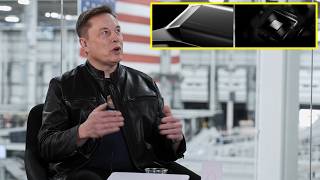
    SpaceX unveiled AI1, its first-generation orbital AI data center satellite, on June 8, 2026, days ahead of its planned IPO, with Musk describing it as essentially solar cells, a radiator, and laser links — simpler than a Starlink satellite.
  • 02.
    AI1 carries a 150 kW solar array, a roughly 110-square-metre deployable liquid radiator, and a ~70-metre wingspan when fully deployed, with a 150 kW peak compute payload sustaining 120 kW average compute power.
  • 03.
    Early reference designs use Nvidia GB300 and upcoming Rubin chips, but AI1 uses an interchangeable compute-provider design not locked to a single chipmaker.
  • 04.
    Musk laid out a roadmap to scale space-based AI compute from 1 GW (annualized, by end of 2027) toward 100 GW and ultimately a terawatt of compute in orbit, with SpaceX having filed an FCC application for up to one million data-center satellites.

Deep Analysis

A Rack of Compute, Wrapped in a Radiator

Musk's framing of AI1 as 'a rack of compute in space' is more literal than it sounds. The satellite is, in his telling, simpler than a Starlink unit — mostly solar cells, a deployable radiator, laser links to talk to other satellites and the ground, and the GPUs themselves [1]. The reported specs are concrete: a 150 kW solar array, a roughly 110-square-metre liquid radiator, a ~70-metre wingspan when deployed, and a 150 kW peak compute payload that sustains 120 kW on average [1]. SpaceNews put the per-satellite power figure near 100 kW with a radiator around 100 square metres, and noted future versions could reach a megawatt [2]. Crucially, the compute provider is interchangeable: Nvidia GB300 and the upcoming Rubin generation are the reference designs, but the architecture is not locked to one chipmaker [1].

The non-obvious point is that power is not the binding constraint — heat is. In a vacuum there is no air to carry warmth away, so every watt a GPU burns must be radiated as infrared. That is why the radiator, not the solar array, dominates the satellite's silhouette. The World Economic Forum's analysis of the physics estimates that a 1 MW orbital data center would need roughly 1,600 square metres of radiator — about the footprint of a hockey rink — which is exactly why early designs cap out in the megawatt range rather than the gigawatt scale of a terrestrial campus [3]. Radiative cooling does have one lever in its favor: heat rejection rises with the fourth power of temperature, so running chips hotter shrinks the radiator dramatically. That trade — durable, high-temperature silicon versus radiator mass — is the real engineering fight, and Musk addressed the skepticism head-on, saying 'for some reason there's been a bizarre debate about radiators in space' [2].

An IPO Pitch at Terawatt Scale

The timing is not incidental. AI1 was revealed just days before SpaceX's planned IPO, positioning orbital AI compute as the growth story behind a roughly $1.77 trillion target valuation — though NYU's Aswath Damodaran pegs the company's intrinsic worth nearer $1.3 trillion [1][4]. The roadmap is deliberately enormous: 1 GW of annualized space AI compute by the end of 2027, scaling toward 100 GW and ultimately a terawatt of compute in orbit [1][2]. The economic thesis Musk keeps returning to is an inversion of conventional wisdom — that 'increasing power on Earth becomes harder over time and more expensive over time, but in space it becomes actually cheaper and easier over time' [2].

What makes the pitch coherent rather than fantastical is that SpaceX controls the two scarcest inputs. Reusable Starship launches are the cost lever — Musk expects the vehicle to eventually fly more than once per hour, driving down per-kilogram launch cost [1]. The second lever is silicon: the entire program is gated on building Terafab, the chip fab targeting one terawatt of processors annually, and Musk has been blunt that without it there are simply no chips for the satellites [2]. That dependency is the quiet headline. A constellation of up to a million satellites [2]is meaningless without a vertically integrated supply of GPUs, which means the orbital-compute bet is really a bet on SpaceX, Tesla, and xAI executing a fab buildout in parallel with a launch cadence no company has ever sustained.

The Numbers the Hype Skips

The Numbers the Hype Skips
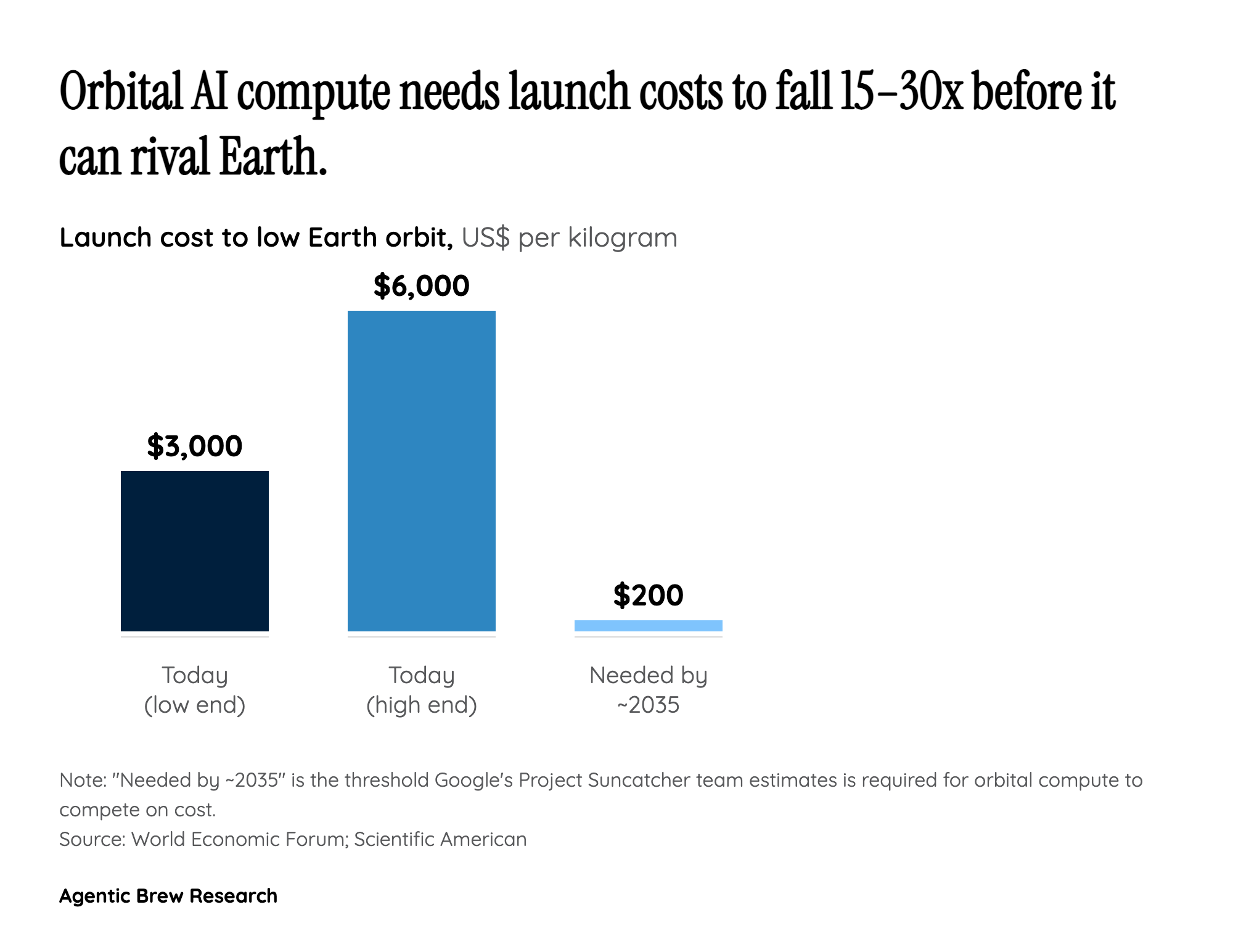
Launch cost per kilogram to low Earth orbit must fall 15-30x for orbital compute to compete with Earth-based data centers.

Strip away the keynote and the case gets harder. Google's own Project Suncatcher team estimates launch costs must fall below roughly $200 per kilogram by around 2035 for orbital compute to pencil out, against roughly $3,000 to $6,000 per kilogram today — a fifteen-to-thirty-fold reduction that no rocket has yet demonstrated [3][5]. The University of Pennsylvania's Benjamin Lee adds that even with reusable rockets, 'we would still require a very large number of launches to build orbital data centers that are competitive with those on Earth,' on top of the mass penalty from radiation shielding and radiators [5]. The environmental ledger may be worse than the marketing implies: Saarland University's Andreas Schmidt argues a solar-powered orbital data center 'could still create an order of magnitude greater emissions than a data center on Earth' once launch and reentry are counted, and astronomer Samantha Lawler warns the reentry pollution and debris problem is already acute [5].

That tension plays out vividly in the community reaction, which has split along feasibility lines rather than fandom. On Reddit, skeptical and at times hostile threads — concentrated on r/singularity and r/technology — frame the reveal as IPO theater and fixate on whether GPU heat can really be dumped in a vacuum, while more receptive voices on r/accelerate and r/SpaceXLounge defend the design on engineering grounds, pointing to T^4 radiative scaling and hotter-running chips. The most-debated single question is cooling, with disposability close behind: each satellite is roughly one rack of GPUs, non-serviceable, and written off as silicon ages every couple of years — though defenders counter that ground GPUs are also retired after about five years. On X, by contrast, the spec reveal landed as near-uniform hype, with the interchangeable-compute design and 'simpler than Starlink' framing drawing the most attention. The gap between an enthusiastic X timeline and a divided Reddit is itself the signal: the dispute is no longer whether it's cool, but whether the physics and the money actually close.

SpaceX Isn't the Only One Trying to Move the Cloud Off-World

AI1 lands in an already-crowded race, which is what makes it strategically interesting rather than merely flashy. Starcloud — formerly Lumen Orbit — launched Starcloud-1 carrying an Nvidia H100 in late 2025, later ran Google's Gemini and trained a small GPT model in orbit, raised a $170M Series A at a $1.1B valuation in March 2026, and has filed for up to 88,000 satellites [6][7][8]. Google's Project Suncatcher, announced in November 2025, takes a TPU-based approach with two prototype satellites targeted for early 2027 [6]. Lonestar Data Holdings put its first two data-center nodes in low Earth orbit in January 2026, aimed at disaster recovery [9]. The orbital data center is no longer a single company's moonshot; it is a category with at least four serious entrants.

SpaceX's differentiator is structural. It is the only entrant that owns its own ride to orbit, which collapses the launch-cost variable that everyone else has to buy on the open market — and that vertical integration extends to chips via Terafab. The community-noted edge is radiation-hardened hardware and operational experience at constellation scale, where SpaceX's Starlink track record is unmatched. The interchangeable-compute design also keeps a door open: AI1 is built to host off-the-shelf Nvidia GPUs and TPUs alike, which leaves room for a future Google partnership even as the two compete. The second-order question is what this does to terrestrial hyperscalers. If orbital compute even partially works at gigawatt scale, the companies pouring tens of billions into ground-based AI campuses are suddenly competing with an infrastructure layer whose marginal cost curve points the opposite direction — and the firm best positioned to build it is the one about to go public on exactly that promise.

Historical Context

2025-11
Launched Starcloud-1 carrying an Nvidia H100 GPU, later running Google's Gemini and training a nano-GPT model in orbit.
2025-11
Announced Project Suncatcher, a moonshot to put solar-powered TPU data centers in orbit, with two prototype satellites targeted for early 2027.
2026-01
Launched its first two data-center nodes to low Earth orbit, targeting disaster-recovery use cases.
2026-01
Filed an FCC application for a constellation of up to one million data-center satellites.
2026-02
Submitted an FCC proposal for a constellation of up to 88,000 orbital data-center satellites.
2026-03-30
Raised a $170M Series A at a $1.1B valuation to build space-based data centers.

Power Map

Key Players
Subject

SpaceX unveils AI1, its first orbital AI data center satellite

SP

SpaceX

Builds and launches AI1 and the planned constellation, filed an FCC application for up to one million data-center satellites, and ties the orbital-compute program directly to its IPO narrative.

EL

Elon Musk

SpaceX CEO who presented AI1 as a 'rack of compute in space', set the 1 GW (end of 2027) and long-term terawatt targets, and argues space power scales cheaper over time while Earth power gets more expensive.

NV

Nvidia

Chip supplier whose GB300 and Rubin GPUs are the early reference compute payload for AI1, giving it a stake in whichever orbital-compute architecture wins.

TE

Tesla / xAI (Terafab)

Terafab chip-fab venture intended to secure the silicon supply chain; Musk says without it there are no chips for the satellites, making it the program's hard dependency.

ST

Starcloud (formerly Lumen Orbit)

Direct competitor that launched Starcloud-1 with an Nvidia H100 in late 2025, reached a $1.1B valuation on a $170M Series A, and filed for up to 88,000 satellites.

GO

Google (Project Suncatcher)

Competitor that announced in November 2025 a solar-powered orbital data center using TPUs, with two prototype satellites planned by early 2027.

Fact Check

9 cited
  1. [1] Inside SpaceX's AI1 Satellite That Musk Calls a Rack of Compute in Space
  2. [2] SpaceX offers details on orbital data center satellites
  3. [3] Why cooling is the biggest challenge for space data centres
  4. [4] What SpaceX is really worth, according to Wall Street's valuation dean
  5. [5] Data Centers in Space
  6. [6] Space data centers: Starcloud, SpaceX and Project Suncatcher explained
  7. [7] Starcloud raises $170 million Series A to build data centers in space
  8. [8] Nvidia-backed Starcloud trains first AI model in space
  9. [9] Orbital Data Center Nodes Launch: Space Computing Infrastructure

Source Articles

Top 5

THE SIGNAL.

Analysts

"Orbital compute needs radiation protection and large heat-rejecting radiators that add significant mass, and even with falling launch costs, 'we would still require a very large number of launches to build orbital data centers that are competitive with those on Earth.'"

Benjamin Lee
Computer architect, University of Pennsylvania

"Warns that 'an orbital data center powered by solar energy could still create an order of magnitude greater emissions than a data center on Earth,' once rocket launch and reentry emissions are counted."

Andreas Schmidt
Computer scientist, Saarland University

"Cautions that mass satellite reentries compound an existing problem: 'There's so much pollution from reentries already and pieces hitting the ground.'"

Samantha Lawler
Astronomer, University of Regina
The Crowd

"SpaceX has just officially unveiled its AI1 satellite, the first generation of its AI satellite. Overall Specs: • 150 kW peak compute payload • 120 kW average compute payload • 70 kW per ton • Compute provider interchangeable Dimensions: • Wingspan: 70 meters • Deployed"

@@SawyerMerritt12335

"Here's what SpaceX's AI1 satellite design looks like A massive orbital compute platform with a 70-meter wingspan, 20-meter deployed height, centralized compute, deployable liquid radiators, and a 150 kW solar array The specs are insane: • 150 kW peak compute payload •"

@@XFreeze321

"For the very first time Elon Musk explains the "space data center plan" of @SpaceX in detail and its AI1 orbital AI data center satellite - and suddenly it looks so much closer than I thought. He says "There's not some magic necessary that doesn't exist for AI satellites. As"

@@rohanpaul_ai73

"SpaceX has just revealed it's first AI satellite design"

@u/truecakesnake521
Broadcast
Elon Musk's Technical SpaceX Update: Manufacture, Launch, and Operate AI satellites at scale

Elon Musk's Technical SpaceX Update: Manufacture, Launch, and Operate AI satellites at scale

SPACEX IPO: ELON'S NEW AI SATELLITE DESIGN

SPACEX IPO: ELON'S NEW AI SATELLITE DESIGN

Elon Musk Unveils AI1 Satellite for Orbital AI Compute

Elon Musk Unveils AI1 Satellite for Orbital AI Compute