OpenAI launches Rosalind Biodefense with GPT-Rosalind
TECH

OpenAI launches Rosalind Biodefense with GPT-Rosalind

30+
Signals

Strategic Overview

  • 01.
    OpenAI launched Rosalind Biodefense on May 29, 2026, sponsoring access to its frontier life sciences model GPT-Rosalind for trusted developers and vetted U.S. government and allied partners working on pandemic preparedness.
  • 02.
    Initial partner stack spans Lawrence Livermore National Laboratory, Johns Hopkins Applied Physics Laboratory, CEPI, and Fourth Eon Biosecurity, with use cases including epidemiological modeling, early detection, medical countermeasure development, and DNA-order screening.
  • 03.
    OpenAI briefed the White House and several federal agencies on its approach before announcing the program publicly.
  • 04.
    GPT-Rosalind — named after DNA structure pioneer Rosalind Franklin — was originally released on April 16, 2026 as a frontier reasoning model tuned for biology, genomics, and drug discovery, with reported performance above the 95th percentile of human experts on prediction tasks.

Deep Analysis

Not a Product Launch — a Channel Decision

Rosalind Biodefense is best understood not as a new model release but as a distribution channel for one. The model — GPT-Rosalind — already shipped on April 16, 2026 to commercial life-sciences partners including Amgen, Moderna, Novo Nordisk, the Allen Institute, and Thermo Fisher Scientific [1]. What's new on May 29 is the legal and policy scaffolding: OpenAI will now sponsor access to GPT-Rosalind and "provide launch support to trusted developers building frontier biosecurity applications" across epidemiological modeling, early detection, screening, and non-pharmaceutical interventions [2].

The partner list signals the intended shape of that channel. Lawrence Livermore National Laboratory anchors the federal national-security end. Johns Hopkins APL plugs the model into a protein-engineering platform for mutant-enzyme screening and biothreat characterization. CEPI brings the global vaccine-acceleration mandate via its 100 Days Mission. Fourth Eon Biosecurity and SecureDNA target the DNA-synthesis chokepoint — using the model to spot dangerous sequence orders before they reach a benchtop [2]. None of these are commercial pharma; all of them sit upstream of, or adjacent to, government biodefense missions. OpenAI also disclosed it briefed the White House and several federal agencies before announcing the program [3].

The interesting move is whom OpenAI is keeping out. Eligibility is officially open to "academic, nonprofit, government-affiliated, and small-to-midsized teams with clear public benefit goals" [4]. That is a deliberately permissive description on paper, but the discretionary verb is "sponsor" — OpenAI alone decides who clears the threshold. The company has built a club, paid for the cover charge, and reserved the right to revoke the membership.

The Dual-Use Tightrope OpenAI Built for Itself

The hardest question Rosalind Biodefense raises is one OpenAI has already answered about itself. In July 2025, the company classified ChatGPT agent as "highly capable" on the biological portion of its Preparedness Framework — a tier reserved for capabilities that "significantly increase existing risks for severe harm" [5]. Pre-deployment testing in 2025 could not rule out that frontier models could meaningfully help novices develop biological weapons. The Rosalind program is the operational answer: if the floor is rising, push frontier capability to defenders first, sponsor their access, and gate the model with vetting.

That thesis collides with two real-world signals. Over 100 reputed scientists have called for tighter controls on sensitive biological data, citing dual-use concerns around models that can redesign biological structures [6]. And on the launch-day discussion threads for the program, the most-upvoted reply was the single-sentence question "Cant this also be used to do offense?" — met by the program designer's bet that university and lab access is screenable, but immediately challenged by skeptics who don't believe academic access is fully secure. The community read here matters: the dual-use objection isn't a fringe take, it's the first-order reaction.

OpenAI's hedge is the gene-synthesis layer. Fourth Eon and SecureDNA aren't using GPT-Rosalind to make biology faster — they're using it to detect dangerous orders before synthesis [4]. If that workstream lands, the bet is that defensive uplift at the manufacturing chokepoint outweighs offensive uplift at the design layer. It is a real bet, with a real adversarial test embedded in it, and the timing of the White House briefing suggests OpenAI knows the policy answer hinges on whether that detection layer holds.

The $45M Down Payment Behind the Announcement

The $45M Down Payment Behind the Announcement
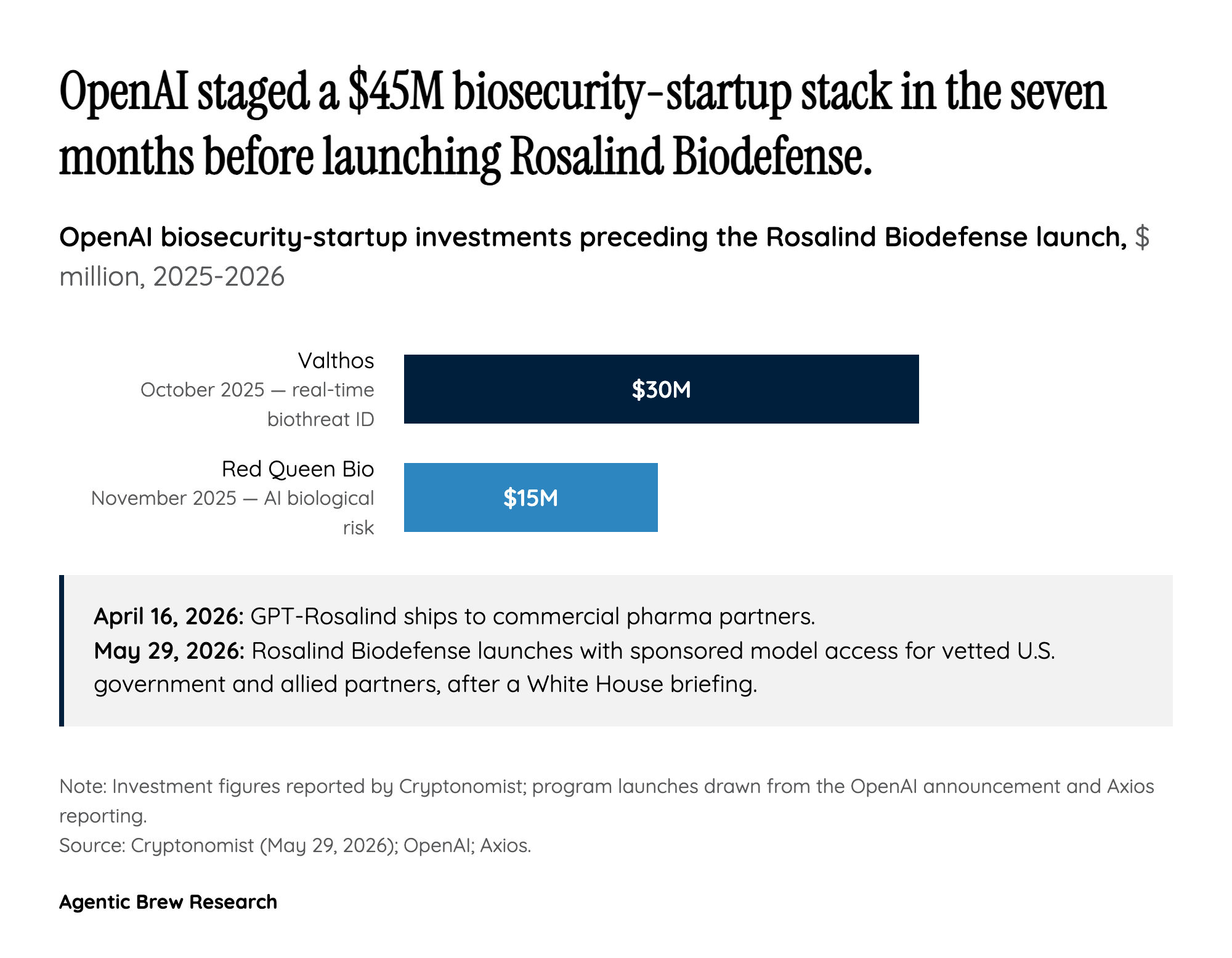
OpenAI staged a $45M biosecurity-startup stack — $30M into Valthos (Oct 2025) and $15M into Red Queen Bio (Nov 2025) — in the seven months before launching Rosalind Biodefense.

Rosalind Biodefense did not appear in a vacuum. In the seven months before launch, OpenAI moved roughly $45M into biosecurity startups: $30M into Valthos for real-time biological threat identification in October 2025, and $15M into Red Queen Bio for AI-related biological risk in November 2025 [7]. Read end-to-end, the sequence is investment first, model second, distribution program third — a deliberate vertical stack rather than an opportunistic announcement.

The market frame explains the urgency. McKinsey-cited estimates put AI value for the pharma and medtech sectors at $60-110 billion per year [6], and the Futurum Group has been describing domain-specific models like GPT-Rosalind as "AI's next competitive battleground after general-purpose chat" [6]. OpenAI's own framing — that "general-purpose models — even GPT-5 class systems — are not enough for serious biological research" [6]— is the strategic confession underneath: chat saturation forces the company into verticals, and life sciences is the largest verifiable value pool with the cleanest defensibility story.

The biodefense framing also delivers regulatory cover. By foregrounding pandemic preparedness, gene-synthesis screening, and a national-lab partner stack, OpenAI gets to make its vertical entry from a position the White House can publicly endorse — a posture that drug discovery alone, with its $60-110B prize, would never have justified. Companies working at the intersection of advanced AI and life sciences are likely to face tougher scrutiny [7]; Rosalind Biodefense is OpenAI's attempt to set the terms of that scrutiny rather than receive them.

Named for an Open-Access Pioneer, Shipped Closed

The naming choice has become the dominant ironic reading in the developer community. GPT-Rosalind takes its name from Rosalind Franklin, whose X-ray crystallography work was essential to understanding DNA, RNA, and viral structures — and whose intellectual legacy is tied up with disputes over credit, openness, and gatekept access to data [8]. The launch threads in r/singularity ran heavy on the contradiction: a closed, gatekept frontier model, distributed by a company whose name still includes the word "Open," named after a scientist whose contributions were partially stolen and whose era is now remembered for its data-sharing failures.

The deeper community split is between two reactions to that contradiction. In r/accelerate, the thread pivoted quickly to Longevity Escape Velocity — the optimistic frame in which a vertical bio model is exactly what's needed to compress the 10-15 year target-to-drug timeline OpenAI says GPT-Rosalind is built to attack. In r/singularity, the dominant takes were skeptical: a recurring question about whether GPT-Rosalind is materially different from GPT-5.4 with biology-heavy post-training, and frustration that OpenAI showed no biology-specific public benchmark at launch. A contrarian voice on the same thread argued the real bottleneck is lab throughput and robotics, not intelligence, predicting major AI medical wins won't arrive until 5-10 years after general-purpose robotics is solved.

The YouTube layer skews more credulous — top videos frame GPT-Rosalind as OpenAI's first true "vertical" frontier model and lead with the >95th percentile expert-benchmark number. The signal worth carrying out of all three platforms: the technical case for vertical AI is being accepted, and the case being contested is the access policy. That is exactly the conversation OpenAI's White House briefing was designed to shape.

Historical Context

2025-07
Classified ChatGPT agent as "highly capable" on the biological portion of its Preparedness Framework — a designation reserved for capabilities that significantly increase existing risks for severe harm.
2025-10
OpenAI invested $30M in Valthos, a startup focused on real-time biological threat identification.
2025-11
OpenAI invested $15M in Red Queen Bio to address AI-related biological risk, bringing its 2025 biosecurity startup commitments to roughly $45M.
2026-04-16
Launched GPT-Rosalind as a frontier reasoning model for life sciences research, with launch partners including Amgen, Moderna, Novo Nordisk, the Allen Institute, and Thermo Fisher Scientific.
2026-05-29
Announced Rosalind Biodefense after briefing the White House, extending sponsored GPT-Rosalind access to vetted U.S. government, allied partners, and a slate of national labs and biosecurity nonprofits.

Power Map

Key Players
Subject

OpenAI launches Rosalind Biodefense with GPT-Rosalind

OP

OpenAI

Program operator and model provider; sponsors access costs to GPT-Rosalind, controls eligibility, and sets the safety posture for the entire downstream ecosystem.

WH

White House and U.S. federal agencies

Pre-launch briefing recipients; their tacit acceptance of OpenAI's gated-access posture is what allows the program to extend to U.S. government and allied partners without prior regulatory action.

LA

Lawrence Livermore National Laboratory

Early national-security partner applying GPT-Rosalind to biopreparedness workflows; lends federal-lab legitimacy to the dual-use framing.

JO

Johns Hopkins Applied Physics Laboratory

Integrating GPT-Rosalind into a protein-engineering platform for mutant-enzyme screening, countermeasure development, and biothreat characterization.

CE

CEPI (Coalition for Epidemic Preparedness Innovations)

Using GPT-Rosalind to accelerate its 100 Days Mission for compressing vaccine development timelines after a novel pathogen is identified.

FO

Fourth Eon Biosecurity and SecureDNA

Building AI-native DNA-order screening to flag dangerous sequence requests before synthesis — a direct bet that the model is more useful for defense than offense at the gene-synthesis chokepoint.

Fact Check

8 cited
  1. [1] OpenAI launches biotech-specific AI model GPT-Rosalind
  2. [2] Strengthening societal resilience with Rosalind Biodefense
  3. [3] OpenAI says it has briefed the White House on its new biodefense program
  4. [4] OpenAI is giving away its life sciences AI model to help governments prepare for the next pandemic
  5. [5] Preparing for future AI capabilities in biology
  6. [6] OpenAI Enters the AI Bio Arms Race With GPT-Rosalind
  7. [7] OpenAI Biodefense program for pandemic preparedness
  8. [8] What to know about OpenAI's new model for life sciences research GPT-Rosalind

Source Articles

Top 3

THE SIGNAL.

Analysts

"OpenAI argues that "general-purpose models — even GPT-5 class systems — are not enough for serious biological research," justifying both the vertical model and the gated-access program as a way to give frontier capability to defenders first."

OpenAI (institutional position)
Model provider, in the Rosalind Biodefense announcement

"More than 100 reputed scientists have called for tighter controls on sensitive biological data, citing dual-use concerns around models that can redesign biological structures."

100+ biosafety scientists
Open letter signatories on AI-bio governance

"Estimates AI value for the pharma and medtech sectors at $60-110 billion per year, framing GPT-Rosalind's vertical focus as a play for one of the largest near-term AI value pools."

McKinsey (cited)
Management-consulting analysis on AI value in life sciences

"Frames domain-specific models like GPT-Rosalind as "AI's next competitive battleground after general-purpose chat," suggesting vertical frontier models, not chat assistants, will define the next wave of model competition."

Futurum Group
Industry analyst commentary
The Crowd

"We're taking steps to accelerate defensive progress in biology: - Launching Rosalind Biodefense to help trusted builders develop new biodefense and pandemic preparedness capabilities. - Expanding trusted access to GPT-Rosalind for select U.S. government and allied partners"

@@OpenAI1735

"defensive acceleration in biology with Rosalind:"

@@gdb341

"Exclusive: OpenAI launches biodefense program"

@@axios50

"Launching Rosalind Biodefense"

@u/throwaway_4791326
Broadcast
OpenAI's New ROSALIND Is Now Performing At Human Level

OpenAI's New ROSALIND Is Now Performing At Human Level

AI SHOCKS AGAIN: GPT-Rosalind Changes Medicine FOREVER + Claude Design STUNS Industry

AI SHOCKS AGAIN: GPT-Rosalind Changes Medicine FOREVER + Claude Design STUNS Industry

GPT-Rosalind Explained: OpenAI's First Vertical AI That Beat 95% of Experts

GPT-Rosalind Explained: OpenAI's First Vertical AI That Beat 95% of Experts