SK Hynix earnings miss triggers global AI chip stock selloff
TECH

SK Hynix earnings miss triggers global AI chip stock selloff

37+
Signals

Strategic Overview

  • 01.
    SK Hynix reported record Q2 2026 results - revenue of 79.32 trillion won (up 257% YoY) and operating profit of 60.54 trillion won (up 557% YoY) - but both missed analyst consensus forecasts.
  • 02.
    Analysts (LSEG SmartEstimate) had forecast operating profit of 64 trillion won and revenue of 84 trillion won; actual results fell short of both.
  • 03.
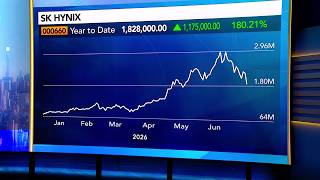
    SK Hynix shares plunged sharply on the earnings miss, down as much as 19% intraday before closing down roughly 9.6%.
  • 04.
    South Korea's KOSPI index suffered its worst two-day drop in history, falling roughly 10.84% on Tuesday and 5.99% on Wednesday.
  • 05.
    The KOSPI circuit breaker was triggered for two consecutive sessions, a first in the exchange's history.
  • 06.
    Chip stocks worldwide lost more than $1 trillion in market cap combined, with Nvidia down $238 billion, SK Hynix down $176 billion, Samsung down $173 billion, and Micron down $113 billion.
  • 07.
    SK Hynix's net profit hit 93.9 trillion won, boosted by 63.3 trillion won in investment gains from its Kioxia stake sale, pushing net cash toward a targeted 100 trillion won.
  • 08.
    SK Hynix committed to a record 2026 capital expenditure outlay in the high-40 trillion won range, up from 30.2 trillion won in 2025.
  • 09.
    SK Hynix's roughly 41-47% stock decline in July 2026 put it on pace for its worst monthly performance since October 2008.

Deep Analysis

The Expectations Machine: Why a Record Quarter Still Crashed the Stock

SK Hynix's Q2 2026 numbers were, by any normal standard, spectacular: revenue of 79.32 trillion won, up 257% year over year, and operating profit of 60.54 trillion won, up 557% [1]. But both landed short of the roughly 84 trillion won in revenue and 64 trillion won in operating profit that analysts, per LSEG SmartEstimates, had priced in [2]. That gap between spectacular and expected - not the results themselves - is what sent the stock down as much as 19% intraday before closing off roughly 9.6% [7]. BNK Investment & Securities' Lee Min-hee flagged the deeper worry underneath the miss: 'There are concerns that tech firms will take a breather in infrastructure spending.' [3]Hyundai Motor Securities' Greg Roh added that SK Hynix 'needs to come up with a concrete shareholder return policy to turn around investor sentiment' [3]- suggesting the miss also exposed a payout gap investors were no longer willing to overlook, even with net profit hitting 93.9 trillion won on Kioxia stake gains [3].

The Long-Term Contract Paradox: Visibility Now, Missed Upside Later

Two structural choices inside the earnings compounded the miss. First, HBM4 shipments came in slower than expected, pushing revenue recognition later and causing HBM price gains to lag conventional memory [3]. Second, SK Hynix locked in roughly ten long-term supply agreements, typically five-year terms, that improve demand visibility but may have capped how much of the current DRAM and HBM price spike the company could capture in the near term [3]. That tension - revenue certainty versus missed spot-price upside - became the central debate among retail investors parsing the print: some read the long-term deals as a prudent hedge against cyclicality, others as evidence SK Hynix left money on the table during the hottest stretch of the AI memory cycle. DS Investment & Securities' Lee Su-rim added a related wrinkle, noting Samsung 'has greater pricing power and has raised prices more aggressively than SK Hynix' this cycle [3], meaning the two Korean rivals aren't equally exposed to the same criticism despite falling together.

China's CXMT and the Fear of What Comes Next

Around the same time SK Hynix reported its results, China's CXMT (Changxin Memory Technologies) debuted on Shanghai's STAR Market, raising $8.6 billion and closing about 466% above its offer price - the largest semiconductor IPO in Asian history [6]. An equity analyst, Kim Seok-hwan, argued the market's real fear isn't CXMT's current output but its trajectory: 'The market's concern lies less in CXMT's current earnings and more in its potential for accelerated capacity expansion to rival Korean companies and technology development following its IPO' [4]. That framing turned an already high-stakes earnings season into a referendum on how much longer Korean firms can hold their memory-chip lead.

A Korea-Wide Contagion: KOSPI's Historic Back-to-Back Circuit Breakers

Because SK Hynix and Samsung together account for over half of the KOSPI's weighting, the earnings miss didn't stay a single-stock story [4]. The index fell 10.84% on Tuesday and another 5.99% on Wednesday - a combined two-day drop of roughly 12.6-18%, its worst two-day stretch on record - and triggered circuit breakers on consecutive sessions for the first time in the exchange's history [4][8]. Much of the prior AI-memory rally had been fueled by leveraged retail positioning, and that same leverage which amplified the run-up accelerated the crash as brokers force-liquidated losing positions [4]. Globally, Nvidia, SK Hynix, Samsung and Micron shed a combined roughly $700 billion in market value [5], with contagion reaching Kioxia, TSMC and ASML over the following week [10], and SK Hynix on pace for its worst monthly performance since October 2008 [9].

The Bull Case: Profit-Taking, Not a Crack

Not every voice in the aftermath read the selloff as a warning sign about the underlying business. Sarah Kunst of Cleo Capital, speaking on Bloomberg Television, framed the drop as ordinary profit-taking after an extraordinary run - SK Hynix and Samsung were both up roughly 500% over the prior year - rather than evidence of a fundamental crack in the AI memory story - a segment that also referenced SK Hynix's own leadership suggesting memory-chip shortages could persist well beyond 2030, meaning the demand backdrop hasn't actually changed. Joe Mazzola of Charles Schwab, on Schwab Network, offered a different reframe entirely: he tied the selloff less to SK Hynix's specific numbers and more to a broader mega-cap tech rotation already underway, with weakness bleeding in from Google, Amazon, Microsoft and Meta - a market-wide repricing of richly valued tech rather than a verdict on Korean memory makers specifically. Taken together, these framings suggest the bearish read on SK Hynix's miss - that it exposes real cracks in AI infrastructure demand - is contested even among those watching the same numbers: what looks like the market losing faith in the memory cycle can just as easily be read as an overheated trade cooling off inside a still-intact supercycle.

Historical Context

2022
Posted a 1.7 trillion won operating loss during the worst chip industry downturn in over a decade, its biggest quarterly loss since SK Group acquired Hynix in 2012.
2026-06
Stock hit an all-time high before entering a rout that erased nearly $600 billion in value over about a month, driven by concerns about overcrowded AI trades and leverage-driven volatility.
2026-07-27
Chinese memory maker CXMT debuted on Shanghai's STAR Market, closing about 466% above its offer price after raising $8.6B, the largest semiconductor IPO in Asian history, intensifying competition fears.
2026-07-29
KOSPI triggered circuit breakers for a second consecutive session, its first-ever back-to-back circuit-breaker event, with the index down over 12.6% across two days and off nearly 40% from its 52-week high.

Power Map

Key Players
Subject

SK Hynix earnings miss triggers global AI chip stock selloff

SK

SK Hynix

South Korean memory chipmaker at the center of the earnings miss and selloff

SA

Samsung Electronics

Rival Korean memory/HBM supplier, dropped sharply amid the selloff

SO

SoftBank Group

Major AI investment proxy (via Arm stake), fell 4.43% in the rout

NV

Nvidia

US AI chip leader, led the selloff with a $238 billion market cap rout

AM

AMD

US chipmaker, lost about 8% amid the selloff

MI

Micron Technology

US memory chipmaker, lost $113 billion in market cap in the rout

CX

CXMT (Changxin Memory Technologies)

Chinese memory chipmaker whose blockbuster Shanghai STAR Market IPO stoked competition fears

KI

Kioxia

Japanese memory chipmaker, fell amid the sector selloff

KO

KOSPI

South Korea's benchmark index, dominated by SK Hynix and Samsung, fell into a record two-day rout

Fact Check

10 cited
  1. [1] SK Hynix Q2 2026 Business Results Slides
  2. [2] SK Hynix Q2 2026 Earnings: Record Profit Misses Estimates
  3. [3] SK Hynix Q2 Profit Jumps 557% on AI Chip Demand, Misses Forecasts
  4. [4] KOSPI Sinks Over 12% in Worst Two-Day Drop Ever as AI Chip Selloff Deepens
  5. [5] Chip Selloff: SK Hynix, Samsung, SoftBank Tumble
  6. [6] CXMT's Rise and the Memory Chip Market
  7. [7] SK Hynix's Rebound From $470 Billion Rout Hinges on AI Spending
  8. [8] KOSPI Triggers Historic Back-to-Back Circuit Breakers
  9. [9] Micron, Samsung, SK Hynix Just Dragged Memory Stocks Into a Bear Market
  10. [10] Asian Chip Stocks Drop as SK Hynix Earnings Disappoint

Source Articles

Top 5

THE SIGNAL.

Analysts

Warns that tech firms may pause AI infrastructure spending, feeding sustainability fears. Quote: "There are concerns that tech firms will take a breather in infrastructure spending."

Lee Min-hee, analyst, BNK Investment & Securities
Sell-side equity analyst

Notes Samsung has stronger pricing power than SK Hynix in the current cycle. Quote: "Samsung has greater pricing power and has raised prices more aggressively than SK Hynix."

Lee Su-rim, analyst, DS Investment & Securities
Sell-side equity analyst

Argues SK Hynix needs a concrete shareholder-return plan to repair investor sentiment after the miss. Quote: "SK needs to come up with a concrete shareholder return policy to turn around investor sentiment."

Greg Roh, analyst, Hyundai Motor Securities
Sell-side equity analyst

Insists AI memory demand from major customers remains robust despite the market's reaction. Quote: "Major customers are still requesting more memory supply."

Song Hyun-jong, President, SK Hynix
Company leadership

Says the market is more worried about CXMT's future capacity-expansion trajectory than its current earnings.

Kim Seok-hwan, analyst
Equity/sector analyst
The Crowd

SK HYNIX $SKHY JUST REPORTED EARNINGS Revenue of $54.6B missing expectations of $57.7B

@@StockMKTNewz1648

SK HYNIX $SKHY Q2'26 DETAILED EARNINGS HIGHLIGHTS Revenue: $54.6B (Est. $57.7B); +257% YoY, +51% QoQ Operating Profit: $41.6B (Est. $44.2B); +557% YoY Operating Margin: 76%; +3,500 bps YoY — record high quarterly OPM Q3 Guide: DRAM Bit Growth: ~+10% QoQ

@@wallstengine467

A $570 billion rout in just a little over a month has flipped South Korean memory chipmaker SK Hynix from one of the world's hottest AI trades to one of the biggest portfolio question marks.

@@business55

SK Hynix crashes after reporting Q2 earnings

@u/Zipski577728
Broadcast
Market Warning: SK Hynix Collapses, Semis Sell, Oil Surges...Major Trouble Brewing

Market Warning: SK Hynix Collapses, Semis Sell, Oil Surges...Major Trouble Brewing

SK Hynix Selloff Is Not a Huge Problem, Kunst Says

SK Hynix Selloff Is Not a Huge Problem, Kunst Says

Samsung & SK Hynix Cause U.S. Tech Sell-Off, "Resets" Earnings Expectations

Samsung & SK Hynix Cause U.S. Tech Sell-Off, "Resets" Earnings Expectations