
Bipartisan political backlash against AI data centers ahead of 2026 midterms
TECH

Bipartisan political backlash against AI data centers ahead of 2026 midterms

44+
Signals

Strategic Overview

  • 01.
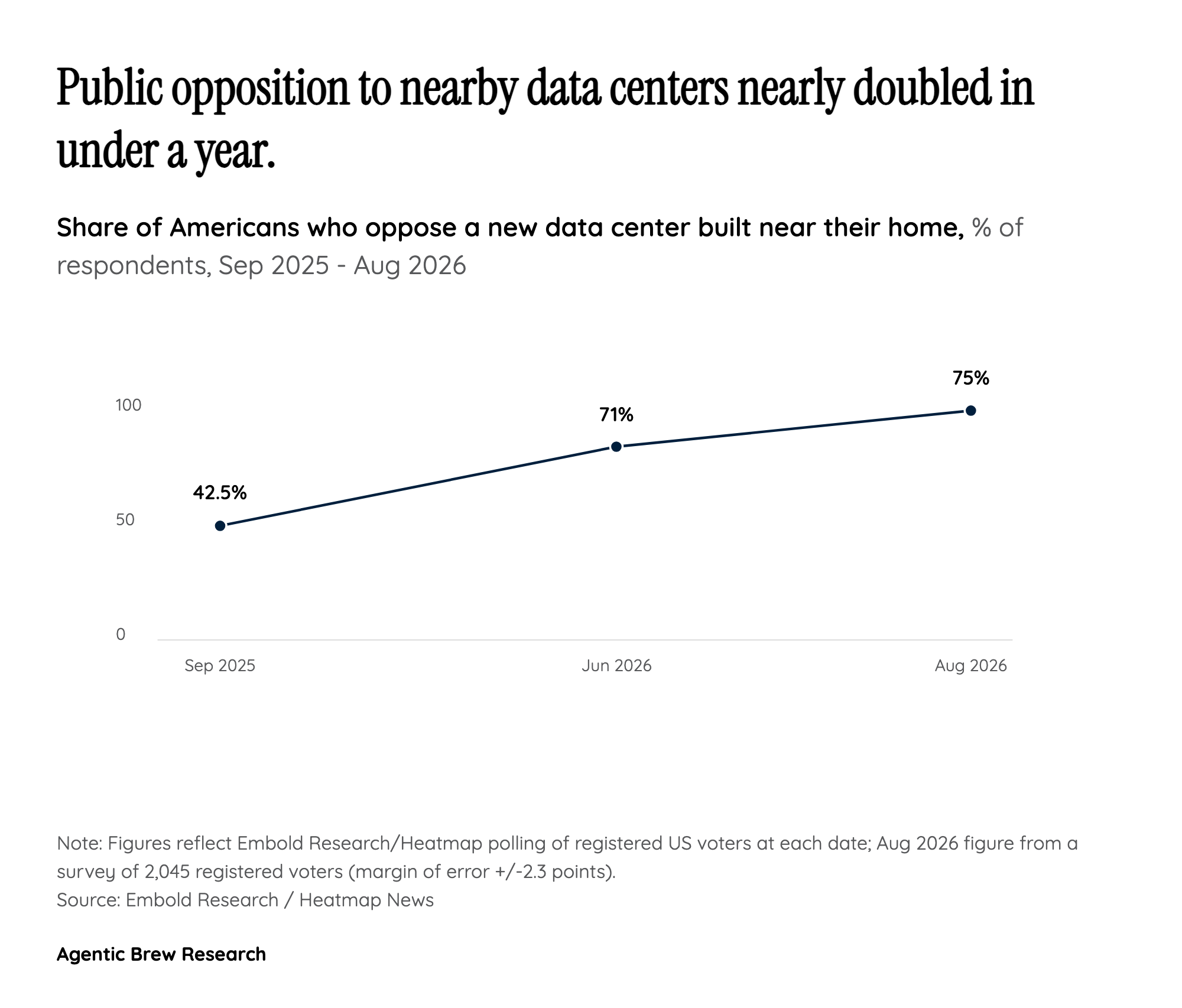
    Public opposition to new data centers has surged to 75% of Americans, up from just 42-43% a year earlier, and the issue has become a live factor in the 2026 midterms.
  • 02.
    A leaked National Republican Senatorial Committee memo warns that data center backlash could cost Sen. Jon Husted his Ohio Senate seat against Sherrod Brown, and could spread nationally if unaddressed.
  • 03.
    Republican Gov. Greg Abbott of Texas and Democratic Gov. Josh Shapiro of Pennsylvania have both moved to restrict data center development in their states in direct response to the same public backlash.
  • 04.
    The fight is playing out at every level: local recall petitions against officials who approved projects, congressional bills from both parties, and a corporate community-outreach spending spree worth hundreds of millions.

Deep Analysis

The Fastest Public Opinion Swing in AI Policy
The Fastest Public Opinion Swing in AI Policy
Public opposition to nearby data centers nearly doubled in under a year, from 42.5% in Sept 2025 to 75% in Aug 2026 (Embold Research / Heatmap News).

In under a year, American sentiment on data centers flipped from ambivalent to overtly hostile. As recently as September 2025, only 42-43% of Americans opposed a new data center being built near their home [1]. By August 2026, that figure had rocketed to 75%, with 61% saying they strongly oppose local development, according to an Embold Research/Heatmap poll of 2,045 registered voters [2]. The opposition is now underwater across the entire political spectrum - 43 points net negative among Republicans, 65 among independents, and 75 among Democrats [2]- a rare case of a single issue moving nearly everyone in the same direction at once.

The swing isn't abstract to the people living through it. Rep. Suhas Subramanyam, whose Virginia district hosts roughly 300 data centers, says local utility bills are "doubling and tripling" as demand climbs [3]. In Pennsylvania, Gov. Josh Shapiro's new executive order goes as far as banning nondisclosure agreements on data center project details entirely, a direct response to complaints that residents only learn about deals after officials have already signed off [4].
A Rare Left-Right Coalition

This isn't a conventional partisan fight. Democratic pollster Anna Greenberg describes the backlash as "a bottom up, organic movement" and points to data centers as tangible proof of wealth inequality: "Data centers are a physical manifestation. Billionaires are building them" [5]. That framing shows up just as readily in populist-right commentary online as it does on the left, with data centers repeatedly cast as the visible face of concentrated tech wealth rather than a conventional environmental complaint.

The coalition shows up in legislation too. Republican Rep. Byron Donalds introduced the "Protecting Ratepayers Act," a mandatory version of a voluntary pledge already signed by Amazon, Google, Meta, Microsoft, OpenAI, Oracle, and xAI, requiring hyperscale data centers to source their own power and water instead of drawing on public utilities [6]. Democrat Suhas Subramanyam is pushing comparable federal accountability measures from the other side of the aisle, while still insisting the US cannot afford to cede the AI race to China [3]. On the ground, residents in more than a dozen communities have filed recall petitions against local officials who approved data center deals without what they consider adequate public input [7].

The Electoral Math: Ohio and Six Toss-Up Races

The clearest evidence the backlash has become a real political liability is a leaked National Republican Senatorial Committee memo warning that data centers could cost the party the Ohio Senate seat held by Jon Husted against Democrat Sherrod Brown: "More than any other thing in this race, data centers are the anchor hanging around Husted's neck" [8]. The memo goes further, cautioning that "if voters' perceptions of data centers are not fixed quickly, the campaign against them will expand far beyond Ohio" [9]. Husted has since introduced a Senate proposal requiring data centers to fund their own power generation and transmission rather than pass the cost to ratepayers, a direct policy response to the political heat [9].

The issue is not confined to one race. It is playing a role in all six US Senate contests currently rated toss-ups by the Cook Political Report [5]. Governors on both sides have pivoted publicly in response. Texas's Greg Abbott, who months earlier was touting the state as an epicenter of AI development, now says data center developers "dug their own grave" by moving into communities without securing local support, and has imposed new state standards developers must meet before they can operate [10]. Pennsylvania's Josh Shapiro signed an executive order imposing what he called the "strictest guardrails in the nation" on data center permitting [11].

Industry's Charm Offensive Meets a Counter-Narrative on Causes

Facing the swing, companies have moved from ignoring local opposition to buying goodwill outright. Oracle has committed roughly $417 million combined around its Project Jupiter campus in New Mexico - $50 million to repair local water systems, $360 million for schools, infrastructure, and local services, and $6.9 million for workforce development - as part of a broader industry "charm offensive" aimed at blunting backlash before it hardens into policy [12][13].

Whether that spending addresses the actual cause of the slowdown is contested. Some online commentary pushes back on the activism narrative entirely, arguing the more consequential constraint is physical: grid capacity, transformer shortages, and skilled labor, not public opposition. The scale of the disruption is real either way: at least 75 proposed data center projects worth roughly $130 billion were halted or delayed in the US in the first quarter of 2026 alone [14], whatever mix of public pressure and infrastructure bottleneck deserves the credit.

Historical Context

2025-09
Only 42-43% of Americans opposed data center construction near their homes, before the sharp swing in opinion over the following year.
2026-06
71% of Americans said they would oppose a data center near their home, an early sign of the swing that would reach 75% by August.
2026-07
Filed the Protecting Ratepayers Act, mandating that data centers supply their own power and water rather than draw on public utilities.
2026-08-13
Survey of 2,045 registered voters found 75% opposition to local data center development, 61% strongly opposed, with underwater sentiment across Republicans (-43), independents (-65), and Democrats (-75).
2026-08-18
Signed Executive Order 2026-05 restricting data center permitting in Pennsylvania via new GRID Requirements.
2026-08-19
Leaked memo describing data centers as a threat to the Ohio Senate race became public via Axios reporting.
2026-08-23
Said data center developers "dug their own grave," confirming a Texas regulatory moratorium and audit requirement, a reversal from his earlier stance touting Texas as an epicenter of AI development.

Power Map

Key Players
Subject

Bipartisan political backlash against AI data centers ahead of 2026 midterms

NR

NRSC (National Republican Senatorial Committee)

Authored a leaked strategy memo warning that data center backlash endangers Sen. Jon Husted's Ohio Senate seat and could spread to other races nationally.

SE

Sen. Jon Husted (R-OH)

Incumbent facing a competitive race against Sherrod Brown; introduced a Senate proposal requiring data centers to fund their own power generation and transmission rather than pass costs to ratepayers.

GO

Gov. Greg Abbott (R-TX)

Reversed his earlier full-throated embrace of the AI buildout, imposing new state standards and community-approval requirements data center developers must meet before operating.

GO

Gov. Josh Shapiro (D-PA)

Signed Executive Order 2026-05 imposing GRID Requirements on data centers and banning NDAs on project details, calling it the strictest guardrails in the nation.

RE

Rep. Suhas Subramanyam (D-VA10)

Represents a district with roughly 300 data centers; pushing federal accountability measures while opposing ceding the AI race to China.

OR

Oracle

Running a community outreach campaign around its Project Jupiter data center campus, including hundreds of millions in local donations for water, schools, and infrastructure.

Fact Check

14 cited
  1. [1] Americans increasingly oppose data centers near them, poll finds
  2. [2] Data center opposition hits 75%, crosses party lines
  3. [3] Subramanyam pushes to rein in data center growth
  4. [4] Governor Shapiro signs executive order on data center development
  5. [5] Data centers become a 2026 midterm flashpoint
  6. [6] Donalds files Protecting Ratepayers Act
  7. [7] Data centers spark dozens of recall petitions against local officials
  8. [8] Leaked GOP memo warns data centers threaten 2026 races
  9. [9] Jon Husted confronts data center backlash in Ohio Senate race
  10. [10] Greg Abbott says data center developers dug their own grave
  11. [11] Josh Shapiro signs data center executive order
  12. [12] Tech companies deploy charm offensive to combat data center backlash
  13. [13] Oracle expands community outreach around Project Jupiter
  14. [14] Data center backlash delays dozens of US projects

Source Articles

Top 5

THE SIGNAL.

Analysts

Characterizes the data center backlash as a genuinely grassroots phenomenon rather than an astroturfed campaign: "It's very much a bottom up, organic movement." She frames data centers as a tangible symbol of wealth inequality driving voter anger: "Data centers are a physical manifestation. Billionaires are building them."

Anna Greenberg
Democratic pollster

Argues data center companies' financial strength undermines the case for tax exemptions on their projects: "It would be very difficult for lawmakers to argue that these companies with their significant financial wherewithal require tax exemption."

Timothy Fox
Analyst, ClearView Energy Partners
The Crowd

Leaked memo about data centers shows GOP worried about Ohio's U.S. Senate race

@@DC_DeWitt17

A data center project in Texas was cancelled after facing local backlash The data center was to be built near a water reservoir and consume 5 million gallons of water per day in its 5th year of operation

@@interesting_aIl3532

POD UP! The Core Four are back! -- Dario Amodei Breaks His Silence: Regulatory Capture or Real Concern? -- The Anti-Data Center Revolt: Abbott, Shapiro, and the GOP Panic Memo -- A "DMV for AI"? Sacks Says the Open Source Ban Is Coming -- Friedberg's RSI Thesis: Why...

@@theallinpod637

Republicans are realizing that no one wants data centers

@u/andmario_com20000
Broadcast
What's really behind the data center backlash?

What's really behind the data center backlash?

Data Center Backlash Has Republicans Panicking

Data Center Backlash Has Republicans Panicking

The AI Data-Center Backlash, Explained

The AI Data-Center Backlash, Explained